
Most of us skip the genealogies in the Bible. All those names we can’t pronounce, all that “begat” language – it feels like the scriptural equivalent of reading a phone book. So when Matthew opens his gospel with Jesus’ family tree, we’re tempted to speed-read our way to the good stuff.
But slow down. Because hidden in that list of names is one of the most subversive statements in all of Scripture.
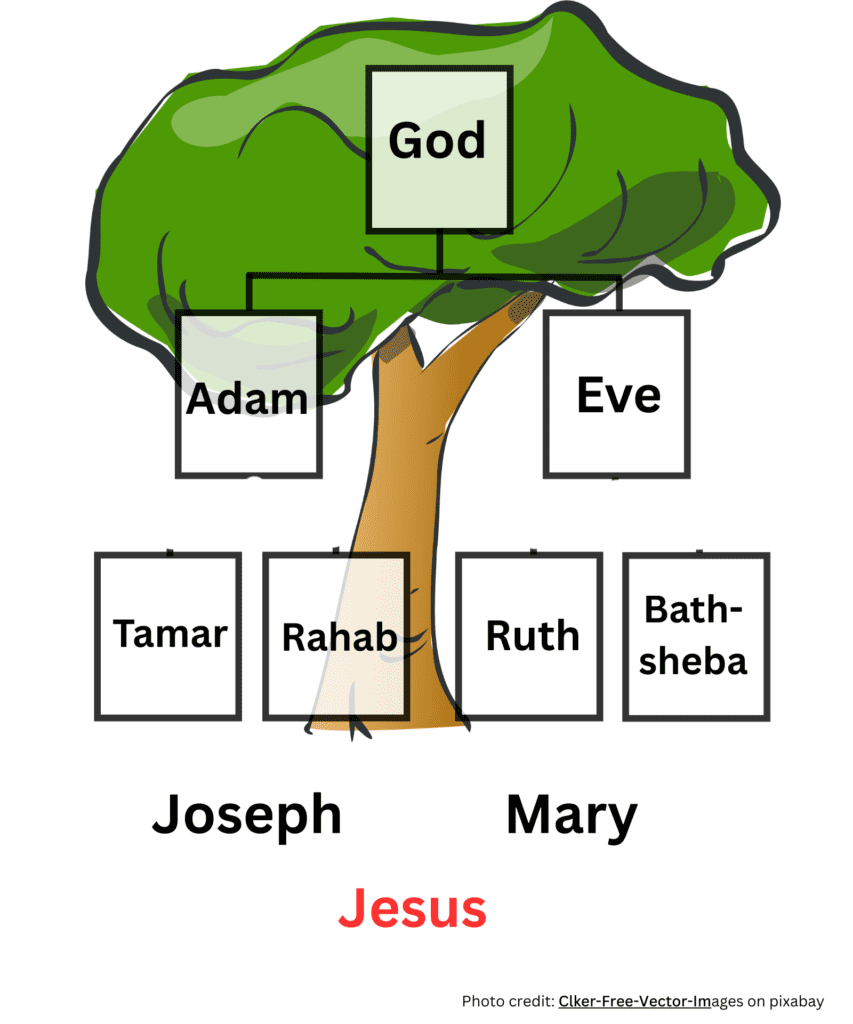
Matthew includes five women in Jesus’ genealogy. In a culture where genealogies traced exclusively through men, where women were rarely named in official records, this alone is remarkable. But it’s not just that Matthew mentions women. It’s which women he chooses to highlight.
He doesn’t list the respectable matriarchs you’d expect – Sarah, Rebekah, Leah. Instead, he names Tamar, Rahab, Ruth, Bathsheba (referred to as “Uriah’s wife”), and Mary.
Every single one of these women has a story marked by scandal, shame, or suspicion. And Matthew puts them right there in the opening chapter, in the official pedigree of the Messiah.
This isn’t an accident. This is a theological statement about the kind of King Jesus came to be and the kind of people He came to save.
Tamar: The Desperate Widow
Tamar’s story, found in Genesis 38, is the kind of tale that makes modern readers deeply uncomfortable. She was married to Judah’s eldest son, who died. According to custom, she was given to the second son, who also died. Judah promised her his third son when he came of age, but then reneged on the promise, leaving Tamar in limbo – unable to remarry, unable to have children, stuck in a legal and social nowhere.
So Tamar took matters into her own hands. She disguised herself as a prostitute and seduced Judah himself, her father-in-law. When her pregnancy was discovered, Judah was ready to have her burned alive for adultery – until she produced evidence that he was the father.
Judah’s response is stunning: “She is more righteous than I.”
This woman, who resorted to deception and prostitution to secure her future, is declared righteous and gets a place in the Messiah’s family tree. Her twin sons, born from that scandalous union, continue the line that leads to David and eventually to Jesus.
Rahab: The Prostitute Who Chose Faith
Rahab wasn’t pretending to be a prostitute like Tamar. She was the real thing, a Canaanite sex worker living in Jericho when the Israelites came to conquer the city. When Israelite spies showed up at her door, she had a choice: turn them in or protect them.
She chose faith. She hid the spies, lied to the authorities, and declared her belief in the God of Israel. “The Lord your God is God in heaven above and on the earth below,” she told them. And when Jericho fell, her household was spared.
A foreign prostitute became a hero of faith, married into the tribe of Judah, and became the great-great-grandmother of King David. The book of Hebrews lists her in the hall of faith alongside Abel, Noah, and Abraham. James holds her up as an example of faith demonstrated through works.
God didn’t wait for her to clean up her life before using her. He met her in the brothel and wrote her into the story of redemption.
Ruth: The Foreign Widow
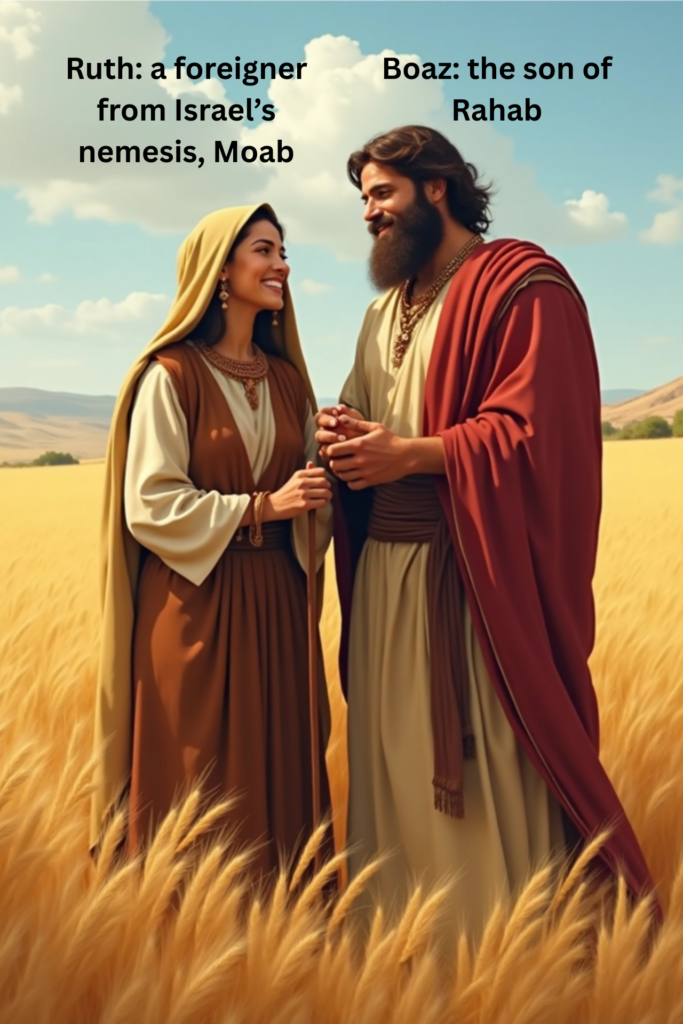
Ruth’s story is gentler than Tamar’s or Rahab’s, but no less scandalous for its original audience. She was a Moabite—one of Israel’s traditional enemies, descended from Lot’s incestuous relationship with his daughter. Moabites were forbidden from entering the assembly of the Lord “even to the tenth generation.”
Yet Ruth, this foreign widow, clung to her Israelite mother-in-law Naomi and declared, “Your people will be my people and your God my God.” She worked in the fields as a gleaner – essentially, gathering leftovers, the ancient equivalent of food stamps. She was poor, foreign, and vulnerable.
When Naomi hatched a plan for Ruth to propose marriage to Boaz (a plan that involved sneaking onto the threshing floor at night and lying at his feet, not exactly conventional courtship), Ruth trusted and obeyed. Boaz, rather than taking advantage of her vulnerability, protected her honor and married her legally.
Their son Obed became the grandfather of King David. The Moabite outcast became the great-grandmother of Israel’s greatest king and an ancestor of the Messiah.
Bathsheba: The Stolen Wife
Matthew doesn’t even name Bathsheba directly. He calls her “Uriah’s wife,” a pointed reminder of David’s sin. We know the story: David saw her bathing, summoned her to the palace, slept with her, and when she became pregnant, orchestrated the murder of her husband to cover up the adultery.
Bathsheba is often blamed in retellings of this story, as if she seduced the king. But the text is clear: she was summoned. She was taken. When the king calls, you don’t say no. The power imbalance was absolute.
Yet here she is in Jesus’ genealogy – not as “David’s wife” but as “Uriah’s wife,” a perpetual memorial to the injustice done to her and her murdered husband. The Messiah’s family tree doesn’t airbrush out the abuse and the cover-up. It names them.
Bathsheba went on to become the mother of Solomon, fought successfully for his right to inherit the throne, and is remembered in Proverbs as the wise woman who taught her son about righteous leadership. From victim to queen to ancestor of the Savior.
Mary: The Unwed Mother
And then there’s Mary. Young, poor, unmarried, and pregnant with a story no one would believe. “I’m a virgin, but I’m pregnant, and the father is the Holy Spirit” doesn’t exactly clear things up at family gatherings.
In her culture, pregnancy outside of marriage carried the death penalty. At minimum, it meant disgrace, rejection, poverty. Joseph nearly divorced her quietly to spare her public humiliation. Her reputation was destroyed before Jesus was even born.
Yet God chose her. Not a married woman. Not a woman of status or education. A teenage girl from a nowhere town, whose pregnancy would raise eyebrows and whispers for the rest of her life.
By including Mary alongside Tamar, Rahab, Ruth, and Bathsheba, Matthew makes a statement: This is the kind of family Jesus comes from. This is the kind of people God works through. The overlooked. The scandalous. The broken. The shamed.
What This Genealogy Tells Us About God
These women weren’t included in Jesus’ family tree despite their scandals. They were included because of what their stories reveal about the character of God.
God works through imperfect people in messy situations. He doesn’t wait for us to get our act together before He uses us. He doesn’t require a spotless past before He writes us into His story.
God sees and values women—even in cultures that don’t. These women had names, stories, choices, and faith that mattered. They weren’t just incubators for the male line. They were active participants in redemption history.
God redeems shame. Tamar’s desperation, Rahab’s profession, Ruth’s poverty, Bathsheba’s trauma, Mary’s scandal – none of these disqualified them. God took what the world saw as disgraceful and made it glorious.
God works through sexual brokenness. Three of these five women have stories involving sex outside of conventional marriage – prostitution, seduction, adultery, scandal. Yet God didn’t distance Himself from these situations. He worked through them. The Messiah’s lineage runs directly through bedrooms and brothels.
God includes outsiders. Rahab was a Canaanite. Ruth was a Moabite. Jesus’ ancestry is international, multi-ethnic, and deliberately inclusive of people who “shouldn’t” belong.
What This Genealogy Tells Us About Jesus
When Jesus arrived, He came with a family history that looked nothing like what people expected from the Messiah. No pristine lineage of perfect people doing everything right. Instead, a family tree that includes sexual scandal, foreign blood, prostitution, abuse, deception, and disgrace.
This is the family Jesus claimed. These are the ancestors He was proud to call His own.
And it tells us something crucial: Jesus came for people with messy stories. He came for the ashamed, the abused, the outsiders, the desperate, the foreign, the broken. He came for people who don’t have their act together, who have made terrible choices, who have had terrible things done to them.
If you’ve messed up badly, there’s a place for you in Jesus’ family. If you’ve been used and discarded, there’s a place for you. If you’re from the wrong side of town, the wrong ethnicity, the wrong family, the wrong side of the tracks, there’s a place for you.
The genealogy Matthew chose to open his gospel is a declaration: No one is too broken for God to use. No past is too shameful for God to redeem. No scandal can disqualify you from being part of God’s story.
The Scandal Continues
Two thousand years later, the scandal continues. Jesus is still building His family from unlikely people. Still choosing the disqualified. Still working through broken vessels. Still including those the religious establishment wants to exclude.
If you feel like your past disqualifies you from being used by God, remember Tamar. If you feel like your profession or reputation makes you unworthy, remember Rahab. If you feel like an outsider who doesn’t belong, remember Ruth. If you carry trauma and shame from what was done to you, remember Bathsheba. If you’re facing scandal and social rejection for following God, remember Mary.
The Messiah came through broken people because that’s the only kind of people there are. And He came to redeem not just individuals but entire family systems, entire histories, entire lineages marked by sin and shame.
This Christmas, as we celebrate the birth of Jesus, let’s remember that He didn’t arrive with a sanitized past. He came with a real family history – messy, complicated, scandalous, and beautiful in its honesty.
He came as one of us. And He made a way for all of us – no matter how broken our stories – to become part of His family.
That’s not just good news. That’s the best news the world has ever heard!
What part of your story feels too messy or broken to be used by God? What if it’s actually the very thing that qualifies you to be part of His redemptive work?

a
The story of Ruth reveals how a Gentile woman married into the line of King David and became an ancestor of Jesus Christ. You can read or listen to Ruth telling her own story in an ebook or audiobook.
a
a
a
Here are links to my blog indexes, so please click one and keep reading!
My Books, Workbooks, and Fun Books
Knowing the Unknowable One
Opening the Treasure Chest
Walking Heart-to-Heart with God
Walking Heart-to-Heart with Each Other
Fighting the Good Fight of Faith
Christian Mysteries: Why I Love Them!
List of Some Nonfiction Books You Don’t Want to Miss
Index of Assorted Topics