
Every Christmas, we tell the story of the heartless innkeeper who turned away a pregnant woman in labor. We imagine Mary and Joseph going door to door in Bethlehem, desperately seeking shelter, only to be rejected by callous, self-absorbed people too busy with their own concerns to make room for a family in need.
It’s a powerful image. It preaches well. It makes for good drama in Christmas pageants.
There’s only one problem: it’s almost certainly not what happened.
The traditional “no room at the inn” narrative has shaped how we understand Christmas hospitality, rejection, and God’s choice to be born in poverty. But when we dig into the historical and cultural context, a very different picture emerges – one that’s actually more beautiful and more challenging than the version we’ve been telling.
There Probably Wasn’t an “Inn”
Let’s start with the word that’s caused most of the confusion. Luke 2:7 says there was “no room for them in the inn.” But the Greek word Luke uses – kataluma – doesn’t mean “inn” in the sense of a commercial hotel or a Motel 6.
A kataluma was a guest room in a private home. It’s the same word Luke uses later when Jesus sends His disciples to prepare the Last Supper in someone’s kataluma, clearly a private upper room in a house, not a commercial establishment.
If Luke wanted to refer to a commercial inn, he would have used the word pandocheion, which he does use in the parable of the Good Samaritan to describe the inn where the wounded man was taken.
So a more accurate translation of Luke 2:7 would be: “There was no room for them in the guest room.”
This completely changes the story.
How Hospitality Actually Worked
In first-century Jewish culture, hospitality wasn’t optional; it was a sacred duty. Turning away a traveler, especially a pregnant woman from your own clan, would have been unthinkable. It would have brought shame on the entire family and violated fundamental codes of honor and kinship obligation.
Joseph was returning to Bethlehem because it was his ancestral hometown – “the city of David.” He had family there. This wasn’t a situation of strangers going door to door begging for shelter from heartless locals. This was Joseph coming home to his relatives during a crowded time.
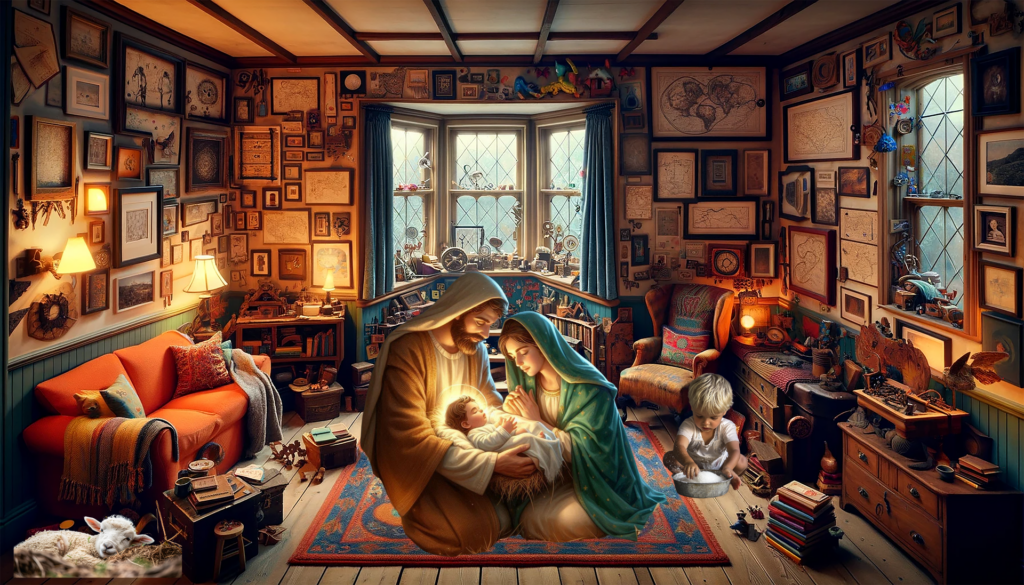
And here’s what likely happened: The family did take them in. But because the guest room was already full (probably with other relatives who had arrived for the census), Mary and Joseph stayed in the main living area of the house, the space where the family actually lived, ate, and slept.
In a typical first-century Israelite home, this main room was where daily life happened. And at night, the family’s animals – a donkey, perhaps some sheep or goats – were brought inside for warmth and protection. They stayed in a lower area or along one side of the room, often separated by a step or a low wall.
The feeding trough, the manger, would have been right there, built into the living space.
Mary Gave Birth Surrounded by Family
So when Luke says Mary “wrapped him in cloths and placed him in a manger,” he’s not describing abandonment or rejection. He’s describing a birth that happened in the warm, crowded, humble main room of a relative’s home, with family nearby and animals sharing the space.
Mary didn’t give birth alone in a cold stable while heartless people partied in the inn. She gave birth surrounded by the sights, sounds, and smells of ordinary life – family members nearby, animals shuffling in their corner, the everyday chaos of a packed household.
This is actually more remarkable than the traditional story. God didn’t choose to be born in isolation, rejected by humanity. He chose to be born right in the middle of normal, messy, crowded family life. Not in the formal guest room reserved for important visitors, but in the main room where real life happened.
Jesus’ first bed wasn’t in a barn because nobody cared. It was in a feeding trough because that’s what was available in a house full of people who did care, who did take in their relatives, who made room however they could.
Why Does This Matter?
You might be thinking, “Okay, interesting historical detail, but does it really matter? Isn’t the point still that Jesus was born in humble circumstances?”
It matters because the story we tell shapes what we believe about God, about hospitality, and about how the kingdom works.
The traditional story teaches us: The world rejected Jesus from the beginning. People are fundamentally selfish. True hospitality is rare. Jesus came to outsiders and outcasts because the insiders wouldn’t have Him.
The more accurate story teaches us: Jesus was born into the midst of normal family life, accepted by His kin, surrounded by the ordinary and mundane. God chose to enter the world not in the special guest quarters but in the everyday living space. The incarnation happened in the mess and crowd and chaos of real human community.
Both stories involve humility. Both involve Jesus being born in unexpected circumstances. But one is about rejection, while the other is about radical proximity.
The Real Astonishment of the Manger
The wonder of Jesus’ birth isn’t that nobody would take Mary and Joseph in. It’s that the King of Glory chose to be born in a place where animals lived, where the smells weren’t pleasant, where there was no privacy or dignity or control.
The Son of God could have been born in the formal guest room, the “proper” place for an important arrival. But He wasn’t. He was born in a regular living space, among regular people, in regular circumstances.
This is the God who doesn’t wait for us to clean up our act before He shows up. He doesn’t need special accommodations or ideal conditions. He enters right into the mess – the crowded, chaotic, smelly, ordinary mess of human existence.
The manger wasn’t Plan B because the inn was full. The manger was always the plan, because God’s strategy for saving the world involves showing up in the midst of normal life, not waiting for special circumstances.
What About the Innkeeper?
So what happened to the villainous innkeeper of our Christmas pageants?
He probably never existed, at least not as we imagine him. There was no callous hotel manager turning away a desperate couple. There was a family doing what families in that culture always did: making room, sharing space, accommodating relatives even when it was inconvenient and crowded.
If anything, the people of Bethlehem, Joseph’s extended family, were models of the very hospitality we often accuse them of lacking. They took in a pregnant woman during a chaotic time. They shared their living space. They made it work, even if it meant Jesus was born in less-than-ideal circumstances.
The fact that it was crowded and humble doesn’t mean people were unkind. It means they were human, dealing with human limitations, doing the best they could.
The Challenge This Poses
Here’s where the corrected story becomes more challenging, not less.
If Mary and Joseph were rejected by heartless strangers, we can feel morally superior. “I would never turn away a pregnant woman! I’m not like those terrible people in Bethlehem!”
But if they were taken in by family who did their best in difficult circumstances, and Jesus still ended up being born in the main room with the animals. Now, the challenge shifts.
It’s not about whether we’d reject Jesus if He showed up at our door. It’s about whether we recognize Him in the messy, ordinary circumstances where He actually shows up. It’s about whether we’re willing to make room in the crowded, chaotic main room of our actual lives, not just in some formal “guest room” we reserve for religious occasions.
Jesus wasn’t born in the space we set aside for God – the sacred, separate, special space. He was born in the space where we actually live. And He’s still showing up there, not in the sanitized version of our lives but in the real, messy, crowded reality.
Hospitality in the Everyday
The revised understanding of Jesus’ birth actually raises the bar for hospitality.
It’s one thing to welcome someone when you have a clean guest room ready and everything is in order. It’s another thing entirely to say, “We don’t have ideal circumstances, but come in anyway. Yes, it’s crowded. Yes, there are animals. Yes, it’s chaotic. But you’re family, and we’ll make it work.”
That’s the hospitality that welcomed Jesus into the world. Not perfect accommodations, but genuine welcome in the midst of imperfect circumstances.
How often do we avoid hospitality because our house isn’t clean enough, our schedule isn’t clear enough, our resources aren’t sufficient enough? We wait for ideal conditions before we open our doors or our lives to others.
But the family in Bethlehem teaches us that hospitality doesn’t require perfection. It requires making room with what you have, even when what you have is crowded and humble and ordinary.
God Chooses the Main Room
There’s something profoundly beautiful about God choosing to be born not in the guest room but in the main room.
The guest room is where we put on our best face. It’s where we display our nice things and hide our mess. It’s where we maintain appearances and control the narrative.
The main room is where we actually live. It’s where the dishes pile up and the laundry overflows and the kids fight and the dog tracks in mud. It’s where life is unfiltered and unedited.
And that’s where Jesus chose to be born.
He didn’t come to the cleaned-up, presentable version of humanity. He came to the real version – the crowded, messy, smelly, chaotic reality of human existence. He was born not in the showroom but in the living room. Not in the place we present to guests, but in the place where we actually are.
This is the incarnation. God doesn’t wait for us to be ready or worthy or put-together. He shows up in the middle of our actual lives, with all their limitations and chaos and ordinariness.
Rethinking Our Christmas Message
For years, we’ve preached sermons about making room for Jesus as if we’re the innkeeper with the power to accept or reject Him. “Is there room in your inn? Will you turn Him away like they did in Bethlehem?”
But that might be asking the wrong question.
The real question isn’t whether we’ll set aside a special guest room for Jesus. It’s whether we’ll welcome Him into the main room, into the actual, everyday, messy reality of our lives.
Will we invite Him into our crowded schedules, our chaotic families, our imperfect circumstances? Or will we keep Him at a distance, waiting for things to be less busy, less messy, less ordinary before we make space for Him?
The family in Bethlehem couldn’t offer Mary and Joseph the formal guest room. But they offered what they had – space in the main room, surrounded by family and animals and the mundane details of everyday life.
And somehow, that was exactly right. That was the setting God chose for the most important birth in human history.
Christmas in the Main Room
This Christmas, maybe we need to stop apologizing for the mess and start recognizing it as the very place where God shows up.
Maybe we need to stop waiting for ideal circumstances before we practice hospitality and start welcoming people into our real, imperfect, crowded lives.
Maybe we need to stop keeping Jesus in the formal “religious” compartment of our lives – the guest room we visit on Sundays – and start recognizing His presence in the main room where we actually live.
The story of Jesus’ birth isn’t primarily about a world that rejected Him. It’s about a God who chose to enter the world exactly as it was – crowded, humble, ordinary, and real.
No room in the guest quarters? No problem. The main room will do just fine.
Because that’s where the family is. That’s where life happens. And that’s where God wants to be.
Where in your life are you waiting for “guest room conditions” before you welcome God or others in? What would it look like to practice “main room hospitality” – welcoming people into your real, messy, imperfect life as it actually is?



Here are links to my blog indexes, so please click one and keep reading!
My Books, Workbooks, and Fun Books
Knowing the Unknowable One
Opening the Treasure Chest
Walking Heart-to-Heart with God
Walking Heart-to-Heart with Each Other
Fighting the Good Fight of Faith
Christian Mysteries: Why I Love Them!
List of Some Nonfiction Books You Don’t Want to Miss
Index of Assorted Topics