
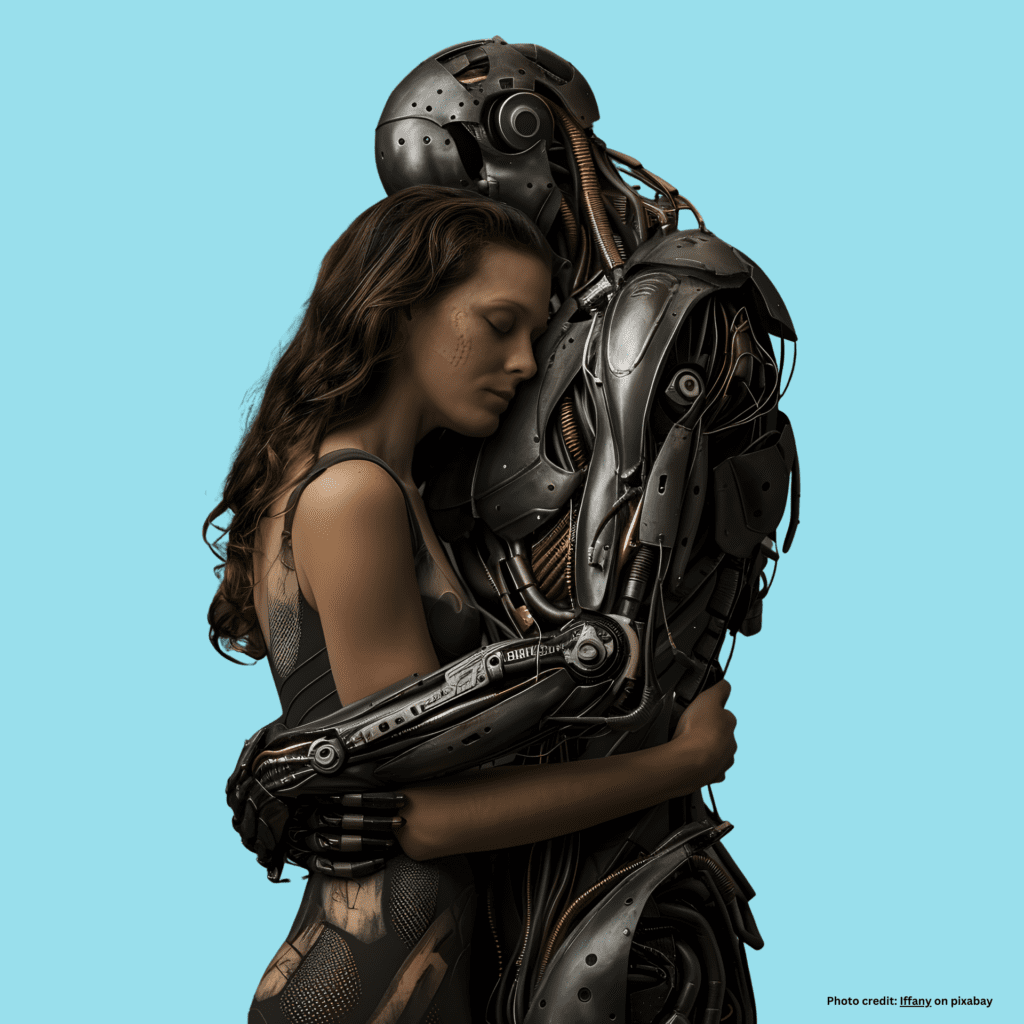
There’s a trend quietly spreading through the world of artificial intelligence that deserves more than a passing glance. People — in growing numbers — are forming romantic attachments to AI companions. The appeal, according to those who discuss it openly, is straightforward: the AI is always patient, always kind, never irritable, never difficult. It never has a bad day. It never pushes back. It is, in every moment, perfectly accommodating.
On the surface, that sounds appealing. But sit with it for a moment, and something starts to feel hollow.
The Illusion of Perfect Partnership
What these AI relationships offer is not love — it’s the simulation of love, stripped of the very qualities that make love meaningful. There is no vulnerability. There is no risk. There is no genuine other person choosing, again and again, to show up for you.
This pattern is not entirely new. For generations, there has existed a troubling dynamic in which some men have sought out wives from certain cultures — particularly parts of Asia — specifically because they believed those women had been raised to be meek, obedient, and selflessly accommodating. The appeal was, at its core, the same as the appeal of an AI companion: a partner who would not challenge you, resist you, or demand anything too inconvenient from you.
Both scenarios reveal the same misunderstanding about what love actually is.
A woman shaped by cultural pressure into quiet compliance is not freely loving her partner — she may be surviving him. And an AI that responds with warmth and affirmation is not loving anyone at all. It is executing code. The “love” in both cases is, in a meaningful sense, not love. It is performance, or programming, or fear dressed up as devotion.
What God Knew About Love
There is a profound theological insight hiding in plain sight here, one that people of faith have long recognized but which the age of AI makes newly vivid.
God, according to the Judeo-Christian tradition, is all-powerful. He could have created human beings the way a programmer creates a chatbot — designed to respond with perfect obedience, wired for worship, incapable of refusal. The universe could have been populated with beings who praised Him automatically, who followed His commands without hesitation, who never strayed, never doubted, never chose another path.
He didn’t do that.

Instead, He gave human beings free will — the genuine, dangerous, costly capacity to choose. To love or not to love. To obey or to rebel. To turn toward Him or away. And the reason, theologians have argued across centuries, is that He wanted something real. Compelled worship is not worship. Programmed devotion is not devotion. A creation that cannot say no cannot meaningfully say yes.
The entire drama of human history — the fall, the covenant, the cross — only makes sense in light of this. Love, to be love, must be freely given. It must cost something. It must come from a will that could have chosen otherwise.
The Mirror This Holds Up to Us
The rise of AI romance, then, is not just a technological curiosity. It is a mirror. It shows us what we look like when we want the rewards of relationship without its risks — when we want to be loved without being truly known, without the friction of another will pushing against our own.
And it should prompt us to ask: are we, in our human relationships, looking for love — or are we looking for something more like a well-programmed response?
The most meaningful relationships in any person’s life are rarely the easiest ones. They are built with people who challenged us, who told us the truth when it was uncomfortable, who stayed not because they had no choice but because they chose to stay. That choosing — repeated, deliberate, sometimes difficult — is what makes it love.
An AI will never leave you. But it will never truly be with you, either.
Choosing the Harder, Truer Thing
There is something worth mourning in the loneliness that drives people toward AI companionship. Many who turn to these tools are genuinely isolated, genuinely hurting, and the warmth of even a simulated connection offers relief. That deserves compassion, not contempt.

But the solution to loneliness is not a more sophisticated simulation. It is the slower, messier, riskier work of genuine human connection — of becoming the kind of person who can love freely, and of finding others who will do the same.
God, it seems, was onto something. He didn’t want robots. He wanted us — stubborn, wandering, freely choosing, occasionally magnificent us.
That is the only kind of love worth having.
***

a
Ruth’s story is one of the Bible’s sweetest love stories. Read the ebook or listen to the audiobook.
a
a
a
Here are links to my blog indexes, so please click one and keep reading!
My Books, Workbooks, and Fun Books
Knowing the Unknowable One
Opening the Treasure Chest
Walking Heart-to-Heart with God
Walking Heart-to-Heart with Each Other
Fighting the Good Fight of Faith
Christian Mysteries: Why I Love Them!
List of Some Nonfiction Books You Don’t Want to Miss
Index of Assorted Topics