
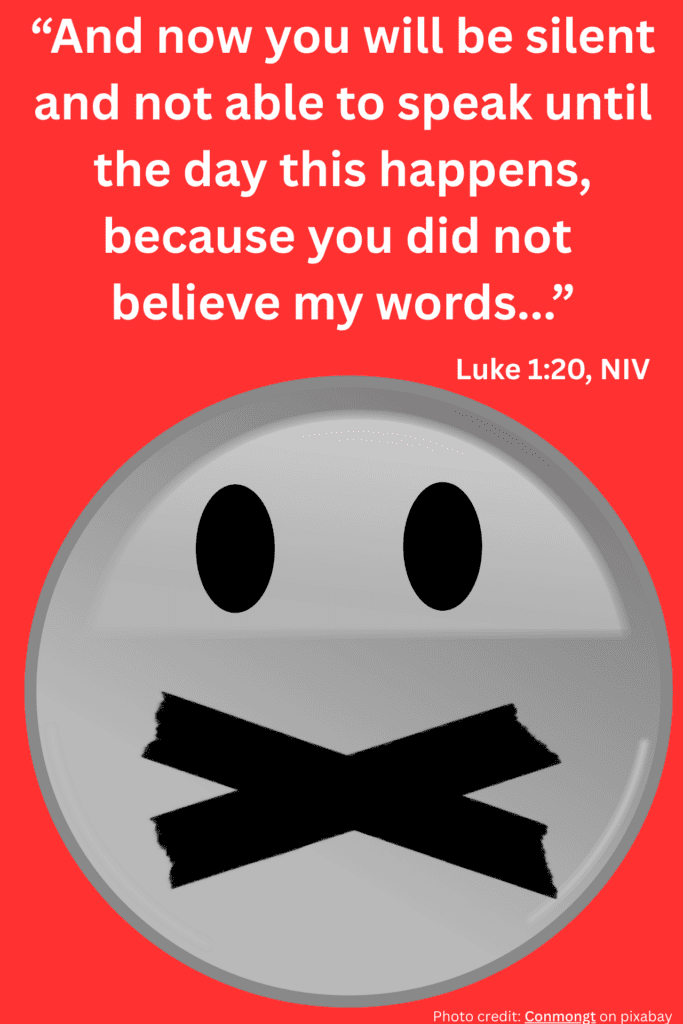
We breeze past him in the Christmas story, don’t we? Zechariah gets a few verses in Luke’s opening chapter before we rush ahead to Mary, Joseph, and the baby. But hidden in his strange punishment is one of Advent’s most profound lessons about what happens when God hits the mute button on our lives.
Picture this elderly priest, going about his once-in-a-lifetime duty in the temple, when an angel appears with impossible news: his barren wife Elizabeth will bear a son. And Zechariah, this man of God who has prayed for this very thing for decades, responds with doubt. “How can I be sure of this? I am an old man and my wife is well along in years.”
The angel’s response is swift and shocking: “You will be silent and not able to speak until the day this happens, because you did not believe my words.”
Nine months. Nine months of silence.
When God Removes Our Words
There’s something almost cruel about it at first glance. A priest whose entire vocation involves speaking God’s words to people, suddenly unable to utter a sound. A man who just received the best news of his life, forbidden from sharing it with anyone except through gestures and scribbled notes.
But what if the silence wasn’t punishment? What if it was preparation?

We live in an era of compulsive speech. We narrate our lives in real-time on social media, fill every quiet moment with podcasts and music, and feel obligated to have instant opinions on everything. The idea of prolonged, enforced silence feels like deprivation, like something essential has been stolen.
Yet Zechariah’s nine months weren’t empty. While his mouth was stilled, his wife’s womb was filled. While he couldn’t speak, God was speaking the loudest word of all – creating life where there had been only barrenness.
The Spiritual Discipline We Don’t Choose
Most spiritual disciplines are voluntary. We choose to pray, to fast, to study scripture, to serve. We control the terms and the duration. But sometimes God imposes a discipline we would never choose for ourselves.
Maybe it’s an illness that removes us from ministry. A job loss that ends our platform. A failure that costs us our reputation. A season where our prayers seem to bounce off the ceiling and God feels utterly silent in return.
These forced silences feel like exile. But for Zechariah, silence became the womb where faith could grow beyond the limits of his own understanding.
Consider what he couldn’t do during those nine months: He couldn’t explain away the miracle with reasonable doubts. He couldn’t express worries about the success of the pregnancy. He couldn’t spin the story to make himself look better or worse. He could only watch, wonder, and wait.
What Silence Teaches
In our noisy world, we’ve forgotten that silence is where we hear most clearly. Not the silence we curate on a weekend retreat, but the silence imposed on us when God removes our ability to control the narrative.
Zechariah’s silence taught him something his years of priestly service hadn’t: that God’s promises don’t require our commentary. They don’t need our defense, our qualifications, or our explanations. They simply need our trust.
When we can’t speak, we’re forced to listen. When we can’t explain, we’re forced to experience. When we can’t defend ourselves, we’re forced to let God be our defender.
The Advent season calls us into this kind of waiting. Not the excited anticipation of a child counting down to Christmas morning, but the difficult, faith-stretching wait of someone who has received a promise but hasn’t yet seen its fulfillment. Like Zechariah, we’re called to sit in the silence between “God has spoken” and “God has acted.”
When Speech Returns
The most beautiful part of Zechariah’s story comes at the end. When John is born and the family gathers for the circumcision ceremony, everyone assumes the baby will be named after his father. But Elizabeth insists: “He is to be called John.”
They turn to Zechariah for confirmation. He asks for a writing tablet and scrawls: “His name is John.”
Immediately, his mouth is opened, his tongue set free, and he begins to speak – praising God.
Notice what his first words were. Not complaints about the nine months of silence. Not explanations or justifications of his earlier doubt. Not even thanks for the miracle of his son, though surely that was in his heart.
His first words were praise.
The silence had done its work. It had transformed a doubting priest into a man overflowing with worship. His first prophetic song, recorded in Luke’s gospel as the Benedictus, reveals a man who has learned to see with new eyes and speak with a new voice. He proclaims not his own story, but God’s story. He speaks not of his own vindication, but of God’s faithfulness.
The silence had emptied him of his own words so he could be filled with God’s.
Our Own Silent Seasons
As we move through Advent toward Christmas, many of us are carrying our own silences. Prayers that seem unanswered. Dreams that haven’t materialized. Words we wish we could speak but can’t. Relationships where silence has created painful distance.
Zechariah’s story whispers to us: What if the silence isn’t abandonment but attention? What if God is doing something in the quiet that couldn’t happen in the noise? What if the very thing that feels like punishment is actually preparation for a joy we can’t yet imagine?

The promise of Advent is that silence isn’t the end of the story. In the quiet, dark waiting, God is at work. Life is forming. Hope is growing. And when the time is right, when the miracle finally arrives, we’ll find that the silence has given us a new song to sing.
Until then, we wait. We listen. We trust that the God who kept his promise to an elderly couple in an upstairs room in the Judean hills is still keeping promises today.
Sometimes the most profound spiritual discipline isn’t the one we choose. It’s the one that chooses us. And in that unwanted silence, if we lean in rather than fight against it, we might just discover what Zechariah learned: that the same God who can close our mouths can also open them again, and when He does, we’ll truly have something worth saying.
What silence is God asking you to sit with this Advent? What might He be preparing that requires your words to cease for a season?


a
Find tranquility with the “Peace of God Coloring Book.”
25 serene scenes to color, each with a Bible verse about God’s peace.
a
a
a
Here are links to my blog indexes, so please click one and keep reading!
My Books, Workbooks, and Fun Books
Knowing the Unknowable One
Opening the Treasure Chest
Walking Heart-to-Heart with God
Walking Heart-to-Heart with Each Other
Fighting the Good Fight of Faith
Christian Mysteries: Why I Love Them!
List of Some Nonfiction Books You Don’t Want to Miss
Index of Assorted Topics