
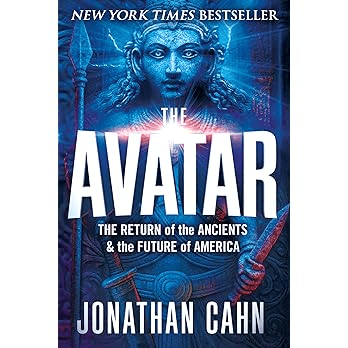
Before we dive into Jonathan Cahn’s provocative book The Avatar, we need to understand what he means by the title, because “avatar” is one of those words that can mean different things depending on context.
In Hinduism, an avatar is the “descent” of a deity into earthly form, a god made manifest in human, superhuman, or animal shape, particularly associated with Vishnu. More broadly in religious contexts, it refers to a divine teacher or savior figure who appears to restore cosmic order. Metaphorically, we might call someone “an avatar of justice” to mean they embody that quality. In our digital age, an avatar is your profile picture or game character, a representation of yourself in virtual space. Science fiction, particularly the film Avatar, popularized the idea of a remotely controlled body serving as a stand-in for someone’s consciousness.
Jonathan Cahn uses “avatar” in that first, ancient sense: a supernatural being descending to take physical form on earth. But he’s not talking about Vishnu. He’s talking about something the Bible presents as far more sinister.
What Cahn’s Book Explores
The Avatar is a sequel to Cahn’s earlier work, The Return of the Gods, where he developed the thesis that ancient principalities – specifically those he identifies as Baal, Molech, and Ishtar – have returned to possess modern Western culture. In The Avatar, he takes this argument further, exploring how these spiritual entities don’t merely influence culture from a distance but actually manifest themselves through individuals, movements, and cultural transformations.
Cahn traces what he sees as the fingerprints of these entities through cultural shifts in sexuality, gender ideology, the breakdown of the family, and the targeting of children. According to Cahn, this isn’t merely cultural drift or secular philosophy; it’s the work of intelligent, malevolent spiritual beings reasserting dominion over societies that have turned away from God. These ancient gods – the same ones that once demanded child sacrifice, temple prostitution, and the obliteration of gender distinctions in pagan worship – haven’t disappeared. They’ve returned, seeking new avatars, new embodiments through which to work their will.
Whether you find Cahn’s specific identifications compelling or speculative, his books force a question that many modern Christians, especially those who want to maintain intellectual respectability, would prefer to avoid: If you take the Bible seriously, can you really dismiss the existence of powerful spiritual beings besides God and His angels?
The Uncomfortable Implication: Christianity Requires Belief in “Little-g Gods”
Here’s where things get theologically awkward for contemporary believers.
We live in a disenchanted age. The scientific revolution, the Enlightenment, and modern rationalism have trained us to be suspicious of invisible forces. Educated people don’t believe in spirits anymore, or so the story goes. Many Christians have absorbed this worldview by osmosis, reducing their faith to a therapeutic relationship with Jesus or a moral philosophy with occasional miracles sprinkled in.
But Scripture won’t let us off that easy.
The Bible consistently, persistently, and unapologetically describes a cosmos teeming with spiritual beings of varying ranks and allegiances. These aren’t metaphors. They’re not symbolic representations of human psychological states. They’re presented as real, intelligent entities with agency, personality, and power.
Consider the evidence:
The Apostle Paul explicitly names them. In Ephesians 6:12, he writes, “For we do not wrestle against flesh and blood, but against the rulers, against the authorities, against the cosmic powers over this present darkness, against the spiritual forces of evil in the heavenly places.” That’s not a single category of demon – it’s a hierarchy. Rulers. Authorities. Cosmic powers. Spiritual forces. Paul isn’t being poetic; he’s describing a structured reality.
Daniel presents them as territorial princes. In Daniel 10, an angel tells the prophet that he was delayed for twenty-one days because “the prince of the kingdom of Persia withstood me.” Another being, “Michael, one of the chief princes,” had to come help. Later, the angel says he must return to fight “the prince of Persia,” and soon “the prince of Greece will come.” These aren’t human political leaders. They’re spiritual entities assigned to (or claiming) nations and territories.
Jesus Himself acknowledged their existence and authority. When tempted in the wilderness, Satan offers Jesus “all the kingdoms of the world and their glory” (Matthew 4:8-9). Jesus doesn’t dispute Satan’s claim to possess this authority. He simply refuses to worship him. Later, Jesus calls Satan “the ruler of this world” (John 12:31, 14:30, 16:11). That’s a title with implications. Paul echoes this, calling Satan “the god of this world” (2 Corinthians 4:4).
The divine council appears throughout Scripture. Psalm 82 depicts God standing “in the divine council” and judging “among the gods.” These elohim (the Hebrew word for divine beings) are condemned for their unjust rule over the nations. The Psalms and prophets repeatedly reference the “host of heaven” – not just stars, but the spiritual beings associated with them, some of whom led Israel astray into idol worship (Deuteronomy 4:19, 17:3).
Paul calls them “gods” without flinching. In 1 Corinthians 8:5, he writes matter-of-factly: “For although there may be so-called gods in heaven or on earth—as indeed there are many ‘gods’ and many ‘lords’—yet for us there is one God, the Father.” He acknowledges their existence while denying their ultimate authority. Later, he states plainly that “what pagans sacrifice they offer to demons and not to God” (1 Corinthians 10:20). The gods of the nations aren’t imaginary; they’re demonic.
What Cahn calls “avatars” – powerful spiritual entities that exert earthly influence or even manifest through human agents – is simply what the biblical writers called principalities, powers, or gods (lowercase “g”). The terminology differs, but the concept is thoroughly biblical.
Why This Matters
If the Bible’s cosmology is true – if there really are intelligent, powerful, malevolent spiritual beings influencing cultures, nations, and individual lives – then our analysis of what’s happening in the world is catastrophically incomplete without accounting for them.
This doesn’t mean we see a demon behind every door or abdicate human responsibility for human choices. The biblical worldview holds both realities in tension: humans have genuine moral agency and they can be deceived, influenced, or even possessed by spiritual forces beyond themselves. Cultural trends aren’t only spiritual warfare, but they’re not merely sociology either.
Cahn’s thesis – that specific ancient spirits like Baal, Molech, and Ishtar have “returned” to repossess Western civilization – may be difficult to prove empirically (how do you fact-check the identity of a principality?). But his broader framework is utterly biblical: powerful spiritual beings do exist, they do exercise influence over territories and cultures, and they are hostile to God’s purposes and God’s people.
To reject this framework isn’t to choose science over superstition – the existence of invisible conscious beings is a metaphysical claim, not one science can adjudicate. It’s to choose modern Western assumptions over the consistent testimony of Scripture, from Genesis to Revelation.
Living in an Enchanted World
The implications are both sobering and clarifying.
We’re not just navigating human ideologies; we’re navigating a spiritual battlefield with real stakes and real enemies. Our ancestors understood this instinctively. We’ve largely forgotten it, to our detriment. Prayer isn’t merely meditation or positive thinking; it’s communication with the highest Power in a cosmos full of powers. Scripture isn’t just ancient wisdom literature; it’s the revelation of God in a world where other voices clamor for our allegiance. Worship isn’t just emotional expression; it’s the pledge of loyalty that matters most in a universe where loyalty determines destiny.
Whether Cahn has correctly identified which ancient spirits are at work today is less important than whether he’s right that some such spirits are at work. And on that question, if you believe the Bible, the answer is unavoidable.
The world is enchanted after all – not with benign fairy-tale magic, but with the terrible wonder of invisible war. The avatar thesis, whatever its specific details, calls us back to the Bible’s own insistence: there are gods (little “g”) in this world, they demand worship, and we must choose which altars we approach.
There is only one God (capital “G”) who deserves our worship. But pretending the other powers don’t exist won’t make them go away. It will only make us easier prey.
***

Here’s a link to my blog about Cahn’s earlier book, The Return of the Gods.

In the introduction to my book, The Bible in Brief, I say this: “The Bible is a story. More specifically, it is a frame story in which one or more shorter tales are contained within the framework of one overarching story. Would it surprise you to hear that the overarching story of the Bible is the story of Cosmic War?”
a

In the book, I trace many of the battles between God and the dark forces of evil, beginning in Genesis and ending in Revelation.
a
a
a
Here are links to my blog indexes, so please click one and keep reading!
My Books, Workbooks, and Fun Books
Knowing the Unknowable One
Opening the Treasure Chest
Walking Heart-to-Heart with God
Walking Heart-to-Heart with Each Other
Fighting the Good Fight of Faith
Christian Mysteries: Why I Love Them!
List of Some Nonfiction Books You Don’t Want to Miss
Index of Assorted Topics