
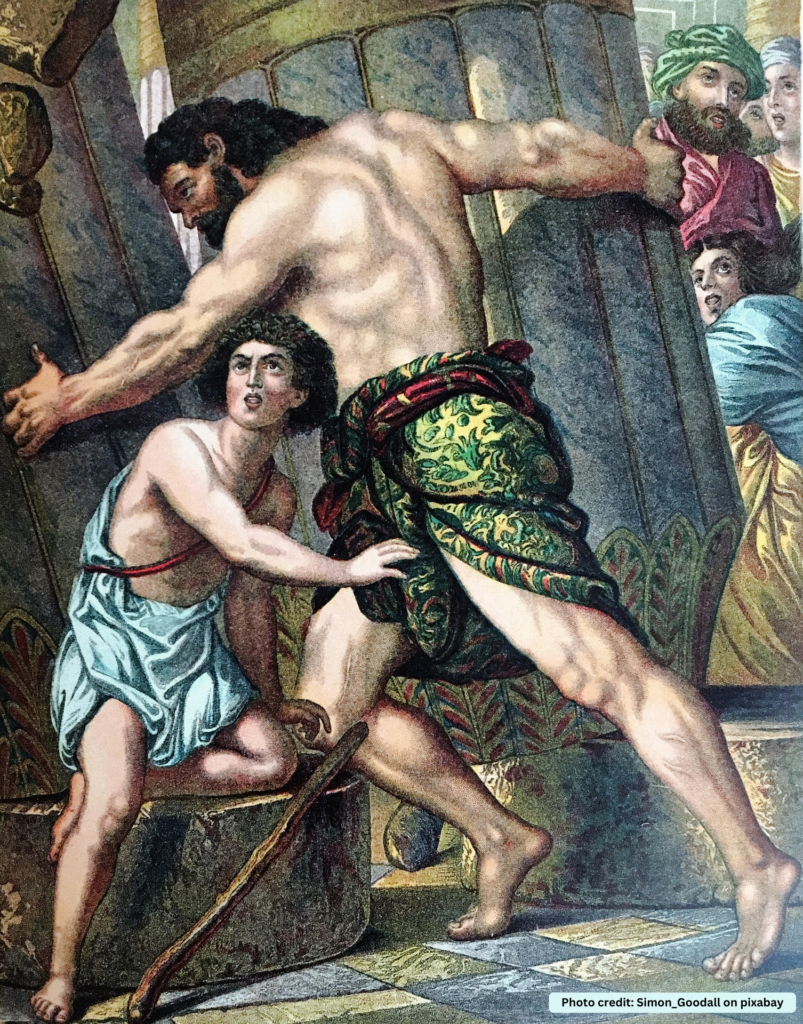
There’s a moment in Judges 16 that has always bothered me a little. Samson — the man blessed with supernatural strength, set apart by God from the womb, consecrated as a lifelong Nazirite — is sitting in a Philistine woman’s lap, pestered into revealing the one secret that will destroy him. And you want to ask: How did we get here?
It’s a fair question. Samson’s story reads less like a heroic narrative and more like a cautionary tale wrapped in a miracle. Lust, anger, pride, vengeance — the man had it all. He broke nearly every boundary God set for him. He married foreign women. He touched a lion’s carcass. He frequented Philistine prostitutes. He handed the key to his own destruction to a woman who had already proven herself untrustworthy. And yet — and this is the part that won’t let go — God never stopped using him.
So what exactly was God doing with Samson? I think the answer reveals something important about how God actually works in the lives of His people — something we’d rather not admit.
Before Samson was born, his parents weren’t even praying for a child. The angel of the Lord simply showed up and announced that they were going to have a son — a son who would begin to deliver Israel from the Philistines. This was entirely God’s initiative. God didn’t find a willing, prepared vessel to pour blessing into. He chose an ordinary couple, gave them an extraordinary son, and then watched that son stumble through life in ways that make us cringe.
God Didn’t Wait for Samson to Get His Act Together
And on the angel’s second visit, God punctuated the announcement with something remarkable: the angel ascended to heaven in the flame of their offering. It was a spectacular, unmistakable display — the kind of sign God reserves for moments He wants people to remember. God was saying, in effect: Pay attention. This matters. I am in this.
I wonder if God granted Samson’s parents the gift of that sign so they would understand, no matter how much Samson messed up, that God had made him and God had chosen him. Samson wasn’t a mistake. Samson was a chosen vessel.
We have a tendency to look at the people God uses and assume they must have had some quality that made them worthy — some hidden faith, some quiet devotion, some secret surrender. Samson had none of that. His motives were, by his own admission, deeply selfish. When he finally brought down the pagan temple in Gaza, it wasn’t out of sacrifice or devotion to God. He said it plainly: he wanted to get even with the Philistines for blinding him. That’s it. That was his reason.
The Uncomfortable Truth About “Useful” People
And God used it anyway.
This is where Samson’s story gets uncomfortable, because it strips away one of our favorite assumptions: that God only works through people who are spiritually “ready.” Samson was never ready. He never seems to have had a single moment of genuine surrender or spiritual growth. He was proud, impulsive, and selfish from start to finish. Yet he judged Israel for twenty years. He was the instrument through which God kept the Philistines in check during one of the darkest periods in Israel’s history.
God didn’t wait for Samson to become a man of faith before using him. He used him as he was — flawed, fractured, and all.
If you’ve ever looked at your own life and thought, I’m too much of a mess for God to do anything with — Samson is your answer. Not because his story is a license to keep sinning, but because it’s a window into how God actually operates. God’s purposes are not contingent on our cooperation. He doesn’t need us to be polished or obedient or spiritually impressive before He decides to act through us.
What This Means for the Rest of Us
That doesn’t mean our choices don’t matter. Samson’s choices cost him dearly — his marriage, his freedom, his eyes, and ultimately his life. The consequences were real and brutal. But they didn’t stop God from accomplishing what He set out to do.
There’s something quietly liberating in that. It means God’s ability to work in your life isn’t something you have to earn or unlock. It means that even when you can’t see it — even when your own story looks like a tangled mess of bad decisions and wasted potential — God may still be weaving something purposeful through it.
Samson will never be anyone’s hero. He’s not the kind of biblical figure who gets put on a poster or held up as a model of faith. But maybe that’s exactly why his story is in the Bible. Because sometimes God’s greatest demonstrations of power aren’t the polished, triumphant ones. Sometimes they’re the messy, impossible ones — the ones where you look at the instrument God chose and think, Really? Him?
I Am in This
And the answer, apparently, is: Yes. Him. Watch what I do.
Remember that moment at the very beginning — before Samson had done a single thing, good or bad? The angel ascending in flame, disappearing into heaven right before their eyes. God wasn’t showing off. He was making a declaration. Pay attention. This matters. I am in this. And He was right. Through every stumble, every selfish detour, every catastrophic mistake Samson made, God was still in it. Still working. Still accomplishing exactly what He set out to do.
So the next time you look at your own life and see nothing but a mess — take heart. God said it about Samson, and He says it about you: I am in this.
That might be the most encouraging thing in the Book of Judges.

***

Here are links to my blog indexes, so please click one and keep reading!
My Books, Workbooks, and Fun Books
Knowing the Unknowable One
Opening the Treasure Chest
Walking Heart-to-Heart with God
Walking Heart-to-Heart with Each Other
Fighting the Good Fight of Faith
Christian Mysteries: Why I Love Them!
List of Some Nonfiction Books You Don’t Want to Miss
Index of Assorted Topics