

Nobody writes poems about feet.
We write about eyes – windows to the soul. About hands – instruments of tenderness and labor. About hearts – the ancient seat of love and longing. But feet? Feet are the unglamorous, utilitarian, slightly embarrassing bottom of the human body. We hide them in shoes. We’re self-conscious about them at the beach. We relegate them to the punchline of jokes.
And yet.
Some of the most profound moments of love in all of Scripture happen at someone’s feet. Not in grand gestures of triumph or in moments of romantic splendor, but down there at the lowest, dirtiest, most servant-level part of the human body.
I don’t think that’s an accident.
The World Feet Walked In
To understand why feet matter in Scripture, you have to understand what feet meant in the ancient world.
People in first-century Palestine walked everywhere. On dirt roads shared with animals. Through markets thick with refuse. Along paths that were, by any modern standard, genuinely filthy. By the end of a day’s journey, a person’s feet weren’t just tired. They were caked with the accumulated grime of the world.
Washing a guest’s feet was therefore one of the first acts of hospitality upon arrival. But it was the task assigned to the lowest servant in the household. Not the butler, not the cook, not the attendant of honor – the lowest. In some rabbinic traditions, Jewish disciples were specifically exempted from washing their teacher’s feet because the act was considered too degrading even for students. It was beneath them.
Feet were where the road met the body. They carried the evidence of everywhere you’d been. They were the point of contact between a human being and the dust of the earth.
Which makes it all the more astonishing what happens around feet in the Gospels.
Mary’s Extravagant Descent
In John 12, six days before Jesus’s last Passover, a dinner is held in His honor. Martha serves. Lazarus reclines at the table. And Mary, the one who always seems to understand what others miss, does something extraordinary.
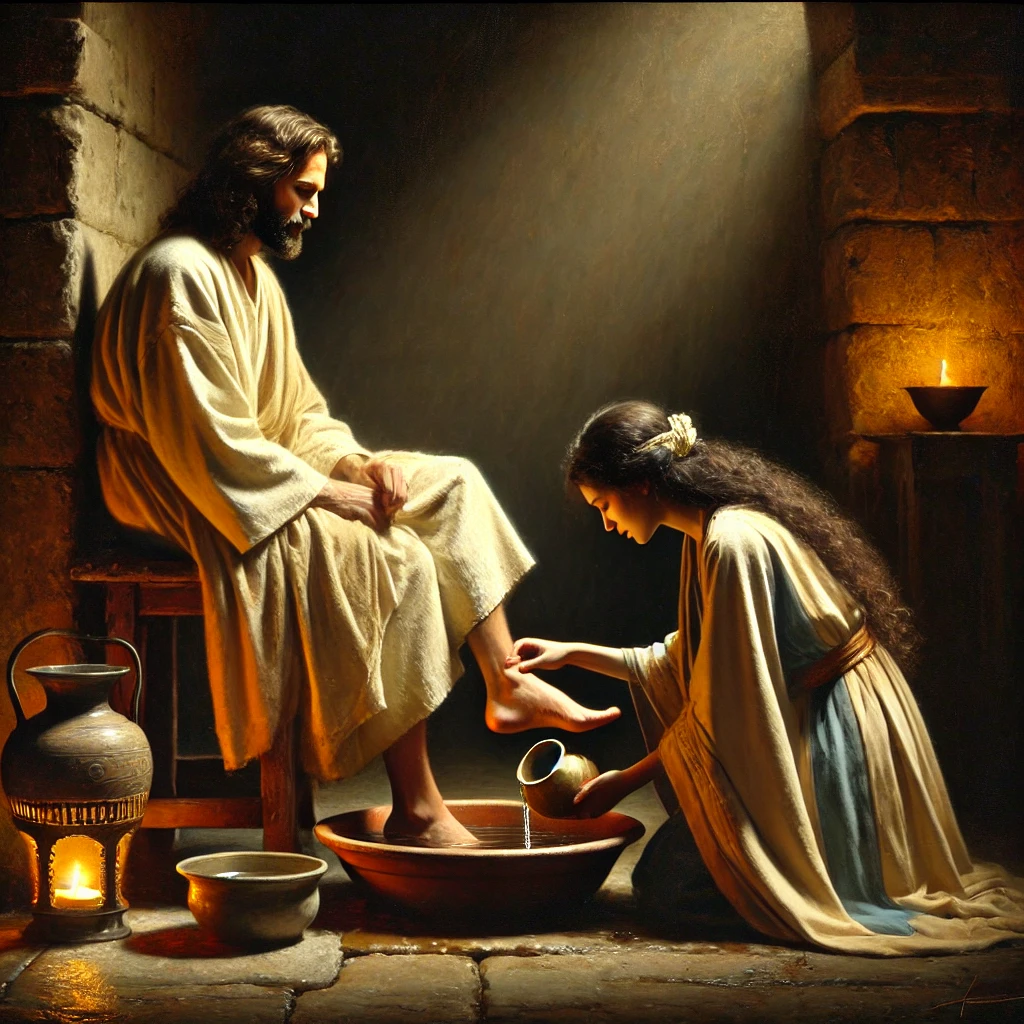
She takes a pint of pure nard, an expensive perfume worth a year’s wages, and pours it on Jesus’s feet. Then she does something even more startling: she lets down her hair – a socially unacceptable act for a woman in that culture – and wipes his feet with it.
The room fills with fragrance. Judas objects to the waste. And Jesus silences the room: “Leave her alone. She has kept this for the day of my burial.”
Mary understood something nobody else in that room had grasped. While the disciples were still arguing about positions in the kingdom, still jockeying for status and influence, Mary was down on the floor, her hair spread across the feet of a man about to die.
She chose the lowest position in the room. Not reluctantly. Not hesitantly. But lavishly. She poured out her most precious possession at his feet. She used the part of herself women were most careful to protect – her hair, her dignity, her social standing – to perform the task of the lowest servant.
This was love expressed as descent. As the willing abandonment of status. As extravagance offered not at eye level but from the floor.
There’s something in Mary’s posture that most of us spend our lives avoiding. She didn’t love Jesus from a safe, dignified distance. She got low. She got close. She let the fragrance of her devotion fill the room regardless of what anyone thought.
The Night He Took the Towel
A few days later, Jesus is in the upper room with his disciples. John sets the scene with careful deliberation: “Jesus knew that the Father had put all things under his power, and that he had come from God and was returning to God.”
In other words, he knew exactly who he was. He understood the full weight of his identity – divine, eternal, omnipotent, ultimate authority.
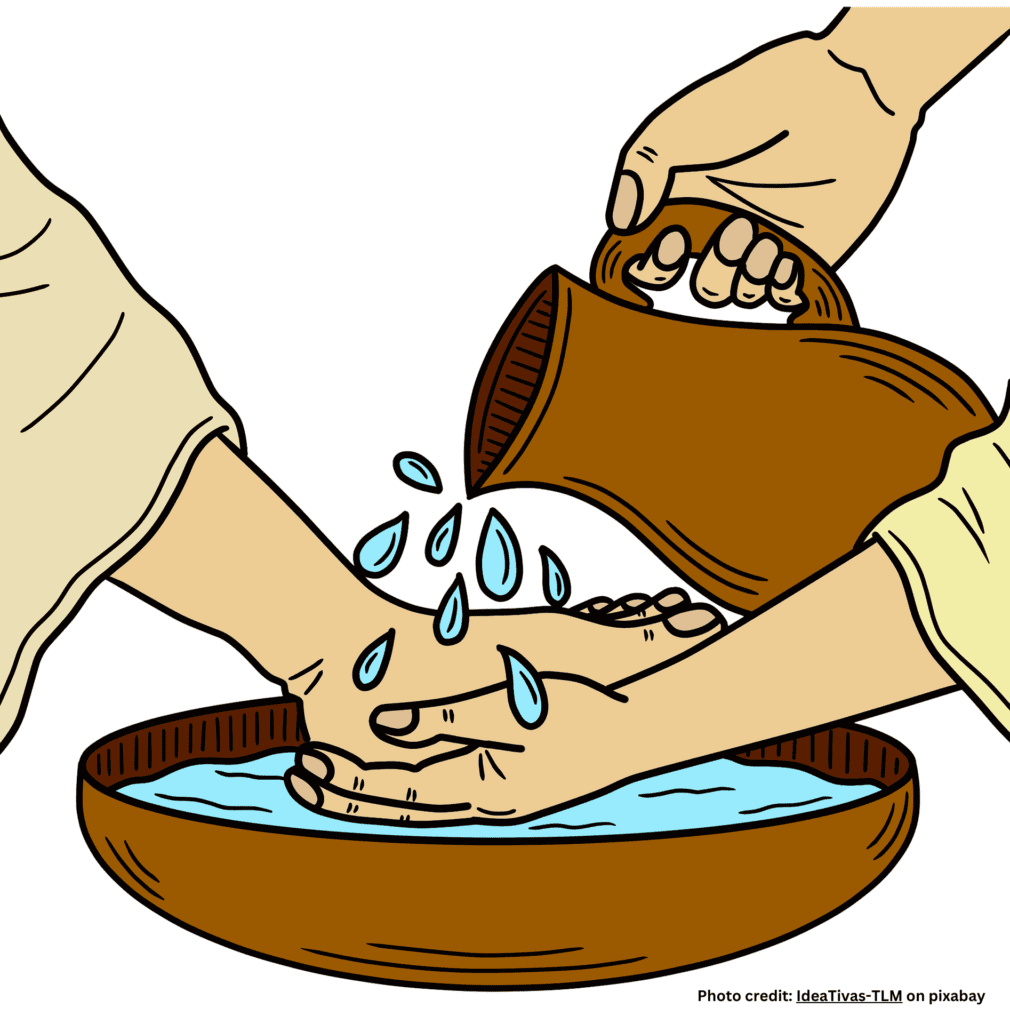
And then he got up, took off his outer clothing, wrapped a towel around his waist, poured water into a basin, and began to wash his disciples’ feet.
The juxtaposition is staggering. The one who spoke the universe into existence, kneeling in the dirt before men who were about to abandon him, performing the task no Jewish disciple was expected to perform for their rabbi.
Peter’s reaction is entirely understandable: “You shall never wash my feet.” There’s something deeply distressing about receiving this kind of service from someone whose greatness you recognize. It upends the order of things. It destabilizes every hierarchy you’ve constructed.
But Jesus insists. “Unless I wash you, you have no part with me.”
He’s teaching them something they won’t fully understand until later. That greatness in his kingdom isn’t measured by how high you climb but by how low you’re willing to go. That love expressed from a position of power means nothing. It’s love expressed through voluntary descent that changes the world.
“I have set you an example,” he tells them. “Now that I, your Lord and Teacher, have washed your feet, you also should wash one another’s feet.”
The greatest act of leadership he modeled that night wasn’t a sermon or a miracle. It was a basin of water and a towel.
The Father Who Hiked Up His Robe
And then there’s the prodigal son. A boy who took his inheritance early, essentially wishing his father dead, and squandered it in reckless living. Who ended up feeding pigs and envying their slop. Who rehearsed a speech of repentance and started the long walk home, expecting at best to be received as a hired servant.
But while he was still a great way off, his father saw him.
Which means the father had been looking. Watching the road. Every day, perhaps, scanning the horizon for a familiar silhouette.
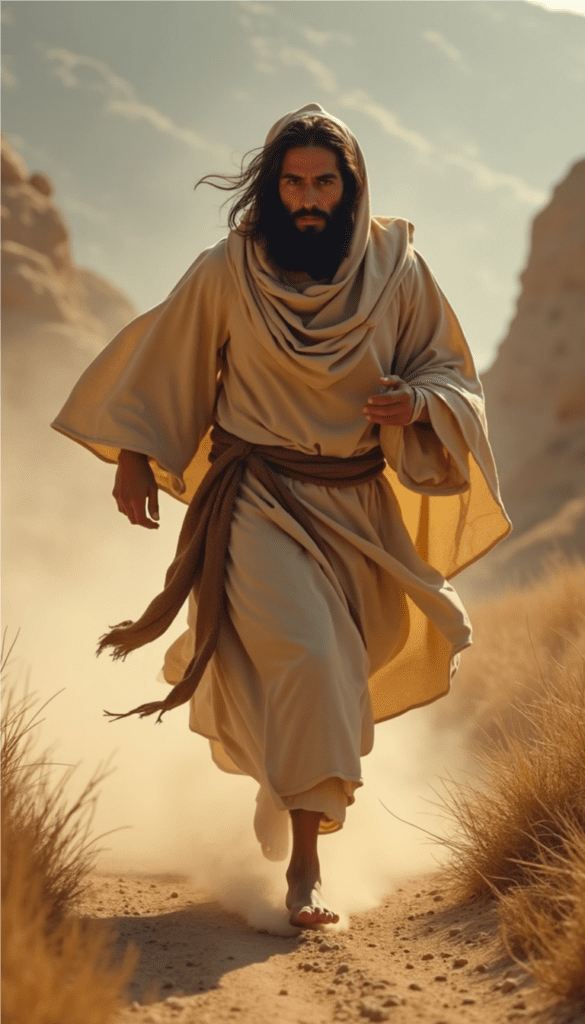
And when he saw him, he ran.
This detail would have been as shocking to Jesus’s original audience as the foot-washing was to the disciples. Wealthy, dignified men in first-century Middle Eastern culture did not run. Running required hitching up your robes, exposing your legs, abandoning all pretense of gravity and decorum. It was undignified. Beneath a man of standing.
The father didn’t care.
He ran. He threw his arms around his filthy, foul-smelling, shame-soaked son. He kissed him before the boy could finish his rehearsed speech. He called for the robe, the ring, the sandals, and the feast.
He got low before his son even reached him. He closed the distance between dignity and disgrace at a sprint.
This is the love language of feet in its most naked form: love that abandons pride and runs. Love that doesn’t wait for the other person to clean up before offering a welcome. Love that is more concerned with closing the gap than maintaining appearances.
What All Three Have in Common
Mary at Jesus’s feet. Jesus at the disciples’ feet. The father’s feet running down the road.
Three different scenes. Three different kinds of love. But the same posture at the heart of each one.
Descent. Humility. The willingness to get low.
In each scene, the person expressing love occupies what the world would consider a lesser position. Mary, already a woman in a patriarchal culture, makes herself lower still. Jesus, who holds all authority, takes the servant’s place. The father, who had every right to stand at the gate with crossed arms, runs like a man who has forgotten that dignity exists.
None of them loves from a safe, elevated distance. None of them extends love as a favor granted from on high. They all come down. They all get close. They all risk something – reputation, dignity, the comfortable distance of pride.
The High Cost of Getting Low
Here’s what I think Scripture is trying to tell us: real love requires a willingness to descend.
Not the theatrical humility of false modesty. Not the self-abasement of someone with no self-worth. But the conscious, deliberate choice to set aside status and get close to someone at whatever level they’re at.
This is perhaps the most countercultural love language of all. We live in an age of personal branding, carefully curated images, and the relentless pursuit of status. We want to love in ways that enhance our reputation, that make us look good, that can be photographed and posted.
But the love language of feet says: get low. Get close. Get dirty if necessary. Close the distance between yourself and the person who needs you, regardless of what it costs your dignity.
It looks like sitting on the floor with the child who’s having a meltdown instead of standing over them with hands on hips.
It looks like visiting the friend in the rehabilitation center when it’s awkward and uncomfortable and you don’t know what to say.
It looks like apologizing first, even when you’re not entirely sure you were wrong, because the relationship matters more than being right.
It looks like running – actually running – toward the person who has hurt you, because you’ve been watching the road and you can’t bear another moment of being apart.
Love From the Floor
We are, most of us, afraid to get low. We worry about what it communicates about our worth, our boundaries, our self-respect. We want to love generously, but from a safe height. At arm’s length. With our dignity intact.
But the great loves of Scripture happen from the floor. From the servant’s posture. From the position that the world considers weakness, and God apparently considers glory.
Mary understood this before anyone else in the room.
Jesus demonstrated it on His last night with His friends.
The father embodied it before his son had spoken a single word of repentance.
None of them counted the cost to their reputation. None of them waited for the other person to deserve it. None of them loved efficiently or safely or from a comfortable distance.
They just got low. And in getting low, they changed everything.
Maybe that’s the invitation for us too. Not to love loudly or lavishly from a position of strength, but to love humbly, closely, extravagantly, from the floor if necessary.
To learn the love language that nobody writes poems about.
The one that smells like nard and looks like a basin of water and sounds like sandals slapping the road at a dead run.
The love language of feet.
***


Here are links to my blog indexes, so please click one and keep reading!
My Books, Workbooks, and Fun Books
Knowing the Unknowable One
Opening the Treasure Chest
Walking Heart-to-Heart with God
Walking Heart-to-Heart with Each Other
Fighting the Good Fight of Faith
Christian Mysteries: Why I Love Them!
List of Some Nonfiction Books You Don’t Want to Miss
Index of Assorted Topics