

There’s a kind of deception that doesn’t announce itself. It doesn’t come dressed as an obvious lie. It comes dressed as common sense, something repeated so often by so many credentialed voices that questioning it feels almost irrational. “Eat less, move more.” “A calorie is a calorie.” We’ve heard it our whole lives. Doctors say it. Government nutrition websites say it. Diet culture has built an entire economy on it.
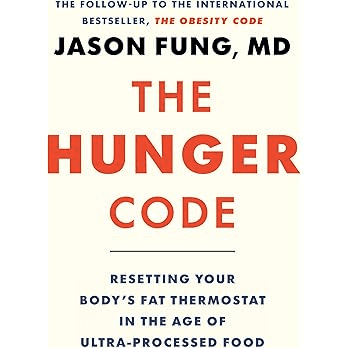
And according to Dr. Jason Fung’s The Hunger Code, it’s wrong. Or at least, it’s a profound oversimplification that has quietly fueled a public health catastrophe.
I want to tell you why I think this book matters, and why I think it matters specifically for those of us who are eagerly waiting for the return of our Lord.
The Deception We Didn’t See Coming
We talk a lot, in end-times circles, about deception increasing as the day draws near. We watch for it in theology, in politics, in culture. But deception can arise in unexpected arenas. In this case, it’s a quiet, decades-long consensus that turns out to be built on sand.
Dr. Fung lays out the numbers plainly: obesity in American adults climbed from roughly 13% in 1962 to over 42% by 2018. That’s not a minor drift. That’s a tripling, accelerating over just the last decade and a half, all while the “eat less, move more” advice has been repeated louder than ever. If the advice worked, we would expect the numbers to improve, not worsen. Something is missing from the official story.
What is missing, Dr. Fung argues, is an understanding of insulin’s role in our battle with obesity. His core insight is that not all calories behave the same way once they enter your body. Two hundred calories of steak and two hundred calories of candy are treated as nutritionally identical under the “calorie is a calorie” model. But your body doesn’t see them that way. The candy triggers a surge of insulin, which shuttles most of those calories into storage as fat. The calories from steak are used for energy rather than stored. Same number on the label. Completely different outcome in your bloodstream.
This is the deception, isn’t it? Not a lie that contradicts the truth outright, but a half-truth that hides the deeper mechanism. Calories do matter. But pretending that’s the whole story has left millions of well-meaning people blaming themselves for a failure that was always about so much more than willpower.
The Devil Doesn’t Care About Your Waistline – He Cares About Your Witness
Let me be clear about something: this is not a post about vanity, and it’s not a post suggesting that bodily health is some kind of righteousness test. Christians are not the only people struggling with weight, and unbelievers are not somehow more “deserving” of the consequences of bad nutrition science. Weight gain, as Fung documents, has multiple contributing root causes – refined carbohydrates, ultra-processed foods, late-night eating, chronic stress, poor sleep, and food addiction. The devil doesn’t care whether you’re thin or heavy. He cares whether you’re useful to the Kingdom.
And that’s exactly why this matters. If the enemy can keep believers exhausted, foggy, inflamed, and physically depleted, through mechanisms most of us don’t even understand, he doesn’t need to win a single theological argument. He just needs us to be tired. Anyone who has tried to pray, study Scripture, disciple a younger believer, or simply show patience to their family after a blood-sugar crash knows exactly what I mean. Our bodies are not unrelated to our witness. Paul didn’t urge us to discipline our bodies by accident.
We are living in days that call for clear minds, sustained endurance, and the energy to love well under pressure. That doesn’t require an Instagram physique. It requires not being a hostage to hormonal chaos that modern food science has, frankly, helped create.
What Fung Actually Offers
What I appreciate most about The Hunger Code is that it isn’t another guilt-trip diet book. Fung systematically rebuilds the picture: he walks through how food, digestion, hormones, and storage actually interact; how ultra-processed foods are engineered – deliberately – to bypass our natural satiety signals; and how factors like meal timing, food order, and fasting affect insulin in ways the “just eat less” crowd never mentions.
He’s not subtle about his frustration with the standard advice. He treats it almost like an inherited myth – repeated, unexamined, and strangely immune to forty years of contrary evidence. And he backs it with research, not just opinion.
For practical purposes, the book reframes weight gain not as one problem with one solution, but as a symptom with many possible root causes – poor sleep, emotional eating, refined carbohydrates, processed fats, distracted eating, and more – each with its own real solution, rather than the blanket “eat less” prescription that has failed so many of us for so long.
A Word of Discernment
I’ll say this plainly, because intellectual honesty matters: Fung is a physician writing from a research and clinical perspective, not a Christian author, and this is a health book, not a theology book. Read it for what it is, a compelling, well-documented challenge to a broken nutritional consensus, not as Scripture. Test everything, as we’re called to do, against the Word. But don’t let the secular source of good information cause you to dismiss the information itself. God can use a doctor’s research to help His people steward their bodies well, just as He can use a pagan king to fulfill His purposes.
Stewardship in the Time We’re Given
We don’t know the day or the hour. But we do know we’ve been given bodies, time, and energy to use for the Kingdom while we wait. If a widely accepted piece of “expert” advice has been quietly working against the health of millions, Christian and non-Christian alike, then exposing that lie and replacing it with truth is worth our attention. Not because thinness is holiness. Because clarity, energy, and stewardship are gifts we can offer back to the One who gave them to us.
The night is far gone; the day is at hand. Let’s not sleepwalk through it on a blood-sugar rollercoaster we didn’t even know we were riding.
“And when these things begin to come to pass, then look up, and lift up your heads;
for your redemption draweth nigh.” — Luke 21:28
***

a

a
Here are links to my blog indexes, so please click one and keep reading!
My Books, Workbooks, and Fun Books
Knowing the Unknowable One
Opening the Treasure Chest
Walking Heart-to-Heart with God
Walking Heart-to-Heart with Each Other
Fighting the Good Fight of Faith
Christian Mysteries: Why I Love Them!
List of Some Nonfiction Books You Don’t Want to Miss
Index of Assorted Topics
Great content! Keep up the good work!
“The Hunger Code” is a great book. I hope lots of people will read it! Thank you so much for your comment. God bless you.