
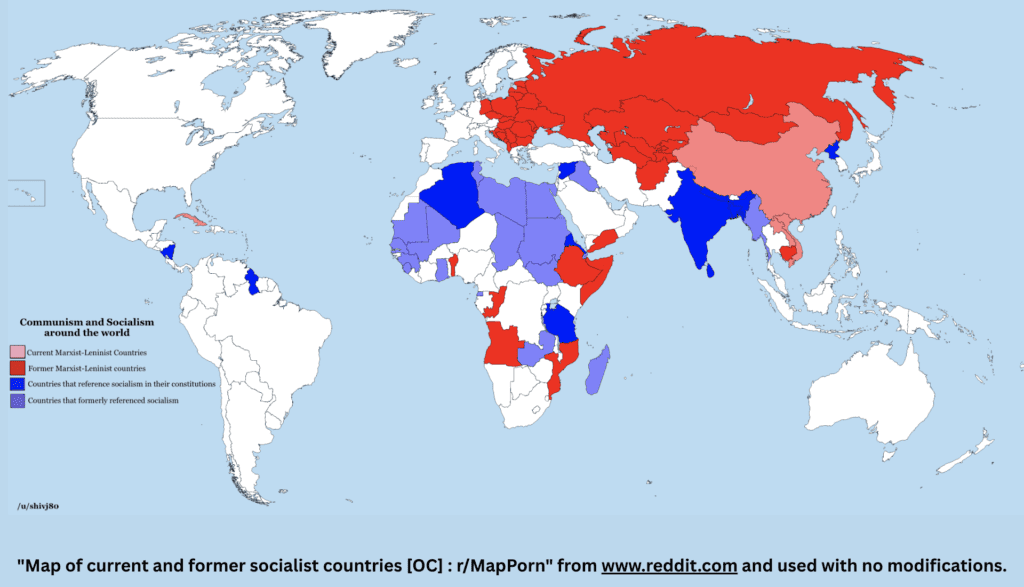
From the Soviet Union to Venezuela, a century of promises, experiments, and outcomes,
told country by country.
Every socialist revolution in history has been sold, not imposed. Before the bread lines come the promises, and the promises are genuinely appealing. No one will go hungry. The wealthy will finally pay their fair share. Healthcare and education will be free for everyone. The gap between the powerful and the powerless will close. For people who are struggling, watching others prosper while they fall behind, those promises don’t sound like a fantasy. They sound like justice.
The dream has a particular pull on younger voters who didn’t live through the Cold War, and on populations exhausted by inequality, corruption, or the feeling that the existing system is rigged against them. When a charismatic leader steps forward and says I can fix this, the emotional case is real even when the economic case is not.
What follows is the other half of the story. What actually happened, country by country, when those promises met reality.
Key Takeaways
- Socialist regimes from the Soviet Union to Venezuela repeatedly produced food shortages, economic collapse, and mass suffering despite differing in geography, culture, and era.
- China and Vietnam saw dramatic improvements only after abandoning core socialist policies in favor of market reforms, lifting hundreds of millions out of poverty.
- Not every country with “socialist” in its constitution or welfare programs actually practices government ownership of production, a distinction that gets lost in modern political debates.
- Comparing North Korea and South Korea, or East and West Germany, offers some of the clearest natural experiments in economic history for testing socialism against market capitalism.
Socialism has been tried in dozens of countries across more than a century, and the results form one of the most consistent patterns in modern economic history. From Lenin’s Russia to Chavez’s Venezuela, the same story tends to repeat: initial promises of equality give way to shortages, corruption, and in the worst cases, famine. Yet the debate over what actually counts as socialism, and whether it ever “worked,” remains fiercely contested.
This article walks through every major socialist regime of the 20th and 21st centuries, examining what each government actually did, what happened to its economy and its people, and how researchers have documented the long-term outcomes. Some of these stories end in collapse. Others end in quiet reform. All of them teach something about how economies actually function when the state controls the means of production.
What Counts as a Socialist Regime?
Before diving into history, it helps to define the term. Socialism is generally defined as government ownership of the means of production, meaning the state controls factories, farms, and major industries rather than private individuals or corporations.
That definition matters because it excludes a lot of countries that get casually labeled “socialist” in everyday conversation. A country can have high taxes, generous welfare programs, and free healthcare without the government actually owning its factories or farms.
- Sweden, Denmark, and Norway are market economies with large welfare states, not state-controlled production systems.
- Roughly 78 countries worldwide offer some form of socialized medicine or welfare benefits, which complicates casual claims that any one of them is “socialist.”
- Venezuela and Cuba, by contrast, directly nationalized industries and seized private property, placing them closer to the textbook definition.
Former Danish Prime Minister Lars Løkke Rasmussen made this distinction explicit: “Denmark is far from a socialist planned economy. Denmark is a market economy.” His comment came in direct response to American politicians citing Denmark as a socialist success story.
Government Ownership of Production vs. Social Democracy
Social democracy and socialism often get confused, but they describe very different systems. A social democracy keeps private ownership of businesses while taxing profits heavily to fund public services. Pure socialism removes private ownership from the equation entirely, putting the state in charge of deciding what gets produced, how much, and at what price.
Why Nordic Countries Aren’t Socialist Economies
Sweden’s own history actually argues against labeling it socialist. Between 1850 and 1950, before the country built its massive welfare state, Swedish incomes increased eightfold, life expectancy rose by 28 years, and infant mortality fell from 15 percent to 2 percent, all while taxes sat at 19 percent of GDP, lower than the United States at the time.
Things changed sharply after that. Government spending jumped from 31 percent of GDP in 1960 to 60 percent by 1980, and Sweden fell from the fourth-richest country in the OECD down to 14th. The country has since rolled back some of those policies, which is precisely why modern Sweden gets held up as proof that market economies with strong safety nets can coexist, rather than proof that socialism works.
The Debate Over State-Owned Resources Like Norway’s Oil
Norway complicates the picture further. The Norwegian government owns roughly 67 percent of the country’s oil industry, which some commentators point to as evidence of socialism. Critics counter that owning one strategic resource, while leaving the rest of the economy in private hands, looks nothing like the comprehensive state control seen in the Soviet Union or Cuba. Context and scale matter when applying the label.
The Soviet Union’s Collapse Into Bread Lines
No case looms larger over this history than the Soviet Union. By 1985, under General Secretary Mikhail Gorbachev, the USSR had become what historians now describe as a bankrupt, disintegrating empire. The gap between socialist promises and daily reality had grown impossible to ignore.
People in Moscow stood in lines stretching for blocks just to buy bread and basic necessities. Meanwhile, Soviet soldiers were coming home in body bags from a losing war in Afghanistan. The empire that once claimed it would bury capitalism couldn’t feed its own citizens.
70 Years of Marxism Left Farms Unable to Feed People
Seven decades of centrally planned Marxist economics left Soviet farms unable to produce enough food and factories unable to meet their own production quotas. Central planners, far removed from the realities of local supply and demand, kept setting targets that collective farms simply could not hit.
Eastern Europe Became a “Museum of the Early Industrial Age”
The Soviet model didn’t stay contained within Russia’s borders. Eastern European countries under Communist rule functioned largely as colonies of the Soviet Union, with little incentive to modernize or compete internationally. The contrast with capitalist economies became almost absurd: tiny Singapore, a city-state of just 2 million people, exported 20 percent more machinery to Western markets in 1987 than the entirety of Eastern Europe combined.
How Lenin and Stalin’s Policies Killed Over 10 Million People
The human toll under Soviet leadership reached staggering numbers. More than 10 million people were killed under the combined rule of Lenin and Stalin, through a mix of famine, forced collectivization, political purges, and labor camps. The chronic shortages produced by the system reached into every corner of daily life. Even reliable birth control was unavailable, leaving Soviet women averaging between five and eight abortions for every live birth simply because contraception wasn’t being produced.
Part of why the full scope of Soviet suffering stayed hidden for so long traces back to Western journalism. New York Times reporter Walter Duranty won the 1932 Pulitzer Prize for his coverage of the Soviet Union even as he downplayed the famine killing millions of Ukrainians, shaping how an entire generation of Americans understood what was actually happening inside the USSR.
China’s “Fake Socialism” Experiment
China presents a stranger case than the Soviet Union because its modern economy barely resembles traditional socialism anymore. The Communist Party still runs the government and controls the political system, but it has allowed enormous amounts of private property and economic freedom to flourish, leading some economists to call modern China “fake socialism.”
The turning point traces back to specific policy decisions made decades after Mao’s death, when China’s leadership realized that strict central planning was failing to deliver growth.
How the Shenzhen Free Zone Sparked a Free Market Shift
China designated Shenzhen as a free economic zone, allowing market mechanisms and foreign investment to operate with far less government interference. The experiment achieved double-digit economic growth, proving to skeptical party officials that market reforms could coexist with Communist political control. Shenzhen’s success became the template later copied in other regions across China, eventually turning a sleepy fishing village into one of the most important manufacturing hubs on earth.
750 Million People Lifted Out of Poverty Since 1981
The number of Chinese citizens living in absolute poverty fell by 750 million people between 1981 and 2011, one of the largest reductions in poverty any country has ever achieved in a 30-year window. It didn’t happen because the Communist Party doubled down on state ownership. It happened because the party loosened its grip on economic activity while keeping tight control over politics.
Why the Communist Party Still Controls Corporate Boards
Despite the free market reforms, China hasn’t fully abandoned state control. Estimates vary, with one source placing state-owned enterprises at around 70 percent of the economy while another puts direct Communist Party ownership closer to 40 percent of industries. Either way, the party maintains significant leverage over major corporations, often through board appointments and regulatory pressure, even as private businesses generate much of the country’s growth.
Vietnam’s Path From Socialism to 7% Growth
Vietnam followed a trajectory strikingly similar to China’s, abandoning strict Marxist economic policy in favor of market-oriented reforms. Rather than repeating the famines and stagnation that plagued pure Marxist economies, Vietnam’s leadership opened the country to foreign investment, allowed private enterprise to expand, and gradually reduced the state’s direct role in day-to-day production decisions. The country’s economy has grown at 7 percent annually, among the fastest in the world. Analysts now describe its economic model as closer to Deng Xiaoping’s reform-era China than to Mao’s centrally planned version.
The lesson from both China and Vietnam is consistent: wherever socialist economies have achieved real, lasting prosperity, it has come after loosening state control, not tightening it.
Israel’s Kibbutz Socialism and Its Abandonment
Israel’s founding generation didn’t stumble into socialism by accident. The original settlers were largely East European Jews aligned with the political Left, and they deliberately set out to build a socialist society from the ground up. For the first two decades of the country’s existence, that experiment appeared to be working spectacularly well. The economy grew at more than 10 percent annually, a pace observers at the time called an economic miracle.
Inside a kibbutz, there was no private property. Members did assigned chores in exchange for food and a small stipend, ate together in communal dining halls, and raised children in shared housing rather than with their own parents. Despite the strong early numbers, the kibbutz system gradually lost ground to private enterprise and market reforms over subsequent decades. Younger generations moved away from communal living, state industries privatized, and Israel transformed into one of the most dynamic tech economies in the world. The kibbutz movement still exists today, but represents a shrinking fraction of Israeli society rather than the national model it once aspired to be.
India’s Socialist Constitution and Slow Growth
India wrote socialism directly into its founding document. The preamble to the Indian Constitution declares: “We, the People of India, having solemnly resolved to constitute India into a Sovereign Socialist Secular Democratic Republic…” That language wasn’t symbolic. India spent decades after its 1947 founding pursuing heavy state involvement in industry, agriculture, and trade. The results were middling: average GDP growth sat around 3.5 percent from 1947 into the 1970s. By the early 1990s, facing a balance-of-payments crisis, India’s government began dismantling many of its socialist-era regulations and opening the economy to foreign investment and private competition. The growth that followed dwarfed anything the earlier socialist framework had produced.
Britain’s Nationalization Era and Thatcher’s Reversal
After World War II, the Labour Party swept into power and nationalized nearly every major industry – coal, steel, railways, and utilities. For a while the numbers looked encouraging: GDP growth averaged 3 percent from 1950 to 1965, and average real wages rose by 40 percent. But beneath those headline figures, nationalized industries grew increasingly inefficient, strikes became common, and Britain’s global competitiveness slipped.
By the 1970s, Britain had earned the unflattering nickname “the sick man of Europe,” burdened by bloated state industries requiring constant government subsidies. When Margaret Thatcher took office in 1979, she moved aggressively to privatize state industries and roll back decades of nationalization. Her observation cut straight to the core problem:
“The problem with socialism is that you eventually run out of other people’s money.”
— Margaret Thatcher
Thatcher’s reforms proved deeply controversial at the time, but Britain’s economy stabilized and modernized in the years that followed, and few serious policymakers have since proposed returning to the nationalization model.
Venezuela’s Collapse From Oil Wealth to Food Rations
Few modern cases illustrate the gap between socialist promises and socialist outcomes as starkly as Venezuela. In 2011, prominent American politicians were praising the country as a model. A 2013 article went so far as to celebrate Hugo Chavez for racking up “an economic record that a legacy-obsessed American president could only dream of achieving.”
Those predictions did not age well. By 2016, researchers at Venezuelan universities found that three-quarters of the population had lost an average of 19 pounds — not through choice, but through food scarcity driven by economic collapse.
How Chavez Bet Everything on a Commodities Boom
Venezuela’s economy started unraveling before American sanctions became a significant factor. Hugo Chavez bet the entire country’s economic future on the commodities boom of the 2000s, pouring oil revenue into social programs and political patronage rather than reinvesting in the oil infrastructure that generated the country’s wealth. When global oil prices dropped, Venezuela had no industrial base left to fall back on.
Government price controls made it impossible for businesses to operate profitably, while waves of property seizures discouraged the private investment that might have cushioned the economic blow. By the 2018 presidential election, many voters reported going straight from polling booths to government-run “Red Spots,” where officials checked IDs and handed out food rations as an incentive for having voted. What started as a celebrated socialist model had devolved into a system using food as a political bribe.
Cuba’s Mixed Results Under a 70-Year Blockade
Cuba occupies a unique place in this history because its outcomes genuinely cut both ways. The government provides free education and healthcare to its entire population, and Cuba’s infant mortality rates, literacy rates, and reading rates actually outperform many Western nations, including the United States in some measures. These social achievements exist alongside persistent economic dysfunction that becomes obvious the moment you look beyond the headline statistics.
Consider the condition of government-run hotels in Havana, where elevators frequently sit out of service, running water isn’t guaranteed, and bathrooms often show visible mold. Meanwhile, privately run accommodations in the same city cost about three dollars less per night and typically offer clean bathrooms and reliable hot water. The side-by-side comparison, within the same city block, shows exactly where Cuba’s dual economy succeeds and where it still struggles.
North Korea vs. South Korea: A Satellite Image Tells the Story
If one comparison sums up the entire socialism debate, it’s North Korea and South Korea. Both nations shared the same history, language, and culture until the 1953 armistice split the peninsula in two. From that point forward, one country guaranteed private property and economic freedom, while the other built a rigid, centrally planned socialist state.
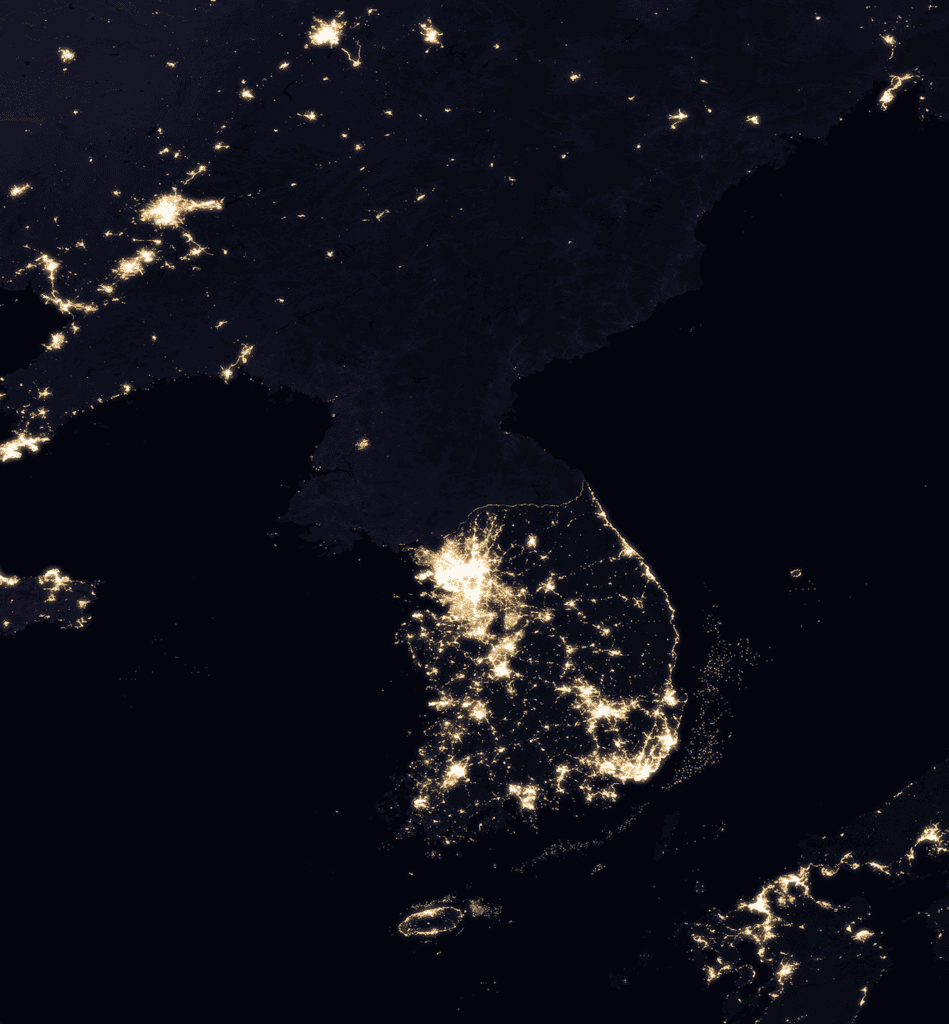
CIA estimates place North Korea’s average income at roughly $1,700 per year, compared to South Korea’s $37,000 — a more than twentyfold difference between two countries that started from the exact same baseline less than a century ago. Millions of North Koreans have starved under the regime’s economic mismanagement, a humanitarian catastrophe with no real equivalent in the South.
South Korea appears lit up like a Christmas tree. North Korea shows almost nothing, a faint dot of light around Pyongyang and darkness everywhere else.
Nothing captures the divide more vividly than nighttime satellite photography. That single image, widely circulated by researchers and journalists, has become one of the most effective visual arguments in the entire socialism debate.
Chile’s Democratic Socialism and U.S. Interference
Chile’s experience complicates the typical narrative because outside interference played a documented role in its outcome. Salvador Allende won election as a democratic socialist president, and the United States actively worked to destabilize his government. CIA records confirm the agency attempted to prevent Allende from winning the election in the first place. Once he took office, Washington shifted toward economic pressure and covert support for opposition groups, and U.S. officials had advance knowledge of coup plans against Allende’s government.
Allende’s socialist policies, including the nationalization of key industries, were already straining Chile’s economy before the 1973 coup that removed him from power. Separating the effects of his domestic policies from the effects of American interference remains genuinely difficult, which is part of why Chile gets cited by both critics and defenders of socialism.
Georgia’s Fast Break From Soviet-Style Socialism
Few countries abandoned Soviet-style economics as quickly or as thoroughly as Georgia did in the mid-2000s. Between 2004 and 2006, the country’s minister of economic reforms, Kakha Bendukidze, pushed through a sweeping set of free-market changes designed to shrink government and unleash private enterprise.
Bendukidze’s approach was aggressive. He slashed the number of employees in the Ministry of Agriculture from 4,374 down to just 600. He replaced Georgia’s progressive income tax, a system the IMF had helped design, with a simple flat-rate tax. The reforms simplified business licensing, removed dozens of regulatory agencies entirely, and privatized businesses that had previously operated under state control. Within a few years, Georgia climbed global ease-of-doing-business rankings faster than almost any other country tracked by the World Bank. The speed of that turnaround makes Georgia one of the clearest modern examples of a former Soviet state choosing to sprint away from its socialist past rather than reform it gradually.
Other Socialist Experiments
The cases above represent the most-studied examples, but the pattern repeats across smaller states as well. Laos adopted a one-party Communist government after 1975 and, like Vietnam, eventually introduced market reforms starting in the late 1980s. Ethiopia’s Derg regime pursued aggressive land collectivization in 1974 and produced widespread famine before collapsing in the early 1990s. Nicaragua’s Sandinista government nationalized banking and agriculture in 1979, weathered a civil war partly funded by the U.S., and lost power in competitive elections by 1990. East Germany was considered one of the more economically successful socialist states within the Soviet bloc, yet still fell dramatically behind West Germany, a gap that became undeniable once the Berlin Wall fell in 1989 and East Germans got a direct look at what they had been missing. In every case, the sequence is similar: promises of equality, nationalization of major industries, falling production, and eventual reform or collapse.
The Human Cost Historians Often Minimize
Economic statistics only tell part of the story. Behind GDP figures and poverty rates sits a human cost that’s harder to quantify but impossible to ignore once you start looking closely at the historical record. Several of the most severe socialist regimes produced death tolls that rank among the worst in modern history, yet these numbers receive far less public attention than comparable atrocities committed by other ideologies.
Democide and the Myth of the “New Socialist Man”
Many socialist regimes justified extreme measures, including forced collectivization and political purges, as necessary steps toward creating what Soviet ideology called the “New Socialist Man”: a citizen reshaped by collective ownership and freed from capitalist self-interest. In practice, the pursuit of this ideological goal frequently caused mass death through famine, forced labor, and political violence. Historians refer to death caused by government policy, as distinct from wartime casualties, as democide, and the term applies extensively to Soviet collectivization campaigns, Chinese famines under Mao, and similar episodes under other socialist regimes.
Leaders often framed brutal policies as temporary sacrifices for a better collective future. The “better future” rarely arrived for the millions who died waiting for it.
Media Coverage Gaps Between Socialist and Nazi Atrocities
Historians have long noted an asymmetry in how Western media and academia have covered socialist versus fascist atrocities. Nazi crimes receive extensive, consistent coverage across textbooks, films, and museums worldwide. Soviet and Maoist-era deaths, despite comparable or larger death tolls, often receive comparatively less sustained attention in Western popular culture. Walter Duranty’s Pulitzer Prize-winning coverage, which downplayed Soviet famine while praising Bolshevik governance, offers one early example of how sympathetic framing shaped Western understanding of socialist regimes for decades:
“I still believe they [the Bolsheviks] are doing the best for the Russian masses and I believe in Bolshevism — for Russia.”
— Walter Duranty, upon accepting the 1932 Pulitzer Prize
Why Young People Today Still Favor Socialism
Despite this extensive historical record, socialism retains significant appeal among younger generations in Western democracies. Surveys consistently show more favorable attitudes toward socialism among younger voters compared to older generations who lived through the Cold War and witnessed Soviet collapse firsthand.
A notable moment came during a 2018 socialism conference in Chicago, where organizers reportedly shifted their framing away from historical examples like the Soviet Union or Venezuela and toward aspirational, undefined future models instead. Critics labeled this a “bait and switch,” arguing that modern socialist advocates often avoid defending actual historical socialist regimes and instead describe socialism in abstract terms disconnected from any real-world implementation.
When pressed on failures like Venezuela or North Korea, many contemporary socialist advocates argue these countries practiced a distorted or corrupted version of “real socialism.” Critics counter that this defense gets applied so consistently, across so many different countries and decades, that it starts to look less like an explanation and more like an unfalsifiable excuse. Every failed attempt gets dismissed as not being “real” socialism, while success stories like China and Vietnam get credited specifically to the moments they abandoned socialist economic policy.
The Pattern That Emerges From Every Case
Looking across every country covered in this history, a clear pattern emerges regardless of continent, culture, or era. Centrally planned economies that eliminate private property and market pricing consistently struggle to match the production efficiency of market-based systems, often resulting in shortages, reduced innovation, and in the most extreme cases, famine and mass death.
Countries that have seen genuine economic improvement after flirting with socialism, including China, Vietnam, and Georgia, all share one thing in common: they moved toward market mechanisms and private property rather than away from them. The data doesn’t suggest socialism simply needs better execution. It suggests the fundamental model runs into the same wall every time it’s tried at scale.
✦ ✦ ✦
Frequently Asked Questions
Has any country successfully stayed socialist long-term?
No country that fully implemented government ownership of the means of production has sustained that model long-term without either collapsing economically or introducing substantial market reforms. Cuba maintains socialist elements today but has allowed limited private enterprise since the 1990s to keep its economy functioning. Even North Korea, often cited as the last truly isolated socialist economy, relies on informal markets and smuggled goods to supplement its failing state distribution system, according to numerous defector accounts and outside researchers.
What’s the difference between socialism and communism?
Socialism refers specifically to government ownership of production, while communism describes a broader political and economic system that eliminates private property entirely and typically concentrates power within a single ruling party. Most 20th-century communist states, including the Soviet Union and Maoist China, treated socialism as a transitional economic phase on the path toward a theoretical communist end state.
Why did Sweden move away from heavy government spending?
Sweden’s government spending climbed from 31 percent of GDP in 1960 to 60 percent by 1980, and during that stretch the country dropped from the fourth-richest nation in the OECD to 14th. Facing declining global competitiveness and slower growth, Swedish policymakers began rolling back some spending and regulatory burdens starting in the 1990s, steering the country back toward its market-economy roots.
Is China still a socialist country today?
Politically, China remains a one-party Communist state. Economically, it has adopted substantial market mechanisms and private enterprise since the Shenzhen reforms, leading many economists to describe it as “fake socialism” or state capitalism rather than traditional socialism. The Communist Party still holds significant influence over major industries, but private businesses now drive much of the country’s economic growth.
Did U.S. sanctions cause Venezuela’s economic collapse?
Venezuela’s economic decline began before American sanctions became a major factor, rooted largely in Hugo Chavez’s decision to rely on oil revenue from the 2000s commodities boom rather than reinvesting in oil infrastructure. Price controls, property seizures, and mismanagement of the state oil company PDVSA all compounded the crisis well before sanctions intensified pressure on an already struggling economy.
✦ ✦ ✦
A Word for Those Who Are Eagerly Waiting
For Christians who are eagerly waiting for the return of Jesus, this historical record carries more than political significance. Both Jesus and the Apostle Paul warned that the final days would be marked by a particular kind of deception. Seductive, plausible, and deeply appealing to human longing. Jesus cautioned his disciples plainly: “Watch out that no one deceives you” (Matthew 24:4). Paul wrote to Timothy that “in later times some will abandon the faith and follow deceiving spirits and things taught by demons” (1 Timothy 4:1). We most often read those warnings in spiritual terms. False prophets, counterfeit signs, theological error.
But we must always think outside the box. Deception rarely announces itself. It arrives dressed as hope. And whether it is wearing the garb of spiritual hope or economic hope, our job is to look below the finery and expose the lie.
Paul’s warning about “doctrines of demons” describes teachings that sound wise but quietly redirect souls away from Christ and toward earthly systems as the source of ultimate hope. The economy touches everyone, our security, our daily bread, our sense of what is possible, and so economic promises carry enormous spiritual weight. A utopia pledged by a political movement is an invitation to place our deepest trust in the wrong place. The pattern this article documents, century after century, is what happens when humanity tries to build heaven without the only King who can create it.
The promise that human suffering can be ended by the right economic arrangement – that a sufficiently managed society will finally produce something approaching paradise – is an ancient lie in modern clothing. It compels because it contains just enough truth to be plausible. Inequality is real. Poverty is real. The longing for a world without want is written into every human heart, because we were made for exactly that world. But that world is not one any government will build. It is the one Jesus Christ Himself will establish when He returns.
For those of us who are eagerly waiting, the antidote isn’t cynicism about suffering or indifference to the poor. Scripture has a great deal to say about both. It is the clarity to see earthly promises for what they are: temporary, fallen, and incapable of delivering what only Christ can.
***
While we’ll never have a perfect world or a perfect government until the Lord returns, we are responsible always to make the wisest decisions we can based on Scripture. In my previous blog, I discussed the passages in God’s Word that relate to the economy: Socialism, Part One: Scripture, and the Signs of the Times


Here are links to my blog indexes, so please click one and keep reading!
My Books, Workbooks, and Fun Books
Knowing the Unknowable One
Opening the Treasure Chest
Walking Heart-to-Heart with God
Walking Heart-to-Heart with Each Other
Fighting the Good Fight of Faith
Christian Mysteries: Why I Love Them!
List of Some Nonfiction Books You Don’t Want to Miss
Index of Assorted Topics