

Introduction
The simple words “Dad, watch this!” capture a universal childhood yearning – to be seen, affirmed, and celebrated by a father. When a child calls out for their father’s attention, they’re seeking more than just an audience; they’re looking for validation, protection, and love. This profound connection between fathers and children shapes our understanding of ourselves and the world around us in ways that echo throughout our lives.
In Romans 8:15, we find a revolutionary concept: “For you did not receive the spirit of slavery to fall back into fear, but you have received the Spirit of adoption as sons, by whom we cry, ‘Abba! Father!'” This passage reveals that the God of the universe invites us into the same intimate relationship that a loving father shares with his children. But what does it mean to call God “Father,” and how does our experience with earthly fathers shape – for better or worse – our understanding of this divine relationship?
The Impact of Human Fatherhood
The Formative Power of Fatherhood

Six-year-old Emma stands at the edge of the pool, toes curled over the concrete lip, her small body trembling with a mixture of excitement and fear. “Daddy, I’m scared,” she whispers. Her father stands waist-deep in the water below, arms outstretched. “I’ve got you, Emma. I won’t let anything happen to you. I’m right here.” She takes a deep breath, closes her eyes, and jumps. For a moment, there’s the shock of cold water, then the security of strong arms catching her. Her father’s proud smile as she surfaces is worth every moment of fear.
This simple scene, played out in countless variations across time and cultures, illustrates a fundamental human truth: a father’s presence creates a secure base from which children can explore their world.
Research consistently confirms what many have experienced firsthand: engaged, loving fathers profoundly shape their children’s development. A 2018 study published in the Journal of Family Psychology found that children with involved fathers demonstrated higher cognitive development scores, better emotional regulation, and more prosocial behavior than peers with absent or uninvolved fathers.
Dr. Kyle Pruett, clinical professor of child psychiatry at Yale School of Medicine, notes in his book Fatherneed that fathers typically interact with children differently than mothers do – often engaging in more physical play, encouraging risk-taking, and using more complex language patterns. These differences aren’t better or worse than maternal approaches, but they provide complementary developmental benefits.
“Children with involved fathers are more likely to exhibit healthy self-confidence, demonstrate emotional intelligence, and form secure attachments in relationships,” Pruett writes. “These benefits extend from early childhood through adolescence and into adulthood, shaping everything from academic achievement to romantic relationships.”
Beyond Provision: The Multifaceted Role of Fathers
While traditional views of fatherhood often focused primarily on economic provision and discipline, modern understanding recognizes the rich tapestry of roles fathers play:
- Protector: Creating physical and emotional safety
- Teacher: Imparting skills, values, and wisdom
- Mentor: Modeling how to navigate the world
- Emotional Anchor: Providing stability during life’s storms
- Affirmation Source: Validating a child’s worth and identity
- Play Partner: Fostering joy, creativity, and resilience

Consider Marco, whose father worked long hours as an auto mechanic to support their family. Each Saturday, however, was sacred “father-son time.” Marco recalls, “Dad would take me to his shop and teach me how engines worked. He’d put his hand over mine to show me how to use tools properly. But he wasn’t just teaching me about cars – he was teaching me patience, problem-solving, and the satisfaction of creating something with your hands. Thirty years later, I still hear his voice when I face a challenge: ‘Step back, think it through, then tackle it one piece at a time’.”
The impact of these father-child connections extends far beyond childhood. A longitudinal study from Harvard University tracked individuals over 75 years and found that the single most powerful predictor of emotional well-being in late adulthood was the quality of relationships with parents, particularly fathers, during childhood.
When Fathers Falter: Acknowledging the Wounds
We must acknowledge that not all fatherhood experiences are positive. Approximately one in four American children grows up without a father in the home, according to U.S. Census Bureau data. Others have fathers who are physically present but emotionally absent, or worse, sources of harm rather than health.
The wounds of absent, neglectful, or abusive fatherhood create their own legacy. Research suggests that children from father-absent homes are more likely to experience behavioral problems, academic struggles, and emotional distress. These patterns can persist into adulthood, manifesting as difficulty trusting others, fear of abandonment, or challenges forming healthy relationships.
Sarah, now 42, reflects on growing up with an alcoholic father: “Dad was like two different people. When sober, he was charming, funny, and could make you feel like the most important person in the world. But when he drank, which was most nights, he became cruel and unpredictable. I grew up never knowing which father would walk through the door. As an adult, I’ve struggled with anxiety and choosing partners who are similarly unpredictable. I’m still learning that love doesn’t have to be chaotic.”
It’s crucial to recognize these painful realities while avoiding both oversimplification and determinism. Many individuals overcome difficult father relationships through resilience, support systems, and sometimes the mentorship of father figures who step into the gap.
Fatherhood Redefined: Beyond Biology and Stereotypes
Modern understanding of fatherhood has expanded beyond biological connections and rigid cultural stereotypes. Foster fathers, stepfathers, adoptive fathers, grandfathers, uncles, mentors, coaches, and teachers can all fulfill vital fathering roles in children’s lives.

James, raised by his grandfather after his parents’ deaths, shares: “Grandpa stepped into a role he never expected at age 67. He taught me to shave, helped me with homework, and showed up to every basketball game. He wasn’t perfect – sometimes his advice was outdated, and he struggled to understand my music – but his commitment never wavered. He showed me that fatherhood isn’t about age or biology; it’s about choice, consistency, and love.”
Similarly, cultural expectations of fatherhood continue to evolve. While traditional models often emphasized emotional stoicism and disciplinary authority, contemporary understandings embrace fathers’ capacity for nurturing, emotional responsiveness, and collaborative parenting partnerships.
Research validates this evolution. A 2020 study from Brigham Young University found that fathers who displayed emotional openness and physical affection had children with higher emotional intelligence and greater relationship satisfaction later in life.
God as Father: A Divine Paradigm
The Revolutionary Concept: “Abba Father”
When Jesus taught his disciples to pray beginning with “Our Father in heaven” (Matthew 6:9), he introduced a radical concept. In the religious landscape of first-century Judaism, God was seen primarily as the transcendent Creator and righteous Judge – holy, separate, and approached with reverent fear. While there were Old Testament references to God’s fatherly nature, Jesus expanded this understanding dramatically.
Most striking was Jesus’ use of “Abba” when addressing God – an Aramaic term akin to “Daddy” or “Papa.” This intimate, familiar language shocked religious authorities but revealed the heart of Jesus’ message: God desires relationship, not just reverence; intimacy, not just obedience.
New Testament scholar Kenneth Bailey notes that in Middle Eastern culture, fathers were traditionally addressed with formal titles conveying respect. “By using ‘Abba,’ Jesus wasn’t being disrespectful but was revealing a profoundly intimate connection with God that he invited his followers to share.”
This invitation extends to us through adoption, as Paul explains in Romans 8:15. The same Spirit who enabled Jesus to call God “Abba” now enables us to do the same. This adoption isn’t metaphorical or sentimental. It’s a legal, transformative reality that fundamentally changes our identity and relationship with God.
Perfect Fatherhood: The Divine Model
If human fathers at their best provide glimpses of what good fatherhood looks like, God represents the perfect archetype – the father who is:
- Consistently present: “I will never leave you nor forsake you” (Hebrews 13:5)
- Unconditionally loving: “I have loved you with an everlasting love” (Jeremiah 31:3)
- Wisely guiding: “I will instruct you and teach you in the way you should go” (Psalm 32:8)
- Protectively watchful: “He who keeps you will not slumber” (Psalm 121:3)
- Generously providing: “Your Father knows what you need before you ask him” (Matthew 6:8)
- Patiently correcting: “The Lord disciplines the one he loves” (Hebrews 12:6)
Consider the father in Jesus’ parable of the prodigal son (Luke 15:11-32). This father breaks cultural norms by running to embrace his wayward son, restoring him to full family status despite his failures. He celebrates his return extravagantly and defends him against his brother’s resentment. This picture – radical in Jesus’ time and still countercultural today – illustrates God’s fatherhood.
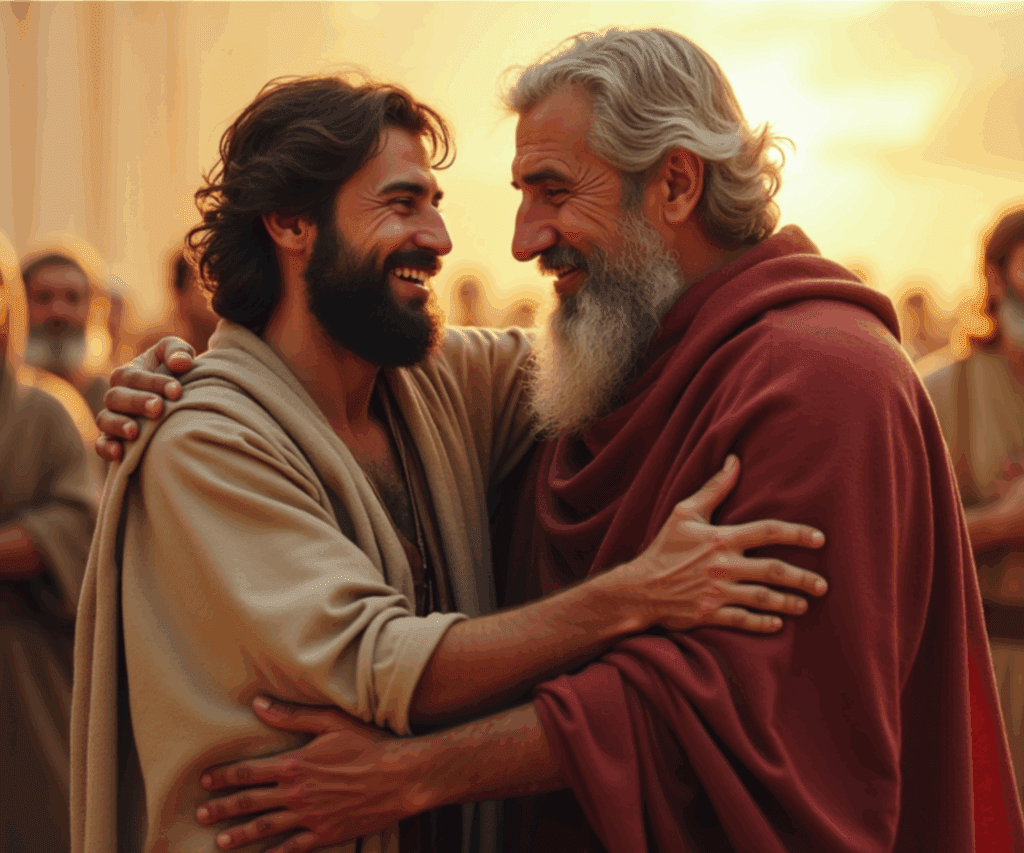
Healing Broken Images: Restoration Through Divine Fatherhood
For those with positive father experiences, understanding God as Father can feel natural and intuitive. But what about those whose experiences with fathers have been marked by absence, disappointment, or harm?
Psychologists and theologians alike recognize that our experiences with human fathers inevitably color our perception of God as Father. Yet paradoxically, experiencing God’s perfect fatherhood can begin healing those distorted images.
Dr. Robert Hillman, clinical psychologist and author of “Healing the Father Wound,” shares from both professional experience and personal journey: “I grew up with a father who was physically present but emotionally unavailable. I transferred those expectations to God – seeing Him as distant, demanding, and impossible to please. My healing began when I allowed Scripture to reshape my understanding of God’s fatherhood rather than filtering it through my experience.”
This process often requires intentional “unlearning” of distorted father images. For some, it means recognizing that God’s correction comes from love, not anger. For others, it means internalizing that God’s love isn’t performance-based. For many, it means truly believing that God won’t abandon them when they fail.
Maria, a survivor of childhood abuse, describes her journey: “I couldn’t call God ‘Father’ for years – it triggered too much pain. My healing began when my pastor suggested I start with what I knew God wasn’t like. He wasn’t cruel. He wasn’t unpredictable. He wasn’t abusive. Gradually, I could begin exploring what He was like, building a new understanding of fatherhood based on His character rather than my experience.”
Adoption and Inheritance: The Privileges of Divine Sonship
The biblical concept of adoption carries profound implications beyond our relationship with God. In Roman culture, where Paul wrote many of his letters, adoption was a well-established legal process with specific consequences:
- New Identity: The adopted person took on the family name and identity.
- Legal Standing: They gained the same legal rights as biological children.
- Inheritance Rights: They received full inheritance privileges.
- Debt Cancellation: All previous debts were considered paid.
- New Father’s Authority: They came under the authority and protection of the new father.
When Paul describes believers as “adopted as sons,” he invokes this entire framework. Our divine adoption means receiving a new identity in Christ, legal standing before God, inheritance rights to eternal life, cancellation of sin’s debt, and placement under God’s loving authority.
This adoption isn’t a consolation prize or secondary relationship; it’s a deliberately chosen connection. As theologian J.I. Packer writes in Knowing God: “If you want to judge how well a person understands Christianity, find out how much they make of the thought of being God’s child, and having God as their Father.”
Living in the Father’s Love
From Orphan to Heir: Identity Transformation
Perhaps the most profound impact of understanding God’s fatherhood is the transformation of our fundamental identity. Rather than spiritual orphans – alone, unprotected, and undefined – we become children and heirs of the King of Kings.
This identity shift affects everything from our self-perception to how we face challenges. Research in positive psychology confirms that our core beliefs about ourselves and our place in the world significantly influence our emotional health, decision-making, and resilience.
Nathan, a former foster child who aged out of the system without being adopted, describes his spiritual journey: “I grew up with no permanent home and no consistent adults. When I encountered the concept of God as Father who chooses me and won’t abandon me, it slowly rewired my entire self-image. I went from seeing myself as fundamentally unwanted to seeing myself as specifically chosen. That change has affected every relationship and decision since.”
Reflecting the Father: Becoming Better Parents Ourselves
As we experience God’s perfect fatherhood, we naturally become better equipped to parent our own children or mentor others. The patterns of love, presence, and wisdom we receive from God provide a template for our relationships.

Mark, a father of three, shares: “Before understanding God as my Father, I parented out of obligation and anxiety, always worried I wasn’t doing enough or doing it right. Now I parent from a place of fullness, passing on the love and acceptance I’ve received. I’m not a perfect father, but I’m a more grace-filled one because I’ve experienced grace firsthand.”
This doesn’t mean that only those who understand God as Father can be good parents. Many excellent parents come from diverse spiritual backgrounds. However, experiencing divine fatherhood provides unique resources for parenting:
- A model of balanced discipline and grace
- An understanding of unconditional love that isn’t based on performance
- A source of wisdom beyond our limited perspective
- Forgiveness for our inevitable parenting mistakes
- Strength and patience beyond our natural capacity
A Global Family: The Unifying Power of Divine Fatherhood
When we recognize God as Father, we also gain countless spiritual siblings. This divine family transcends the barriers that typically divide humanity – ethnicity, nationality, social class, education level, and more.
The early Christian movement was revolutionary precisely because it created family bonds between people who would otherwise have remained separated by societal boundaries. Slaves and masters, Jews and Gentiles, men and women all became brothers and sisters through their shared relationship with God the Father.

This reality remains revolutionary today. David, a pastor who leads reconciliation work between historically divided communities, observes: “When people truly grasp that they share the same Father, it becomes much harder to maintain barriers of hostility. Not impossible – we’re still human – but the theological foundation for unity is powerful. I’ve watched people who began as enemies embrace as family when they recognized their common adoption.”
The Father’s Voice: Practical Ways to Experience God’s Fatherhood
Understanding God as Father intellectually differs from experiencing His fatherhood daily. Here are some practical ways to deepen this relationship:
- Study biblical passages about God as Father with fresh eyes, imagining how they might sound to someone hearing them for the first time.
- Pray specifically about your father wounds or gaps, inviting God to heal and fill those specific places.
- Practice “Abba prayer” where you simply sit in God’s presence and address Him intimately as Jesus did.
- Keep a “Father’s provision journal” documenting ways God has cared for your needs, building evidence of His faithfulness.
- Participate in community where you can observe how others experience God as Father, expanding your understanding.
- Extend fatherly love to others, particularly those who lack father figures, becoming a channel of what you’ve received.
- Rest in being a beloved child rather than striving to earn approval through performance.
Conclusion: Coming Home to the Father
The journey of understanding and experiencing God as Father is lifelong. For some, it’s a natural extension of positive earthly fatherhood. For others, it’s a healing contrast to painful experiences. For all, it’s a relationship that continuously deepens and evolves.

As we embrace our identity as beloved children of a perfect Father, we find ourselves living from a place of security rather than fear, acceptance rather than performance, and belonging rather than isolation. Whether your experience with human fathers has been positive, painful, or somewhere in between, the invitation remains open: come home to the Father who has always been waiting with open arms.
In the words of Henri Nouwen: “The Father is always looking for you. Every time you approach home, the Father is already there, waiting, watching. And His only desire is to welcome you home.”

***


Here are links to my blog indexes, so please click one and keep reading!
My Books, Workbooks, and Fun Books
Knowing the Unknowable One
Opening the Treasure Chest
Walking Heart-to-Heart with God
Walking Heart-to-Heart with Each Other
Fighting the Good Fight of Faith
Christian Mysteries: Why I Love Them!
List of Some Nonfiction Books You Don’t Want to Miss
Index of Assorted Topics
The bond between a father and child is truly special, as it provides a foundation of love and security. Emma’s leap into the pool shows how a father’s presence can turn fear into confidence. This moment highlights the importance of fathers in shaping their children’s courage and self-esteem. Research supports the idea that involved fathers positively impact their children’s development. How can society better support fathers in being more engaged in their children’s lives? WordAiApi
That’s a great question! Do you have any suggestions?