

Article-at-a-Glance: The Evolution of Antichrist Imagery
- The Antichrist figure has evolved from a purely biblical concept into a powerful cultural symbol that reflects society’s deepest fears across different historical periods.
- Medieval artwork established the visual language of the Antichrist, depicting him with specific attributes like horns, dragon associations, and grotesque physical features that continue to influence modern interpretations.
- During the Reformation, Antichrist imagery became a political weapon, with opposing religious factions casting their enemies as the embodiment of evil through widely distributed woodcut prints.
- The 20th century saw the Antichrist concept shift from religious to secular contexts, with dictators like Hitler and Stalin being portrayed with apocalyptic imagery in wartime propaganda.
- Modern digital media and Hollywood have dramatically expanded the Antichrist’s visual vocabulary, creating a globally recognized aesthetic that transcends religious boundaries while maintaining core symbolic elements from biblical texts.
The Antichrist figure has undergone one of the most fascinating visual evolutions in Western cultural history. From obscure biblical references to Hollywood blockbusters, this embodiment of ultimate evil has reflected humanity’s deepest fears while serving as a mirror to society’s changing anxieties. Art Historians Guild researchers have documented how this imagery has been continuously reimagined to maintain its power across vastly different historical contexts, demonstrating art’s ability to adapt ancient archetypes for contemporary audiences.
How the Antichrist Became a Cultural Icon
The transformation of the Antichrist from biblical concept to cultural phenomenon represents one of history’s most remarkable examples of visual evolution. What began as cryptic references in ancient texts has morphed into a universally recognized symbol that transcends religious boundaries. This visual journey reflects not just changing artistic styles, but deeper shifts in human psychology, social structures, and technological capabilities. The Antichrist image has continuously adapted to embody whatever a society fears most – whether theological corruption, political tyranny, or technological dystopia.
Biblical Roots: The Original Antichrist Concept
The Antichrist as we understand it today emerged from a surprisingly limited textual foundation. Despite popular belief, the specific term “Antichrist” appears only five times in the Bible, all within the epistles of John. However, the concept drew significant influence from apocalyptic imagery in Daniel and Revelation, where beasts with multiple heads and horns rise from the sea. These early descriptions were purposefully symbolic rather than literal, designed to communicate theological concepts through powerful visual metaphors that would resonate with early Christian communities facing persecution.
Key Passages in Daniel and Revelation
The Book of Daniel introduced the template for apocalyptic beasts that would later influence Antichrist imagery, particularly in Chapter 7 where four beasts emerge from the sea representing successive empires. Revelation expanded this visual language dramatically, describing a seven-headed beast that “was given authority over every tribe, people, language and nation.” These cryptic descriptions provided artists with both creative freedom and symbolic guidelines that would shape visual representations for centuries. Early interpreters understood these passages as coded references to Roman persecution, creating a tradition of associating the Antichrist with contemporary political powers.
The vivid language in Revelation 13 offered particularly fertile ground for artistic interpretation: “And I stood upon the sand of the sea, and saw a beast rise up out of the sea, having seven heads and ten horns, and upon his horns ten crowns, and upon his heads the name of blasphemy.” This combination of familiar animal features arranged in supernatural configurations established a pattern of representing the Antichrist as simultaneously recognizable and unnaturally distorted – a visual strategy that continues in contemporary horror imagery.
The Number 666: Origins and Significance
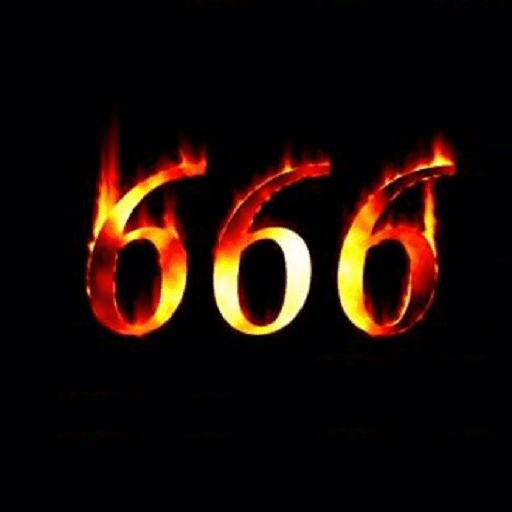
Perhaps no element of Antichrist symbolism has penetrated popular culture more thoroughly than the number 666. Revelation 13:18 introduced this cryptic identifier: “Here is wisdom. Let him that hath understanding count the number of the beast: for it is the number of a man; and his number is Six hundred threescore and six.” Early Christians likely understood this as a numerical code referring to Emperor Nero through gematria, a system where letters correspond to numbers in Hebrew. The triple six pattern represented human imperfection (falling short of the divine number seven) repeated three times, suggesting complete moral failure.
Visual representations of 666 evolved from subtle inclusions in medieval manuscripts to overt modern references. Medieval illuminators might hide the number within decorative elements, while Renaissance artists incorporated it into complex visual allegories. By the 20th century, the number had become so synonymous with the Antichrist that it could stand alone as a visual shorthand, appearing on foreheads, hands, or integrated into corporate logos in films like “The Omen,” demonstrating how biblical symbols can become untethered from their original contexts while retaining their emotional impact.
Early Christian Interpretations
The earliest visual interpretations of the Antichrist emerged in a context where Christianity was transitioning from persecuted sect to imperial religion. Church fathers like Irenaeus, Hippolytus, and Augustine developed theological frameworks that would guide artistic representations, emphasizing the Antichrist as a false messiah who would deceive through miraculous signs and apparent virtue. This concept of dangerous deception influenced early depictions, which often showed the Antichrist with seemingly holy attributes – like a false halo – that revealed their true nature only upon closer inspection.
Byzantine art established important visual precedents by depicting the Antichrist with specific attributes that would become standard: horns hidden in hair, association with dragons or serpents, and an ability to transform appearance. These early images appeared primarily in illuminated manuscripts with limited circulation among the educated elite. The Antichrist was represented less as a monster and more as a deceptive human figure, reflecting theological concerns about false teaching rather than apocalyptic destruction – a nuance that would gradually disappear as imagery became more sensationalized for broader audiences. For more insights, you can explore the Revelation 13:11-18 interpretation at Alliance Bible Fellowship.
Medieval Fear: When Satan Ruled Imagination
The medieval period marked a critical turning point in Antichrist imagery, as abstract theological concepts materialized into vivid visual forms accessible to largely illiterate populations. Church authorities recognized the power of visual storytelling to communicate complex religious ideas, leading to an explosion of Antichrist representations in architecture, manuscripts, and altar pieces. This era established the visual vocabulary that would influence representations for centuries to come, including physical deformities, demonic associations, and scenes of false miracles designed to deceive the faithful.
Church Artwork and Illuminated Manuscripts
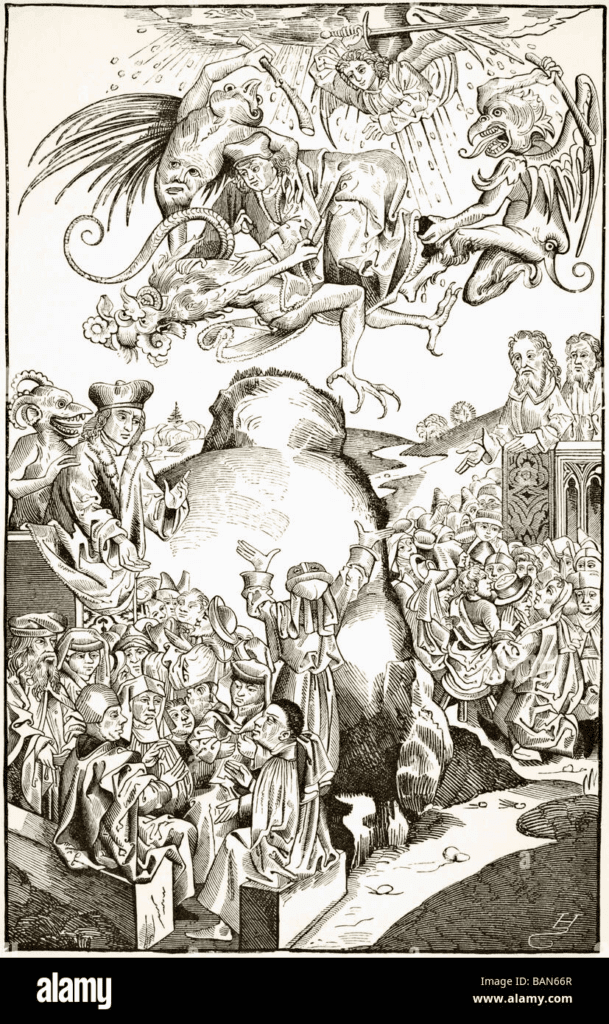
Cathedral sculpture and illuminated manuscripts became the primary vehicles for Antichrist imagery during the 11th-13th centuries. The “Hildegard of Bingen’s Scivias” (12th century) contained some of the most influential early depictions, showing the Antichrist as a beast-headed figure emerging from the Church itself – reflecting growing concerns about internal corruption. The spectacular Liber Floridus (c.1120) depicted the Antichrist as simultaneously human and monstrous, setting a precedent for the uncanny visual quality that would become characteristic of these representations.
By the 13th century, illuminated apocalypse manuscripts became extraordinarily popular among wealthy patrons, with the Morgan, Trinity, and Lambeth Apocalypses showcasing increasingly detailed Antichrist narratives. These works established a sequential approach to depicting the Antichrist’s life that paralleled and perverted Christ’s life story – from miraculous birth to false death and resurrection. Artists developed visual shorthands, including yellow skin (signifying Jewish associations in medieval antisemitic iconography), reversed halos, or subtly demonic features visible only to the faithful viewer, creating multi-layered images that rewarded careful examination.
[Photo credit: “Reign of antichrist devil satan ages …” from www.alamy.com and used with no modifications.]
The Antichrist as Social Control
Medieval Antichrist imagery served explicit social control functions beyond religious instruction. Church authorities used these frightening visuals to reinforce conformity during periods of social upheaval, connecting heretical movements, social dissent, and religious minorities with apocalyptic consequences. The famous Bamberg Apocalypse (c.1000) visually associated political enemies of the Holy Roman Empire with the Antichrist, demonstrating how seamlessly religious imagery served political purposes.
Visual programs in churches frequently positioned the Antichrist narrative within a cosmic moral framework that emphasized the consequences of sin and disobedience. The north transept portal of Notre Dame Cathedral (c.1250-1260) juxtaposed Last Judgment scenes with Antichrist narratives, making explicit the connection between individual moral choices and collective eschatological outcomes. These sophisticated visual arguments transformed abstract theological concepts into immediate emotional experiences accessible to all social classes, demonstrating medieval artists’ profound understanding of visual rhetoric.
Popular Depictions During the Black Death
The catastrophic Black Death (1347-1351) triggered an intensification of apocalyptic imagery, as communities struggled to comprehend unprecedented suffering. Antichrist imagery proliferated in response, with new emphasis on his role as harbinger of the end times. The Velislav Bible (c.1340) and similar picture bibles expanded their Antichrist sections, showing him commanding armies of demons that spread disease – directly connecting contemporary suffering with biblical prophecy.
Post-plague artwork introduced increasingly graphic elements, with the Antichrist depicted not just as deceptively human but as physically grotesque. The Wellcome Apocalypse manuscript (c.1420) shows him with animal limbs poorly disguised beneath robes, reflecting growing skepticism about authority figures and heightened awareness of bodily corruption. These images helped communities process collective trauma by providing supernatural explanations and moral frameworks for suffering that otherwise seemed random and meaningless.
Theatrical Representations in Mystery Plays

Medieval mystery plays brought Antichrist imagery to life through theatrical performance, creating some of the most memorable and influential representations of the period. The Chester Mystery Cycle and York Corpus Christi plays included elaborate Antichrist sequences featuring actors using trapdoors, pyrotechnics, and mechanical devices to create supernatural effects. These performances transformed two-dimensional manuscript images into dynamic, multi-sensory experiences that could reach entire communities simultaneously.
Theatrical conventions established during this period had lasting influence on visual depictions. The convention of showing the Antichrist’s entrance from beneath the stage (suggesting hellish origins) translated into artistic compositions showing him emerging from the ground. Similarly, the theatrical practice of having demons visibly manipulate the Antichrist character (often visible to the audience but not to other characters) established the visual tradition of showing subtle demonic presences in Antichrist scenes, a motif that would persist through Renaissance painting and beyond.
[Photo credit: “The Renaissance Antichrist: Riess …” from www.amazon.com and used with no modifications.]
Political Weaponization During the Reformation
The Reformation period witnessed a radical transformation in Antichrist imagery as it became weaponized in the religious conflicts dividing Europe. Technological innovations in printing allowed for unprecedented dissemination of visual propaganda, with both Protestant and Catholic factions deploying Antichrist imagery against opponents. This period marked a crucial shift from the Antichrist as an eschatological future figure to an immediate present reality supposedly embodied by religious adversaries.
The mass reproduction capabilities of woodcuts and engravings democratized access to these powerful images, extending their reach beyond church walls and illuminated manuscripts to ordinary households. This wider circulation fundamentally changed how Antichrist imagery functioned in society, transforming it from primarily instructional religious iconography to potent political symbolism that could mobilize populations against perceived enemies.
Martin Luther vs. The Pope
Martin Luther’s strategic deployment of Antichrist imagery against papal authority represented one of history’s most successful visual propaganda campaigns. His collaboration with artist Lucas Cranach the Elder produced the influential “Passional Christi und Antichristi” (1521), which used contrasting images to juxtapose Christ’s humility with papal luxury. These paired woodcuts created a devastating visual argument identifying the papacy with the Antichrist, showing Christ washing disciples’ feet opposite the Pope having his feet kissed – simple, powerful imagery accessible even to illiterate viewers.
Catholic authorities responded with equally potent counter-imagery, depicting Luther himself with demonic attributes. The remarkable “Septceps Lutherus” (Seven-Headed Luther) pamphlet showed the reformer as a seven-headed monster directly referencing the beast of Revelation, while other Catholic propaganda depicted him consulting with demons or destroying the Church. This visual battle demonstrated how thoroughly Antichrist imagery had become detached from its eschatological origins to serve immediate political objectives, establishing patterns of demonizing opponents that would persist in political cartoons for centuries.
Woodcut Propaganda and Mass Communication
The technical limitations of woodcut printing paradoxically enhanced the effectiveness of Reformation-era Antichrist imagery. Artists developed bold, high-contrast styles with simplified forms that reproduced clearly and communicated instantly, establishing visual conventions that would influence political cartooning for centuries. Pamphlets like “The Birthplace and Origin of the Pope” (1545) used crude but effective visual metaphors showing the Pope being excreted by devils, combining scatological humor with religious condemnation in ways accessible across social classes.
Print distribution networks transformed how Antichrist imagery spread, with traveling merchants carrying identical images across vast geographical areas and creating unprecedented visual consistency across regions. This standardization helped construct collective imaginations of the enemy “other,” with recognizable visual attributes (papal tiaras, Luther’s distinctive profile) serving as shorthand for complex theological disputes. The resulting visual language became increasingly standardized, allowing viewers to immediately identify heroes and villains through established symbolic conventions.
Shifting from Religious to Political Symbol
By the late 16th century, Antichrist imagery had expanded beyond strictly religious contexts to encompass broader political threats. Spanish propagandists depicted Elizabeth I of England with Antichrist attributes, while English posters showed the Spanish Armada as apocalyptic beasts. This secularization process accelerated during the Thirty Years’ War, when apocalyptic imagery became standard in political communication across Europe, regardless of specific religious affiliations.
This gradual secularization established important precedents for how Antichrist imagery would function in later periods. The core visual language – monstrous attributes, deceptive appearances, control over masses – remained consistent while the specific targets shifted according to political necessities. This adaptability ensured the continued relevance of Antichrist imagery as a propaganda tool even as Europe’s religious unity fractured, demonstrating how effectively these ancient symbols could be repurposed to address contemporary fears.
Enlightenment to Victorian Era: Rational Devils
The Enlightenment’s emphasis on reason and empiricism fundamentally challenged traditional Antichrist imagery by questioning the supernatural framework that had sustained it. Artists and intellectuals of this period reimagined the Antichrist as a symbolic rather than literal figure, often representing irrational thinking itself. William Blake’s revolutionary illustrations merged apocalyptic imagery with political critique, depicting reason and imagination in cosmic battle. His “The Great Red Dragon” series created a visual vocabulary that bridged medieval apocalypticism with modern psychological symbolism.
As the Victorian era dawned, the Antichrist concept underwent further transformation through scientific and industrial progress. Romantic artists like John Martin created spectacular apocalyptic landscapes where natural disasters appeared indistinguishable from divine judgment. The Industrial Revolution with its polluted cities, mechanical monstrosities, and social upheaval provided fertile visual material for updated apocalyptic imagery, with smokestacks and factories replacing medieval towers in scenes of destruction.
Scientific Revolution’s Impact on Supernatural Beliefs
The Scientific Revolution fundamentally altered how educated Europeans conceptualized the Antichrist. Enlightenment thinkers increasingly viewed traditional apocalyptic imagery as superstitious remnants of a less rational age. Francisco Goya’s “The Sleep of Reason Produces Monsters” (1797-1799) encapsulated this new perspective, suggesting that humanity’s nightmares – including the Antichrist – emerged from abandoned rationality rather than external supernatural forces. This interpretive shift transformed Antichrist imagery from literal prophecy to psychological metaphor, a profound conceptual change that would accelerate throughout the 19th century.
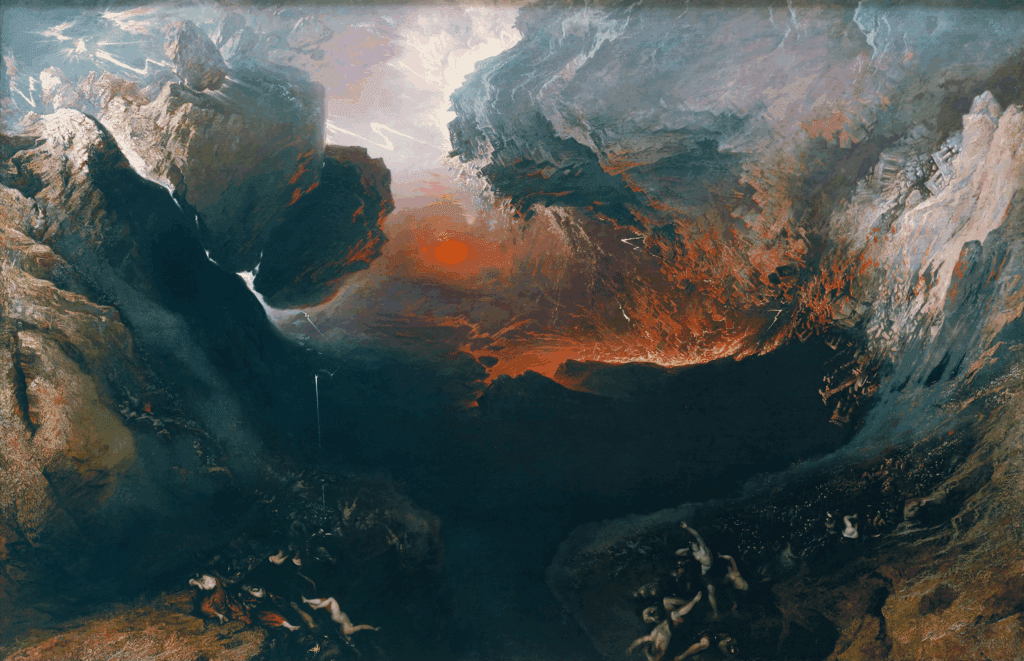
Scientific advances provided new visual vocabulary for apocalyptic imagery. Geological discoveries about extinction events and astronomical observations of cosmic phenomena offered artists secular apocalyptic scenarios that maintained emotional resonance while dispensing with traditional religious frameworks. John Martin’s “The Great Day of His Wrath” (1851-1853) depicts mountain ranges collapsing in a manner consistent with geological understanding while maintaining biblical apocalyptic drama, demonstrating how scientific knowledge could refresh rather than eliminate apocalyptic visual traditions.
Literary Antichrists in Gothic Fiction
Gothic literature reimagined the Antichrist for an increasingly secular readership, focusing on psychological terror rather than theological warnings. Characters like Mary Shelley’s Frankenstein monster embodied Antichrist attributes – unnatural creation, superhuman abilities, ambiguous moral status – while functioning within narratives concerned more with human hubris than divine punishment. These literary innovations influenced visual arts, with illustrations for Gothic novels establishing new Antichrist imagery conventions that emphasized psychological uncanniness over traditional demonic representations.
Illustrations for apocalyptic literature created enduring visual interpretations that significantly influenced public imagination. Gustave Doré’s engravings for Milton’s “Paradise Lost” (1866) and Dante’s “Inferno” (1857) visualized Satan and hellish landscapes with unprecedented detail and emotional intensity. Though not explicitly depicting the Antichrist, these widely reproduced images established visual standards for representing ultimate evil that would inform later Antichrist depictions across media. Their photographic realism combined with fantastic subject matter created a disturbing verisimilitude that remains powerful in contemporary horror imagery.
Secret Societies and Antichrist Conspiracy Theories
The 18th and 19th centuries witnessed the proliferation of conspiracy theories linking secret societies like the Illuminati and Freemasons to Antichrist narratives. Political caricaturists incorporated masonic symbols, all-seeing eyes, and hidden hands into illustrations suggesting global manipulation by unseen forces. These visual conspiracies appealed particularly during periods of rapid social change, when traditional power structures seemed threatened by invisible forces, demonstrating the Antichrist concept’s remarkable adaptability to shifting social anxieties.
Anti-Semitic Antichrist imagery intensified during this period, with publications like “La France Juive” (1886) promoting conspiracy theories that explicitly linked Jewish communities with apocalyptic evil. Illustrations in these works recycled medieval Antichrist attributes but applied them to contemporary Jewish figures, showing how ancient visual hatred could be reactivated for modern political purposes. This toxic tradition would reach its horrific culmination in Nazi propaganda, demonstrating the real-world dangers when apocalyptic imagery becomes attached to identifiable human groups.
20th Century Dictators as “Living Antichrists”
The unprecedented horrors of 20th-century totalitarianism provided Antichrist imagery with renewed relevance and urgency. World War propaganda on all sides deployed apocalyptic visual language, with dictators like Hitler and Stalin depicted with traditional Antichrist attributes including horns, beast associations, and control over masses through deception. These representations transcended religious boundaries, appearing in secular contexts while maintaining recognizable apocalyptic visual elements. The Antichrist image had completed its evolution from religious prophecy to universal symbol of political evil, accessible across diverse cultural and religious backgrounds.
Hitler, Stalin, and World War Propaganda
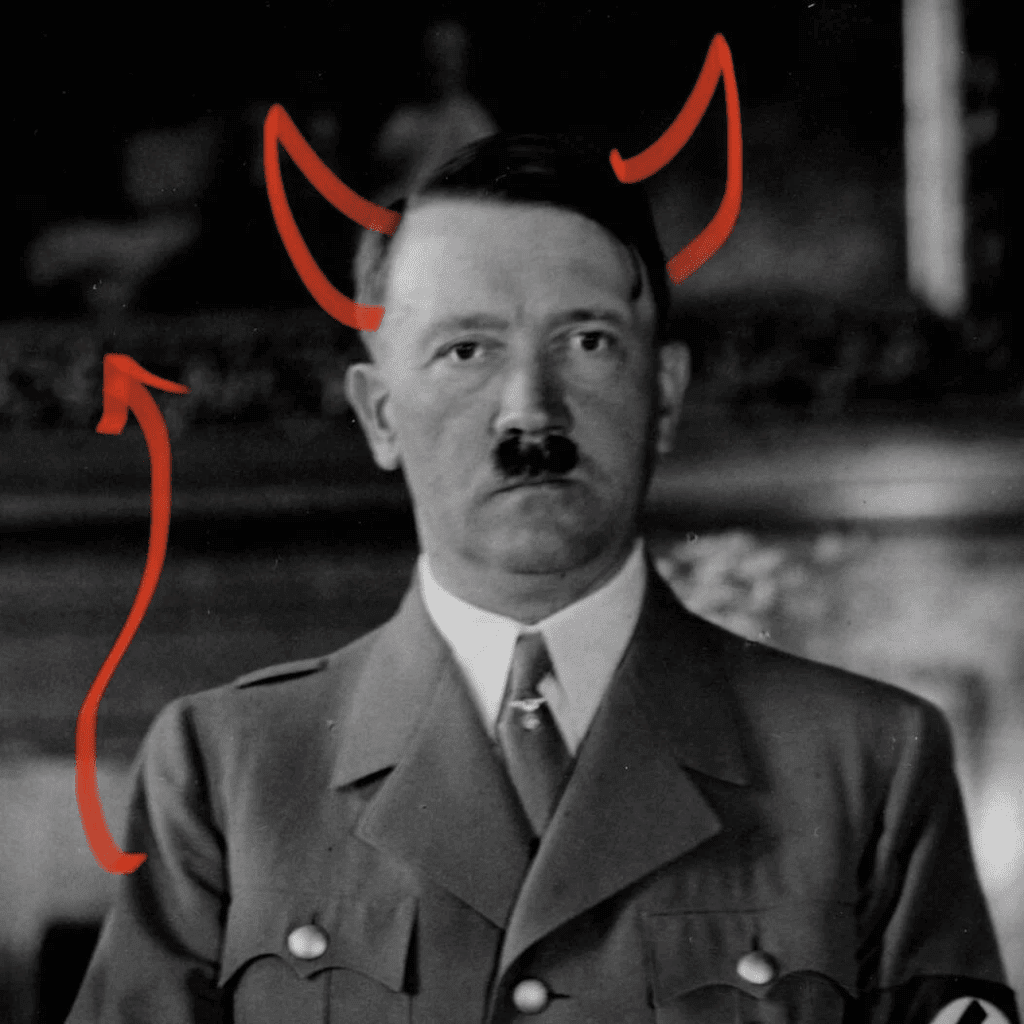
Wartime propaganda across nations portrayed enemy leaders with explicit Antichrist attributes, demonstrating how thoroughly this ancient religious imagery had penetrated secular visual culture. American propaganda posters showed Hitler with horns and demonic features, while Soviet artists depicted him as a beast rising from the abyss in direct reference to Revelation imagery. British publications like Punch magazine regularly portrayed both Hitler and Mussolini with apocalyptic motifs, showing the remarkable persistence of medieval visual vocabulary in modern political contexts.
What distinguished 20th-century Antichrist imagery was its photographic realism combined with symbolic elements, creating particularly disturbing visual propaganda. Photomontage techniques pioneered by artists like John Heartfield allowed Hitler’s actual photographic likeness to be manipulated with symbolic additions like horns, scales, or beast attributes, blurring the line between documentary reality and apocalyptic symbolism. This technological innovation created unprecedented visual impact, making abstract theological concepts seem immediately present in contemporary political figures.
Cold War Symbolism and Nuclear Fears
The Cold War era shifted Antichrist imagery from individual dictators to systemic threats, particularly nuclear annihilation. Civil defense materials often employed apocalyptic imagery without explicit religious references, showing mushroom clouds and devastated landscapes that visually echoed traditional End Times illustrations. The famous “Doomsday Clock” created by the Bulletin of Atomic Scientists in 1947 secularized apocalyptic time-keeping, replacing biblical prophecy with scientific assessment while maintaining the emotional resonance of imminent catastrophe.
This period also witnessed the Antichrist concept explicitly entering American evangelical visual culture through prophecy charts and illustrated study Bibles. The Scofield Reference Bible’s dispensationalist framework popularized a specific interpretation of the Antichrist as a future world leader, visualized in complex prophetic timelines and charts. These materials established visual conventions – the Antichrist as suited businessman or diplomat rather than obvious monster – that would profoundly influence later evangelical visual culture and eventually mainstream media depictions.
Popular Culture Adaptations
Comic books and pulp fiction magazines introduced Antichrist imagery to mass audiences through characters combining traditional apocalyptic attributes with contemporary contexts. EC Comics’ horror titles featured numerous Antichrist-inspired narratives with striking visual interpretations that influenced generations of artists. Superman comics occasionally depicted Lex Luthor with subtle Antichrist attributes, demonstrating how apocalyptic visual language had been thoroughly integrated into secular storytelling traditions while maintaining recognizable connections to biblical sources.
Television expanded Antichrist imagery’s reach through programs like “The Twilight Zone” and “The Outer Limits,” which frequently incorporated apocalyptic themes. Rod Serling’s iconic anthology series regularly featured false messiahs, deceptive leaders, and technology gone awry – all traditional Antichrist motifs translated for contemporary audiences. These adaptations demonstrated the Antichrist concept’s remarkable versatility, as it shifted from explicitly religious contexts to broader explorations of technology, authority, and deception in modern society.
Hollywood’s Fascination: From “Rosemary’s Baby” to “Left Behind”
Cinema revolutionized Antichrist imagery by combining sophisticated visual techniques with unprecedented audience reach. Films like “Rosemary’s Baby” (1968) and “The Omen” (1976) established visual conventions that would dominate popular imagination, including subtle physical attributes (Damien’s 666 birthmark), ominous musical motifs, and systematic narrative structures tracing the Antichrist’s development. These films democratized previously esoteric theological concepts, making apocalyptic imagery accessible to secular audiences worldwide while dramatically expanding its visual vocabulary through cinematic techniques impossible in static media.
“The Omen” and Horror Genre Conventions

Richard Donner’s “The Omen” (1976) represents a watershed moment in Antichrist visual representation, establishing conventions that would influence both religious and secular imagery for decades. The film’s strategic use of seemingly innocent childhood imagery juxtaposed with subtle demonic elements created a uniquely disturbing visual aesthetic. Its innovative death sequences, combining graphic violence with supernatural causality, established a template for visualizing the Antichrist’s power that countless horror films would imitate.
The film’s most significant innovation was portraying the Antichrist as a child rather than an adult, contradicting traditional representations while creating disturbing new emotional resonances. The iconic image of Damien Thorn on a tricycle – innocent in appearance but harboring hidden evil – became one of cinema’s most recognizable Antichrist representations, demonstrating how visual innovations could rejuvenate ancient concepts for contemporary audiences. The film’s commercial success proved that apocalyptic imagery retained powerful cultural relevance even in increasingly secular societies, inspiring numerous sequels and imitators that further embedded these visual conventions in popular culture.
“Looking back at the evolution of Antichrist imagery in cinema reveals not just changing visual techniques, but shifting cultural anxieties. From The Omen’s fear of corrupted innocence in the 1970s to modern digital-era fears of technological control and surveillance, each generation reimagines this ancient archetype through their own cultural lens.” – Dr. Angela Harrison, Film Studies Professor at Columbia University
Recent decades have witnessed increasingly sophisticated cinematic Antichrist representations that blend traditional attributes with contemporary concerns. Films like “End of Days” (1999) and “Constantine” (2005) incorporated digital effects to visualize the Antichrist’s supernatural powers, while “The Devil’s Advocate” (1997) explored corporate power and moral corruption through explicitly apocalyptic imagery. These productions demonstrate cinema’s unique capacity to continuously refresh ancient symbolic systems through technological innovation and contemporary settings.
Evangelical Literature’s Market Explosion
The late 20th century witnessed unprecedented commercial success for evangelical apocalyptic literature, dramatically expanding the Antichrist’s visual presence in American culture. Salem Kirban’s illustrated novel “666” (1970) sold over 500,000 copies within three years, establishing a market for explicitly prophetic fiction featuring detailed Antichrist narratives. These works typically featured cover art showing political leaders with subtle demonic attributes, establishing visual conventions that balanced recognizable contemporary settings with supernatural elements.
Hal Lindsey’s “The Late Great Planet Earth” (1970) sold over 35 million copies worldwide, bringing previously esoteric prophetic interpretations to mainstream audiences through accessible language and compelling visual packaging. The book’s global impact ensured that specific American evangelical interpretations of the Antichrist – as political leader implementing economic control through technology – would influence visual representations internationally. Subsequent illustrated editions and documentary adaptations further expanded this influence, establishing visual expectations that later fictional representations would either conform to or deliberately subvert.
“666” Goes Mainstream: Salem Kirban to Tim LaHaye
Tim LaHaye and Jerry Jenkins’ “Left Behind” series (1995-2007) represents the commercial pinnacle of Antichrist narratives, with over 65 million copies sold and multiple film adaptations. The series’ depiction of Antichrist figure Nicolae Carpathia – charismatic, politically sophisticated, and superficially benevolent – established a template that significantly influenced both religious and secular representations. Cover artwork and film adaptations visualized Carpathia as a professional politician rather than an obvious monster, emphasizing the Antichrist’s deceptive appearance rather than supernatural attributes.
This mainstreaming process paradoxically decreased explicit visual markers while expanding implicit connections to contemporary figures and institutions. Late 20th-century Antichrist imagery increasingly incorporated technological elements (barcodes, microchips, surveillance systems) alongside traditional attributes, reflecting anxieties about digital technology’s potential for control and manipulation. These innovations demonstrated the remarkable adaptability of apocalyptic imagery to address emerging cultural concerns while maintaining recognizable connections to ancient sources.
Reality vs. Fiction: How Hollywood Changed Perceptions
Hollywood’s immersive approach to Antichrist narratives fundamentally transformed how audiences conceptualized this figure, shifting it from abstract theological concept to visceral cinematic presence. The technical sophistication of films like “The Devil’s Advocate” (1997) and “Constantine” (2005) created unprecedented visual spectacle, with digital effects visualizing supernatural transformations impossible in previous media. These productions democratized previously esoteric theological imagery, making complex apocalyptic concepts accessible through narrative and visual techniques requiring no religious background to appreciate.
This cinematic mainstreaming created interesting feedback loops between religious and secular representations. Evangelical publications increasingly adopted Hollywood visual conventions to remain relevant, while filmmakers incorporated authentic theological elements to enhance narrative authenticity. This cross-pollination produced increasingly sophisticated visual hybrids that functioned simultaneously as entertainment and religious expression, demonstrating the remarkable flexibility of apocalyptic imagery in navigating between sacred and secular contexts while maintaining its emotional impact.
Digital Age Transformations
The digital revolution has fundamentally transformed how Antichrist imagery circulates and evolves in contemporary culture. Social media platforms enable unprecedented image sharing and modification, allowing apocalyptic visual language to spread globally with remarkable speed. Digital manipulation technologies have democratized image creation, enabling anyone to generate sophisticated Antichrist imagery that would previously have required professional artistic skills. These developments have accelerated the evolution of apocalyptic visual language while simultaneously fragmenting it across innumerable subcultural interpretations, creating a more diverse but less coherent visual tradition than in previous eras.
(For example, check out the featured image for this blog. I’m no artist, and I used three different platforms before I was happy with the image, but DALL-E and I created that image together.)
Internet Memes and Visual Evolution
Internet meme culture has dramatically accelerated the evolution of Antichrist imagery through rapid iteration and global distribution. Social media platforms enable unprecedented visual experimentation, with users combining traditional apocalyptic elements with contemporary references in constantly shifting combinations. This democratized creation process has produced remarkable innovations, including ironic appropriations of religious imagery, deliberate subversions of traditional representations, and unexpected hybrid forms combining apocalyptic elements with unrelated visual languages.
- Algorithmic filtering creates personalized apocalyptic content bubbles, where users encounter increasingly tailored Antichrist imagery aligned with their existing beliefs
- Cryptocurrency and blockchain discussions frequently incorporate Antichrist imagery related to “the mark of the beast,” updating ancient concepts for digital contexts
- Artificial intelligence tools like DALL-E and Midjourney enable non-artists to generate sophisticated apocalyptic imagery based on text prompts
- QAnon and similar conspiracy communities have developed elaborate visual languages incorporating traditional Antichrist imagery into contemporary political contexts
- Youth-oriented platforms like TikTok have spawned ironic or satirical Antichrist visual references, demonstrating how apocalyptic imagery can function as cultural critique
Political communication has particularly embraced digital Antichrist imagery, with opponents across the spectrum routinely depicted with subtle or explicit apocalyptic attributes. The 2008 Obama “Joker” poster with the word “Socialism” demonstrated how effectively traditional Antichrist visual elements (distorted face, unnatural coloration) could be adapted to contemporary political contexts. Similar techniques have been applied to virtually every major political figure, demonstrating the continuing utility of apocalyptic visual language for expressing opposition and fear.
The speed of digital image circulation has compressed the evolutionary timeline for Antichrist imagery. Visual innovations that might previously have developed over decades now emerge, spread, and transform within days or hours. This acceleration has produced unprecedented visual diversity but decreased symbolic stability, as apocalyptic images rapidly shift contexts and associations. The resulting visual landscape combines remarkable innovation with decreased collective understanding, as apocalyptic references become increasingly personalized and context-dependent.
Video Games and Interactive Antichrist Narratives
Video games have revolutionized Antichrist imagery by introducing interactivity to previously passive representations. Games like “Diablo,” “Darksiders,” and “Dante’s Inferno” allow players to directly confront apocalyptic scenarios, transforming abstract theological concepts into immediate experiential realities. This medium has particularly excelled at visualizing demonic environments, with games like “DOOM” creating meticulously detailed hellscapes that far exceed the descriptive capabilities of traditional media.
The interactive nature of gaming has fundamentally altered how audiences engage with apocalyptic narratives. Rather than simply witnessing the Antichrist’s actions as in literature or film, players actively participate in opposing (or sometimes embodying) this figure. Games like “Shin Megami Tensei” explicitly incorporate theological concepts into gameplay mechanics, requiring players to make moral choices with apocalyptic consequences. This participatory dimension creates unprecedented psychological engagement with apocalyptic imagery, blurring boundaries between symbolic representation and virtual experience.
“Video games have transformed passive viewers into active participants in apocalyptic narratives. When players must personally confront the Antichrist figure through their avatar, ancient theological concepts become immediate emotional experiences rather than abstract intellectual propositions. This represents perhaps the most significant evolution in how humans interact with apocalyptic imagery since medieval mystery plays first brought static manuscript illustrations to life.” – Dr. James Ellington, Digital Media Studies, MIT
The technical capabilities of modern gaming engines have enabled unprecedented visual sophistication in Antichrist representations. Games like “Bayonetta” and “Devil May Cry” feature meticulously designed demonic entities with complex visual attributes impossible in static media. The 2016 “DOOM” reboot’s portrayal of hell combined traditional apocalyptic imagery with science fiction elements, demonstrating how interactive media can successfully integrate ancient and contemporary visual languages while maintaining narrative coherence.
Psychological Function: Why We Need Monsters
The remarkable persistence of Antichrist imagery across vastly different historical and cultural contexts suggests it fulfills essential psychological functions beyond specific religious beliefs. Psychologists and anthropologists identify apocalyptic imagery as performing crucial social roles: providing explanatory frameworks for suffering, establishing clear moral boundaries, externalizing internal conflicts, and creating collective meaning during chaotic periods. The Antichrist functions as what Carl Jung termed a “cultural complex” – a collectively inherited image that helps societies process threatening emotions and experiences that might otherwise overwhelm individual psychological resources.
Embodiment of Cultural Fears
Each historical period projects its deepest anxieties onto Antichrist imagery, creating visual representations that function as repositories for collective fears. Medieval depictions emphasized false religious authority during periods of church corruption, while Cold War imagery focused on nuclear annihilation and technological control. Today’s representations frequently incorporate surveillance, artificial intelligence, and environmental collapse – demonstrating how consistently this ancient visual language adapts to address emerging threats.
This psychological projection mechanism allows societies to externalize and concretize otherwise abstract and overwhelming fears. The visual specificity of Antichrist imagery – the beast has particular attributes, appears in specific contexts, follows predictable patterns – creates an illusion of comprehensibility and potential control over otherwise chaotic threats. By transforming amorphous anxieties into visually defined antagonists, apocalyptic imagery performs crucial psychological work, making overwhelming societal threats mentally manageable.
Scapegoat Mechanism in Society
Antichrist imagery frequently functions as what René Girard identified as a “scapegoat mechanism”—a psychological process where internal social tensions are projected onto external figures to preserve community cohesion. Historical examples abound: medieval communities accused Jews of apocalyptic conspiracies during plague outbreaks, Reformation-era factions identified opposing Christian denominations with the Antichrist, and modern political movements routinely apply apocalyptic imagery to opponents. This psychological displacement allows societies to maintain self-image as fundamentally good while attributing negative elements to identifiable external sources.
The Shadow Self in Collective Consciousness
Jungian psychological analysis suggests Antichrist imagery represents the collective shadow—disowned aspects of society projected onto external figures. The striking consistency of Antichrist attributes across cultures (deception, hidden nature, superficial attraction) suggests these representations externalize universal human capacity for moral failure. By creating monstrous embodiments of our worst potentials, apocalyptic imagery allows cultures to acknowledge these possibilities while maintaining psychological distance from them. For more insight, explore the Revelation 13:11-18 analysis at Alliance Bible Fellowship.
This shadow projection explains why Antichrist imagery remains psychologically compelling even in secular contexts. The visceral response many experience to apocalyptic visual language – even without theological commitment – suggests it activates deep psychological patterns transcending specific belief systems. Contemporary horror films and video games effectively utilize these patterns, demonstrating how ancient religious imagery continues addressing fundamental psychological needs even as its explicit theological content becomes less culturally central.
What Antichrist Imagery Reveals About Us Today
Contemporary Antichrist imagery reveals our culture’s particular anxieties: technological control, surveillance, artificial intelligence, and environmental collapse. Where medieval imagery emphasized false religious authority and Renaissance depictions focused on political corruption, today’s representations frequently feature technological manipulation – subtle control systems replacing obvious monstrous attributes. This evolution demonstrates how consistently apocalyptic visual language adapts to address emerging threats while maintaining recognizable connections to ancient sources. The Antichrist has evolved from horned beast to algorithm, from false pope to tech CEO, while continuing to embody what each era finds most threatening to its fundamental values.
Frequently Asked Questions
The persistence of Antichrist imagery across diverse historical periods demonstrates its remarkable capacity to adapt while maintaining core symbolic elements. From medieval manuscripts to digital memes, this visual tradition has continuously evolved to address changing cultural contexts while preserving recognizable connections to ancient sources. This adaptability explains why apocalyptic imagery remains culturally relevant even as specific theological frameworks become less central to mainstream discourse.
Contemporary Antichrist imagery increasingly incorporates technological elements alongside traditional attributes, reflecting modern anxieties about digital surveillance, artificial intelligence, and environmental collapse. This visual evolution demonstrates how consistently apocalyptic imagery functions as a repository for collective fears, regardless of specific religious or secular contexts. The Antichrist remains what it has always been: a powerful visual symbol that helps societies process threatening possibilities that might otherwise overwhelm individual psychological resources.
What does the Bible actually say about the Antichrist?
The term “Antichrist” appears only five times in the Bible, all within the epistles of John (1 John 2:18, 2:22, 4:3; 2 John 1:7), where it refers both to a specific future figure and a more general “spirit of antichrist” already present in the world. The apocalyptic beasts described in Daniel 7 and Revelation 13 never explicitly use the term “Antichrist,” though these passages became central to later visual traditions. Revelation describes a “beast rising out of the sea with ten horns and seven heads, with ten diadems upon its horns and a blasphemous name upon its heads” that would be given “authority over every tribe and people and tongue and nation.”
This limited textual foundation contrasts sharply with the elaborate visual tradition that developed over centuries. Many elements commonly associated with the Antichrist – specific physical attributes, biographical details, relationships with other figures – emerged through interpretive tradition rather than explicit biblical description. This interpretive flexibility explains the remarkable adaptability of Antichrist imagery across different historical contexts, as artists and theologians continuously reinterpreted limited textual sources to address contemporary concerns.
Why is the number 666 associated with the Antichrist?
Revelation 13:18 states: “This calls for wisdom: let the one who has understanding calculate the number of the beast, for it is the number of a man, and his number is 666.” Early Christian interpreters understood this as a numeric code referring to Emperor Nero through gematria (a system where letters correspond to numbers in Hebrew), as “Nero Caesar” transliterated into Hebrew letters produces the numeric value 666. This interpretation connected the apocalyptic vision with contemporary Roman persecution, establishing a pattern of applying apocalyptic imagery to present political realities that would continue throughout history.
How have different religions depicted the Antichrist?
While the Antichrist concept originated in Christian tradition, similar apocalyptic antagonists appear across many religious systems. Islamic eschatology features al-Masih ad-Dajjal (“the false messiah”), typically depicted with one eye and the ability to perform deceptive miracles. Jewish tradition developed concepts like Armilus, an end-times adversary who would persecute Israel. These parallel traditions sometimes influenced each other through cultural exchange, particularly in regions with religious diversity. Modern Hindu apocalyptic art occasionally incorporates Christian-influenced Antichrist imagery, demonstrating how visual languages can transcend specific theological frameworks while addressing universal human concerns about cosmic evil and ultimate justice.
Were any historical figures officially declared to be the Antichrist?
No single authority could “officially” designate someone as the Antichrist, but numerous historical figures have been widely identified as such by significant religious authorities. Pope Gregory IX formally accused Emperor Frederick II of being the Antichrist in 1239, while Martin Luther published numerous works identifying the papacy itself with the Antichrist. During the French Revolution, counter-revolutionary Catholics widely depicted Napoleon as the Antichrist in pamphlets and illustrations. These identifications typically reflected political conflicts rather than theological consensus, demonstrating how consistently apocalyptic imagery has functioned as political weaponry throughout Western history.
How has digital technology changed Antichrist imagery?
Digital technology has fundamentally transformed both the creation and distribution of Antichrist imagery. Computer-generated imagery allows for unprecedented visual sophistication, while internet platforms enable global circulation of apocalyptic visual language across traditional cultural boundaries. Artificial intelligence tools now permit non-artists to generate complex apocalyptic imagery through text prompts, democratizing creative processes previously limited to skilled illustrators. These technological developments have accelerated visual evolution while fragmenting interpretive communities, creating a more diverse but less coherent visual tradition than in previous eras when religious authorities exercised greater control over apocalyptic representations.
The interactive dimension of digital media represents perhaps the most significant innovation in apocalyptic imagery’s history. Video games and virtual reality experiences transform passive viewers into active participants, creating unprecedented psychological engagement with apocalyptic narratives. This participatory aspect fundamentally alters how apocalyptic imagery functions psychologically, as audiences no longer simply witness but actively navigate and influence eschatological scenarios through their choices and actions.
Social media algorithms have created personalized apocalyptic content ecosystems, where users encounter increasingly tailored Antichrist imagery aligned with their existing beliefs and fears. This algorithmic curation accelerates belief polarization, as different communities develop increasingly distinct visual languages for representing apocalyptic concerns. The resulting fragmentation contrasts sharply with previous eras when more centralized media environments ensured greater visual consistency across social and geographical boundaries.
***
Links to my whole Antichrist Series:
“The Antichrist Explained: What the Bible Really Says (And Why Peter Thiel’s Secret Lectures Matter)” – What might a billionaire tech giant say about the antichrist? And what does the Bible say about that man of lawlessness?
“Exploring the Role of Antichrist Symbolism in New World Order Theory” – a blog about mankind’s ancient fascination with the antichrist of the Bible and his connection to a proposed New World Order
“Tracking the Cultural Shift: Antichrist Imagery through the Ages” – this blog
“The Antichrist’s Playbook: How Ancient Tyrants Established the Template” – What if Satan has been honing his skills down through the ages? This blog studies five antichrist types and their diabolical methods of trying to deceive God’s people.
“Building the Beast System: How Modern Infrastructure Enables Ancient Strategies” – exploring modern systems the antichrist may use in controlling the Earth
“Field Testing the Playbook: Modern Movements Rehearsing Ancient Strategies” – exploring movements and ideologies already in place in our world and providing a “test run” for the antichrist system
“Lessons from the Faithful: How Believers Throughout History Resisted the Playbook” – finding encouragement from the faithfulness of Bible heroes
“Preparing for the Unknown: Practical Steps for Faithful Readiness” – a mini-survival guide to help you prepare for difficult times we may face in the near future


Here are links to my blog indexes, so please click one and keep reading!
My Books, Workbooks, and Fun Books
Knowing the Unknowable One
Opening the Treasure Chest
Walking Heart-to-Heart with God
Walking Heart-to-Heart with Each Other
Fighting the Good Fight of Faith
Christian Mysteries: Why I Love Them!
List of Some Nonfiction Books You Don’t Want to Miss
Index of Assorted Topics