

As we approach the second anniversary of October 7th, I found myself returning to the Bible Book of Esther. Esther’s story hid an unexpected message for me.
I thought I knew how to pronounce Haman. I’d been saying HAY-man for years – long “a,” emphasis on the first syllable, the way most English speakers do. But when my audiobook narrator began recording the story of Esther, she did her research. She consulted YouTube experts on Hebrew pronunciation. And when she said “huh-MAHN,” I caught my breath.
My first reaction was correction mode: That sounds wrong.
I’d have to get used to it.
Then, as I listened to chapter after chapter, correction mode gave way to something else – a growing discomfort I couldn’t name. The name felt wrong in my mouth, wrong in my ears. Something about it made my chest tighten.
And then, in one of those moments of clarity that feels less like discovery and more like recognition, I realized why.
Her pronunciation of Haman was nearly identical to Hamas – different by only the final consonant, an “n” instead of an “s.”
I Wasn’t the First

When I started researching, I discovered I was far from alone in making this connection. Jewish scholars, rabbis, and writers have been exploring the Haman-Hamas parallel for years, especially around Purim. The linguistic similarity isn’t coincidental; it’s prophetic. As one writer put it: “The difference between Haman and Hamas is the little n or nth degree.”
The articles I found traced the lineage brilliantly: Haman the Agagite, descended from Agag, king of the Amalekites, the people who attacked the vulnerable Israelites fresh out of Egypt, not from fear but from pure malice. Haman, like his ancestor, despised the Jewish people with a hatred that transcended reason or politics. He built his identity on their destruction.
The pattern repeats. Haman. Hitler. Hamas. Hezbollah. The “H” names march through history like a drumbeat.
But I didn’t want to write another article tracing that lineage. That work has been done, and done well.
What Esther Teaches Us About Survival
Instead, I found myself asking: What does the Book of Esther teach us about surviving such threats?
Because Esther’s story isn’t just about evil repeating. It’s about how courage and strategic wisdom can counter evil.
Esther didn’t just oppose Haman. She exposed him.
She used the very systems he thought protected him – his access to the king, his seat at the royal banquet, his own pride – to reveal his true nature. She didn’t meet him in the street with arguments. She invited him to dinner and let his arrogance hang him on his own gallows.
The heroes in this story are often hidden.
Mordecai, sitting at the king’s gate, gathering intelligence, refusing to bow. Esther, concealing her identity until the precise moment it mattered most. Even the king’s sleepless night, a seemingly small detail that changes everything when he discovers Mordecai’s unrecognized loyalty.
Small actions. Strategic timing. Courage in the face of annihilation.
The gallows built for Mordecai became Haman’s fate.

This is the reversal principle at the heart of Purim: the weapons designed to destroy the Jewish people become the means of their deliverance. The day appointed for their slaughter becomes a day of victory. The threat meant to erase them from history instead ensures they’ll be remembered.
This pattern, too, repeats.
Why It Matters Now
What we’ve witnessed in recent years – the October 7th attack two years ago, the resurgence of ancient hatreds dressed in modern rhetoric – reminds us that this story isn’t safely contained in the past. The “spirit of Amalek” still haunts the world.
But Esther’s story also reminds us that such evil can be countered. Not through despair, but through courage. Not through passivity, but through strategic action. Not through silence, but through speaking truth at precisely the right moment, even when it costs everything.
Esther risked her life with the words, “If I perish, I perish.”
She didn’t perish. Neither did her people.
The Story Comes Alive Again
I’ve published an ebook and an audiobook of the story of Esther, and I have to tell you – hearing it aloud changes things. When my narrator says “huh-MAHN,” I don’t flinch anymore. Instead, I remember.
I remember that these patterns are ancient, but so is the wisdom to resist them.
I remember that hidden heroes exist in every generation.
I remember that reversal is possible, that gallows built for the righteous can become monuments to the downfall of tyrants.
And I remember that some pronunciations, however uncomfortable, carry truth we need to hear.
The people of Israel have lived this story not once, but again and again across millennia. They have faced Haman’s gallows in every generation, and in every generation, they have survived. Today, as Israel faces threats that echo with ancient malice, the world witnesses the same courage Esther embodied – the refusal to be erased, the determination to protect their people, the strategic wisdom that has preserved Jewish life against impossible odds.
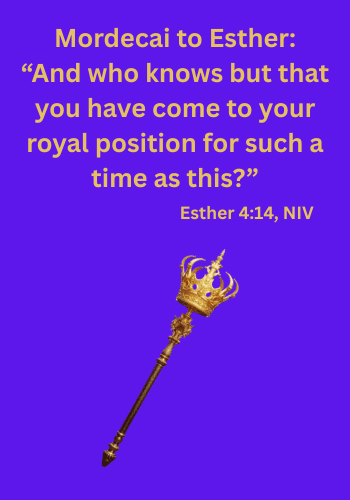
The story of Esther reminds us that Israel’s survival has never been accidental. It has always required courage. It has always demanded that some stand up and say, “If I perish, I perish” – and then act on their convictions.
That courage continues today.
The story of Esther is more than history. It’s a blueprint for survival, for courage, for the kind of strategic hope that refuses to bow even when destruction seems certain.
Especially now, that’s a story worth remembering.
Read my blog in honor of Israel’s 77th birthday last May 14, “Satan’s War on Israel: The Spiritual Roots of Antisemitism,” in which I explore Satan’s eternal war on Israel.


Here are links to my blog indexes, so please click one and keep reading!
My Books, Workbooks, and Fun Books
Knowing the Unknowable One
Opening the Treasure Chest
Walking Heart-to-Heart with God
Walking Heart-to-Heart with Each Other
Fighting the Good Fight of Faith
Christian Mysteries: Why I Love Them!
List of Some Nonfiction Books You Don’t Want to Miss
Index of Assorted Topics