

My pastor’s sermon this week focused on the genealogy of Jesus, organizing it into three memorable categories: the Faithful (like Abraham, Ruth and Boaz), the Failures (like Judah and King David), and the Forgotten (all those names we’ve never heard of before). It was a beautiful message about how God works through all kinds of people to accomplish His purposes.
But as the service ended, I found myself stuck on a question that wouldn’t let go: If Jesus wasn’t biologically Joseph’s son, why does Joseph’s genealogy even matter?
The Question That Wouldn’t Go Away
I know the two genealogies in Matthew and Luke don’t match perfectly. I’ve always heard the explanation that one traces Joseph’s line while the other traces Mary’s, and that’s never bothered me. What bothered me was something more fundamental: Jesus was conceived by the Holy Spirit. Mary was a virgin. Joseph wasn’t Jesus’ biological father. So why do both Matthew and Luke seem to trace Jesus’ lineage specifically through Joseph?
It felt like tracing someone’s ancestry through their stepfather. What’s the point?
The Answer: Adoption Changes Everything
When I got home, I did what we all do these days – I asked an AI. And buried in the response was a concept that made everything seem to click: adoption.
In ancient Israel, adoption wasn’t some lesser form of family connection. When you adopted someone, they became yours legally, fully, and completely. They inherited your name, your property, your status, and your rights. This wasn’t a technicality; it was real sonship.
Jesus was Joseph’s son by adoption. And that adoption gave Jesus the legal right to David’s throne.
Why This Matters in Prophecy
The messianic prophecies promised that the Messiah would come from David’s line and sit on David’s throne. This wasn’t just about biology – it was about legitimate succession, about having the right to rule. In the ancient world, that right came through legal lineage.

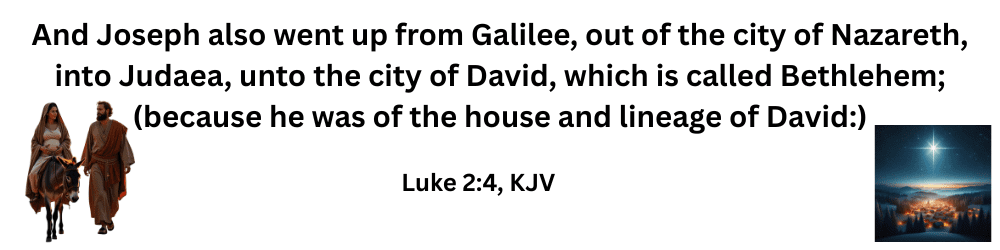
Joseph was a descendant of King David through Solomon, the royal line. When Joseph adopted Jesus as his son (and that’s exactly what he did when he named Him and raised Him), Jesus inherited that royal claim. He became the legal heir to David’s throne, fulfilling the prophecies even though He was conceived by the Holy Spirit.
God didn’t bypass the prophetic requirement that the Messiah be David’s heir – He fulfilled it through the mechanism of adoption.
The Beautiful Pattern of Adoption
This morning, I was listening to Chuck Missler’s audiobook on Genesis, and he discussed something that suddenly seemed relevant: Jacob adopting Joseph’s sons, Ephraim and Manasseh. Jacob elevated them from grandsons to sons, making them individual tribes in Israel with full inheritance rights. They weren’t a generation removed from Jacob. They were sons, period.
Adoption runs throughout Scripture as a powerful theme. God adopts us as His children through Christ. Paul writes about our adoption as sons and daughters. And here, at the very beginning of the Gospel story, we see adoption playing a crucial role in God’s redemptive plan.
Joseph’s genealogy matters because adoption matters. It matters legally, it matters theologically, and it matters personally.
Two Genealogies, One Purpose
Matthew traces the royal line through Solomon, emphasizing Jesus’ legal right to David’s throne. Luke may trace a different line (possibly through Mary, though scholars debate this), emphasizing Jesus’ actual human descent. Together, they show us both aspects: Jesus is legally qualified to be King, and He is genuinely human, truly one of us.
The genealogies don’t need to match perfectly because they’re answering different questions. Matthew is establishing Jesus’ legal credentials. Luke is showing His human connection to all of humanity, tracing the line all the way back to Adam.
But both genealogies matter. Both tell us something true and essential about who Jesus is and why He can be our Savior and King.
The Takeaway
So why does Joseph’s genealogy matter? Because God chose to work through the established human systems – through marriage, adoption, legal inheritance, and family lines. He didn’t just drop Jesus into history disconnected from everything that came before. He wove Him into the fabric of Israel’s story, making Him the fulfillment of promises made centuries earlier.
And He did it, in part, through a humble carpenter who said “yes” to adopting a son who wasn’t biologically his own, a son who would grow up to save the world.
That’s the kind of God we serve. He works through adoption, through unexpected families, through people who choose to love and claim children as their own. Joseph’s genealogy matters because Joseph mattered. His obedience, his faithfulness, and his willingness to be a father to the Son of God made him an essential part of the greatest story ever told.
***
Footnote: In case you’re wondering why Judah and King David are listed as failures in this context:
1) Judah’s contribution to the Messianic line came through his daughter-in-law Tamar, disguised as a prostitute, after he failed to keep his promise to her. (See Genesis 38.) And 2) David’s contribution to the Messianic line came as a result of adultery (or rape) and murder. (See II Samuel 11.)

a
The story of Ruth reveals how a Gentile woman married into the line of King David and became an ancestor of Jesus Christ. You can read or listen to Ruth telling her own story in an ebook or audiobook.
a
a
Here are links to my blog indexes, so please click one and keep reading!
My Books, Workbooks, and Fun Books
Knowing the Unknowable One
Opening the Treasure Chest
Walking Heart-to-Heart with God
Walking Heart-to-Heart with Each Other
Fighting the Good Fight of Faith
Christian Mysteries: Why I Love Them!
List of Some Nonfiction Books You Don’t Want to Miss
Index of Assorted Topics
Thank you for sharing and making me think!
So glad you liked it. I did some thinking too! Thank you for taking the time to comment.