

The Prosperity Gospel Is the Worst Possible Preparation for End Times
Article At A Glance
- The prosperity gospel teaches that faith equals financial reward, a theology that crumbles the moment real persecution begins.
- The Chinese underground church has endured decades of imprisonment and state violence, and their faith has only grown stronger, precisely because it was never built on comfort.
- Scripture, from the Book of Job to the life of Jesus himself, directly contradicts the core claims of prosperity gospel teachers like Joel Osteen and Oral Roberts.
- End times theology in the Bible does not promise believers wealth and ease. It promises tribulation and calls for a faith that can survive it.
- There is a stark and urgent lesson Western Christians need to hear before hardship arrives and comfort-based faith has nothing left to stand on.
The faith that cannot survive suffering was never real faith to begin with, and no movement in modern Christianity exposes that truth more sharply than the prosperity gospel.
At its core, the prosperity gospel is a simple transaction: give God your faith, and God gives you back wealth, health, and favor. It sounds encouraging. It fills stadiums. It sells millions of books. But when you place it next to the actual witness of Christians who have suffered for their faith – believers who lost everything and still would not walk away – the prosperity gospel doesn’t just look shallow. It looks dangerous.
The stakes here are not abstract. If end times prophecy means anything at all, it means that real pressure is coming. And the theology you hold when that pressure arrives will either hold you up or fall apart.
The Prosperity Gospel Sets Believers Up to Fail When It Matters Most
What the Prosperity Gospel Actually Teaches
The prosperity gospel is not a fringe idea whispered in small circles. It is mainstream, polished, and broadcast to millions every week. Its central claim is that God’s will for every believer includes material abundance and that financial blessing directly reflects spiritual faithfulness. Give generously to the church, confess positively, and expect God to return your investment with interest. This is not a metaphor in prosperity theology; it is presented as a literal spiritual law.
Oral Roberts, widely credited as the movement’s American architect, built his ministry on the concept of Seed Faith, the idea that money given to God’s work would be multiplied back to the giver. Joel Osteen, who studied at Oral Roberts University, refined the message into something warmer and more palatable: stop settling for mediocrity, believe that good things are coming, and God will lift you to your best life. The mechanism is the same. The packaging is just better.
Why Comfort-Based Faith Collapses Under Pressure
A faith built on the promise of reward is only strong as long as the rewards keep coming. The moment the diagnosis arrives, the business fails, or the government shows up at the church door, that faith has no framework for what is happening. It has no theology of suffering. It has no category for the faithful believer who loses everything. When comfort-based faith meets real loss, it doesn’t bend; it breaks. And it often takes the believer’s trust in God with it, because they were taught that suffering meant they had failed or displeased him.
How the Prosperity Gospel Started and Who Is Spreading It
Oral Roberts and the Roots of “Expect a Miracle” Theology

Oral Roberts launched his ministry in the late 1940s and built it on the twin pillars of divine healing and material expectation. His signature phrase, “Expect a miracle,” was not just a slogan. It was a theological statement. Roberts told followers that God actively wanted to reward their faith with tangible, physical, financial results. He founded Oral Roberts University in Tulsa, Oklahoma in 1963, creating an institution that would shape a generation of prosperity preachers who came after him.
Roberts reframed the covenant promises in Deuteronomy as a personal, direct contract between the individual believer and God. If Israel was promised blessing for obedience, then surely every faithful Christian could claim the same. It is a reading of Scripture that pulls certain texts forward while leaving others – the Book of Job, the Sermon on the Mount, the entire narrative of Paul’s imprisonments – completely behind.
Joel Osteen and the Mainstreaming of Wealth-Based Faith
Joel Osteen leads Lakewood Church in Houston, Texas, the largest congregation in the United States by attendance, and has sold tens of millions of copies of books like Your Best Life Now and Become a Better You. His message is softer than Roberts’ but no less transactional. “Friend, you have to start believing that good things are coming your way and they will,” Osteen has told his audience. It is Christianity repackaged as optimism – therapeutic, affirming, and almost entirely silent on the cross.
Joyce Meyer, T.D. Jakes, and the Televangelist Machine
Joyce Meyer and T.D. Jakes have both extended the prosperity gospel’s reach into massive media empires. Joyce Meyer Ministries broadcasts in over 100 countries. Jakes leads The Potter’s House in Dallas, a congregation of tens of thousands, and has crossed into mainstream entertainment as a film producer. Both teachers blend genuine pastoral warmth with prosperity-adjacent theology, which makes their influence harder to critique and easier to absorb uncritically. The message travels far because it feels good, and that is precisely the problem.
What the Bible Actually Says About Suffering and Faith
If prosperity theology is true, the Bible is one long contradiction.
The Book of Job Directly Contradicts the Prosperity Gospel
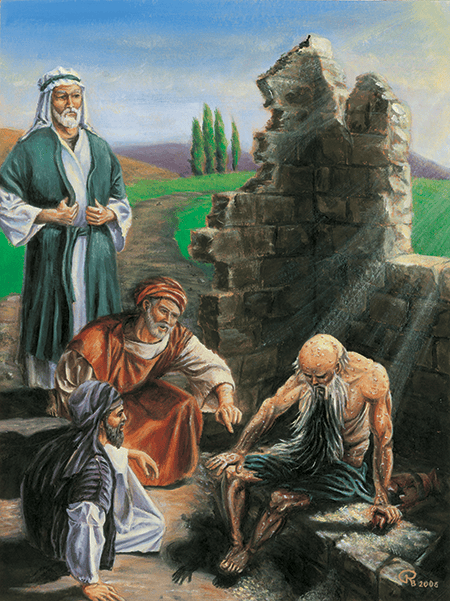
The Book of Job is not a minor footnote in Scripture. It is an entire theological argument aimed directly at the idea that faithfulness guarantees earthly reward. From the first verse, Job is described as “blameless and upright,” a man who fears God and shuns evil. He is also a man who loses his children, his wealth, and his health in rapid succession, not because he sinned, but precisely because he was righteous. The Book of Job exists, at least in part, to dismantle the neat equation that prosperity theology depends on.
Job’s three friends, Eliphaz, Bildad, and Zophar, operate exactly like prosperity gospel teachers. They insist Job must have done something wrong because, in their framework, suffering comes only to the unfaithful. God’s response to them at the end of the book is withering. He tells them directly that they have “not spoken the truth about me, as my servant Job has.” God rebukes the prosperity gospel’s entire theological architecture in the whirlwind. That should give every follower of Osteen serious pause.
Jesus Was Not the Richest Man in Nazareth
If material blessing is the natural result of deep, authentic faith, then Jesus of Nazareth presents an insurmountable problem. He owned nothing. He had nowhere to lay his head, by his own admission. He died with only the clothes on his back, which soldiers gambled away beneath the cross. Although prosperity gospel teachers present Jesus as the model of blessed, abundant living, He was, by every measurable standard, materially poor and socially marginalized. His glory was not displayed in wealth. It was displayed in resurrection after suffering, a completely different gospel than the one preached in Houston on Sunday mornings.
St. Thomas More Lost Everything and Died a Saint
Thomas More was Lord Chancellor of England — one of the most powerful positions in the kingdom — and he surrendered it all rather than endorse Henry VIII’s break from Rome. He was imprisoned in the Tower of London, stripped of his titles and property, and beheaded in 1535. By any prosperity gospel metric, More’s faithfulness to God destroyed his life. By the actual Christian tradition, it made him a saint and martyr whose witness has endured five centuries. His story does not fit the prosperity framework at all, and that is exactly the point.
The Chinese Underground Church Has Endured What Osteen Followers Cannot Imagine
“When we were arrested, we did not pray for release. We prayed for strength to honor God in whatever came next. That is the only prayer that makes sense when you do not control the outcome.” (A house church leader in China, as documented by persecution watchdog organizations monitoring the underground church movement)
Since the establishment of the People’s Republic of China in 1949, Christians who refused to worship under state-sanctioned religious structures have faced arrest, imprisonment, forced labor, and torture. The underground church, a network of house churches operating outside government control, did not shrink under this pressure. It multiplied. Estimates of China’s Christian population have grown dramatically across the decades of persecution, a phenomenon that has confounded sociologists and stunned missiologists around the world.
This is a community that has never had the luxury of a comfort-based faith. When the state can raid your home, confiscate your Bible, and sentence you to years of hard labor for holding a prayer meeting, your theology is tested in ways that no Joel Osteen sermon could prepare you for. And yet the underground church did not collapse. It did not produce a generation of believers who walked away from God because the blessings stopped coming. It produced something almost incomprehensible to Western Christianity: a faith that got stronger the harder it was pressed.
The contrast with prosperity gospel communities is not subtle. It is stark. One tradition prepared its people for suffering by telling them the truth about what faith costs. The other prepared its people for abundance by telling them what they wanted to hear. Only one of those traditions has been tested by fire, and only one has passed.
Decades of State Persecution and Imprisonment

The Chinese Communist Party’s campaign against unregistered churches has operated in waves, with major crackdowns documented in 1983, 1999, and again in the late 2010s under President Xi Jinping’s tightened religious controls. Specific high-profile cases include Pastor Wang Yi of Early Rain Covenant Church in Chengdu, who was sentenced in 2019 to nine years in prison on charges of “inciting subversion” after refusing to register his congregation with the state. He was not an outlier. He was representative of thousands of house church leaders who made the same choice across decades, knowing exactly what it would cost them.
“Why Their Faith Grew Stronger Under Pressure, Not Weaker
There is a theological principle at work in the underground church that runs entirely counter to prosperity thinking: suffering, when understood through the lens of Scripture, does not signal God’s absence. It signals the believer’s participation in the suffering of Christ himself. Paul writes in Philippians 3:10 of wanting to know Christ “and the fellowship of sharing in his sufferings.” For underground church believers, persecution was not a sign that God had broken his promises. It was a sign that they were walking the same road their Lord had walked. That reframing changes everything.
The Theology of Suffering That Keeps Them Standing
Underground church theology is not sophisticated in an academic sense; it is sophisticated in a survival sense. These believers have developed a working understanding of Romans 8:18, which says that the sufferings of this present time are “not worth comparing” to the glory that will be revealed. They hold that promise not as a bumper sticker but as a lifeline. When everything visible is being taken from you, the invisible has to become more real than what you can see. That is a faith muscle that only gets built through resistance training.
Compare that to a faith tradition that tells its followers to visualize their breakthrough and confess their blessing into existence. One theology trains believers for the worst. The other leaves them completely exposed to it. The underground church did not stumble into spiritual resilience by accident. They were forged into it by circumstances that prosperity gospel theology never even acknowledges as a possibility for faithful Christians.
End Times Theology Demands a Faith Forged in Hardship
Read Matthew 24 carefully, and what you find is not a promise of increasing comfort for believers as history moves toward its conclusion. Jesus describes wars, famines, earthquakes, and persecution. And then he says directly, “you will be hated by all nations because of me.” He does not say this might happen to some believers in difficult countries. He says it as a statement of what his followers should expect. End times theology, taken seriously, demands a kind of faith that has been pressure-tested, not pampered.
What Scripture Says Believers Should Expect Before the End
The New Testament is consistent and unsentimental about what the end of the age looks like for believers. Jesus warns in Matthew 24 of false prophets who will deceive many, a warning that many theologians apply with uncomfortable precision to teachers who tell people exactly what they want to hear. Paul tells Timothy in 2 Timothy 3:12 that “everyone who wants to live a godly life in Christ Jesus will be persecuted.” Not some. Not those in difficult geopolitical situations. Everyone. The Book of Revelation, whatever one’s interpretive framework, does not depict the end times as a season of increasing prosperity for the faithful.
The specific promises Scripture makes about the end times include:
- Widespread deception — false teachers and false christs who perform signs and wonders compelling enough to mislead even the elect if possible (Matthew 24:24)
- Persecution and martyrdom — believers handed over to be killed, hated by all nations for the name of Jesus (Matthew 24:9)
- Economic pressure — the Book of Revelation describes conditions where buying and selling are tied to allegiance, not abundance (Revelation 13:17)
- The love of many growing cold — not just unbelievers, but those who once professed faith abandoning it under pressure (Matthew 24:12)
- The one who endures to the end being saved — endurance, not prosperity, is the eschatological virtue Scripture calls for (Matthew 24:13)
Why Prosperity Gospel Believers Are Theologically Unprepared
A believer who has been told that faith produces wealth and health has been given a theology with no category for tribulation. When the end times scenario Scripture describes actually unfolds – when buying and selling require allegiance, when public profession of faith draws state hostility, when the community that was supposed to protect you scatters – that believer has no framework to interpret what is happening. Worse, they may interpret it as evidence that God has abandoned them, or that their faith was insufficient. Prosperity theology not only fails to prepare believers for hard times. It actively sets them up to interpret hard times as spiritual failure.
The underground church in China did not have the option of believing that faithfulness would be rewarded with earthly comfort. Reality dismantled that option immediately. What they had instead was a theology built around the actual promises of Scripture: that God is present in suffering, that suffering produces perseverance, and that perseverance produces a proven character that hope can anchor to. Romans 5:3–4 is not a verse that prosperity gospel theology knows what to do with. The underground church had it memorized out of necessity.
This is the theological gap that matters most as end times discussions move from academic speculation to urgent preparation. The question is not whether your faith makes you feel good today. The question is whether your faith will hold when everything that made it feel good is gone. A theology that has never been tested by real cost is a theology that has never been proven. And an untested faith meeting end times pressure is a serious spiritual crisis waiting to happen.
- Prosperity gospel theology has no framework for persecution — it interprets suffering as the absence of faith rather than the testing of it
- End times Scripture calls for endurance, not expectation of reward — the believer who endures to the end is saved, not the one who confessed the biggest blessing
- The underground church model proves resilience is built, not inherited — it comes from a theology that tells the truth about what following Christ costs
- Comfort-based faith has no survival mechanism — when comfort disappears, so does the only evidence such faith was ever resting on
- Biblical faith is anchored to the resurrection, not to present circumstances — which means it can survive the destruction of every circumstance
What Western Christians Can Learn From the Underground Church
The underground church in China is not a cautionary tale. It is a masterclass. These are believers who faced down the full coercive force of a hostile state with nothing but Scripture, community, and a theology built on the actual promises of God, not the edited, comfort-maximized version sold in Western bookstores. What they developed under pressure is exactly what Western Christianity is most lacking: a faith that does not require favorable conditions to function.
The first lesson is the most uncomfortable one for Western Christians to hear. Suffering is not a detour from the Christian life. It is, according to Scripture and the testimony of the global church across two thousand years, one of its primary features. The underground church did not look for a way around suffering. They looked for a way through it, guided by a theology that told them the way through was the same road Jesus walked. That reorientation, from avoiding suffering to understanding it, is the single most important shift Western Christianity could make right now.
The second lesson is about community. Underground church networks in China survived because they were genuinely interdependent. When one family was raided, others hid their members. When a leader was imprisoned, others stepped into the gap without waiting to be asked. This is not the consumerist church model where individuals attend services and manage their own spiritual portfolios. This is the kind of community the early church formed in Jerusalem, described in Acts 2, where believers held things in common and nobody claimed that their possessions were their own. That kind of community is the only kind that survives real pressure.
The third lesson concerns Scripture. Underground church members memorized large portions of the Bible because their physical Bibles were confiscated regularly. They could not rely on having a copy. What they hid in their hearts could not be taken. Western Christians, who have access to Scripture in more formats than any generation in history, are often the least biblically literate. When the infrastructure of comfortable Christianity is removed – and end-times theology suggests it will be – the believer who has Scripture embedded in memory will stand. The one who relied on a church app may not.
Three Pillars of Underground Church Resilience
Pillar What the Underground Church Did What Western Christianity Often Does Instead Theology of Suffering Embraced suffering as participation in Christ’s own suffering; used Romans 5 and Philippians 3 as core frameworks Treats suffering as a sign of spiritual failure or insufficient faith Community Structure Genuine interdependence; mutual protection, resource sharing, leadership redundancy Consumer-model attendance; individual spiritual management; program dependency Scripture Retention Memorized Scripture extensively due to confiscation of physical Bibles High Bible access, low Bible literacy; heavy reliance on digital and institutional delivery
The Faith That Survives Is the Faith Built for the Storm
There is a version of Christianity that is built for exactly what is coming, and it looks nothing like what is being sold in the largest churches in America right now. It looks like a house church in Chengdu meeting before dawn. It looks like a believer in a detention cell with Psalm 23 on their lips. It looks like Thomas More on the scaffold, cracking a joke to the executioner because his peace was not dependent on his circumstances. That faith does not just survive the storm; it was made for it. The storm is actually where it becomes most fully itself.
The prosperity gospel will not survive contact with end-times pressure. It was never designed to. It was designed for comfort, and comfort is precisely what end-times theology says believers should not count on. The call right now, for any Christian who takes eschatology seriously, is to build the kind of faith the underground church built – rooted in the real promises of Scripture, forged in community, and anchored not to present circumstances but to the resurrection of Jesus Christ, which no government, no economic system, and no amount of tribulation has ever been able to take away.
Frequently Asked Questions
The prosperity gospel raises questions that go far beyond theological debate. They touch on how believers prepare for real-world hardship, what Scripture actually promises, and whether the most popular expressions of Christianity in the West prepare people for what is coming or leave them dangerously exposed.
Below are the most pressing questions Christians are asking at the intersection of prosperity theology and end-times faith, answered directly from Scripture and the testimony of the global church.
Is the Prosperity Gospel Considered a False Teaching by Mainstream Christianity?
Yes, broadly speaking. Across Catholic, Eastern Orthodox, and mainline Protestant traditions, the prosperity gospel is regarded as a serious theological error. Critics from Bishop Robert Barron to Reformed theologians like John Piper have argued that it fundamentally misrepresents the nature of the covenant, the life of Christ, and the explicit teachings of the New Testament on suffering and discipleship. The fact that it is enormously popular does not make it orthodox. And popularity, Jesus noted in Matthew 7:13–14, is not a reliable marker of the narrow road.
What Does the Bible Say About Christians Facing Persecution?
Scripture is consistent and direct. Jesus tells his disciples in John 16:33, “In this world you will have trouble.” Paul writes in 2 Timothy 3:12 that “everyone who wants to live a godly life in Christ Jesus will be persecuted.” Peter instructs believers not to be surprised by the “fiery ordeal” that comes as though something strange were happening to them (1 Peter 4:12). Persecution in Scripture is not a worst-case scenario for the unusually faithful. It is the expected condition of anyone who lives the gospel without compromise in a world that rejected its author.
How Has the Chinese Underground Church Maintained Faith Under Persecution?
Through a combination of deeply rooted theology, genuine community interdependence, extensive Scripture memorization, and a clear understanding that suffering does not contradict God’s promises. It fulfills them. House church networks developed redundant leadership structures so the community did not collapse when one pastor was imprisoned. They shared resources, hid each other’s families, and passed handwritten Scripture between members when printed Bibles were unavailable. Their resilience was not accidental. It was the fruit of a theology that told them the truth about what following Jesus cost, and a community that took that truth seriously enough to actually prepare for it.
Did Oral Roberts Actually Found the Prosperity Gospel Movement?
Roberts is widely credited with shaping prosperity theology in its modern American form, though he drew on earlier Pentecostal healing revival traditions. His concept of Seed Faith, the theological claim that money given to God’s work returns to the giver multiplied, became the economic engine of the prosperity gospel movement and was adopted and adapted by virtually every major prosperity teacher who followed him.
Roberts founded Oral Roberts University in Tulsa, Oklahoma in 1963, which became an institutional incubator for prosperity theology. Joel Osteen studied there before eventually taking over Lakewood Church in Houston. The lineage is direct and documented, and it traces a theology that moved from fringe Pentecostal speculation in the mid-20th century to the center of American megachurch culture in a single generation.
What Is the Difference Between Biblical Prosperity and the Prosperity Gospel?
Biblical prosperity is a real concept, but it is far broader and more demanding than what the prosperity gospel presents. In the Old Testament, blessing is consistently tied to covenant faithfulness and described in communal terms. A people who follow God’s commands will flourish together. It was never a personal wealth formula, and even the Deuteronomic blessings were always paired with warnings about what unfaithfulness would cost.
The prosperity gospel strips the concept of blessing from its covenantal, communal, and eschatological context and turns it into a transaction between an individual and God. It removes the cross from the center of the Christian life and replaces it with an expectation of comfort. That is not a minor theological adjustment. It is a fundamental reorientation of what Christianity is about and what it is for.
True biblical prosperity includes the kind of peace that “passes understanding” (Philippians 4:7), the wealth of wisdom described in Proverbs, and the inheritance of eternal life that Jesus calls the “treasure in heaven” no thief can reach and no moth can destroy. None of those promises are contingent on earthly circumstances. All of them survive the worst the world can do. That is a prosperity worth building a life on, and it is the only kind of prosperity the underground church has ever needed.
The prosperity gospel is a controversial belief system that suggests faith, positive speech, and donations to religious causes will increase one’s material wealth. However, critics argue that this approach is misleading and not rooted in traditional Christian teachings. In contrast, the Chinese underground church has been noted for its resilience and commitment to faith despite persecution. This stark difference highlights what the Chinese underground church knows that prosperity gospel proponents like Joel Osteen may overlook.
***
Here are links to my blog indexes, so please click one and keep reading!
My Books, Workbooks, and Fun Books
Knowing the Unknowable One
Opening the Treasure Chest
Walking Heart-to-Heart with God
Walking Heart-to-Heart with Each Other
Fighting the Good Fight of Faith
Christian Mysteries: Why I Love Them!
List of Some Nonfiction Books You Don’t Want to Miss
Index of Assorted Topics