
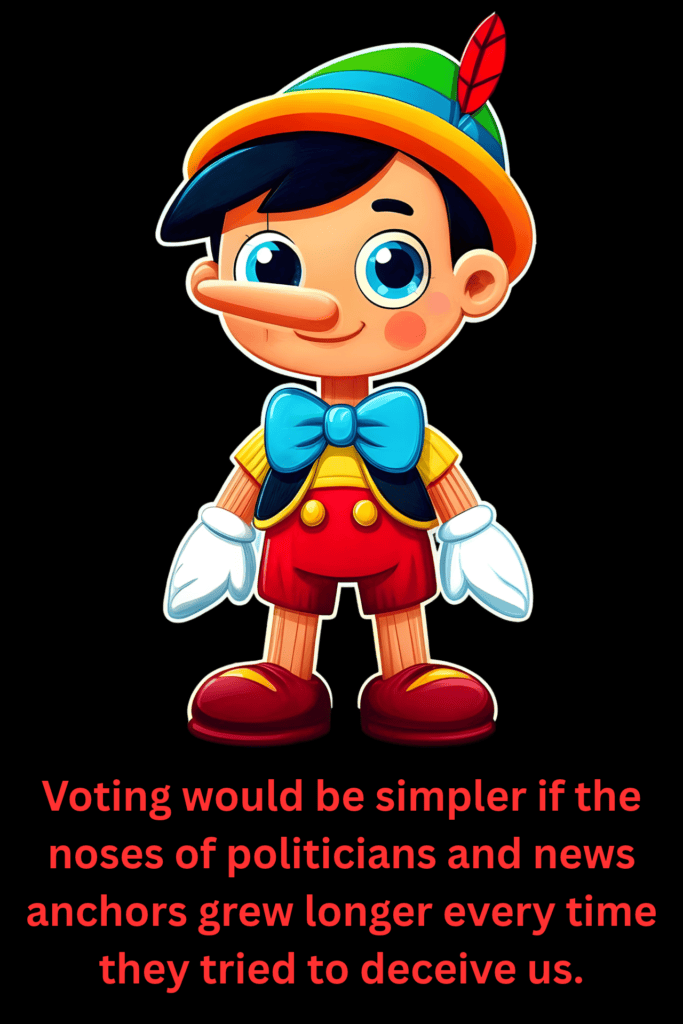
Imagine you’re on trial for a crime you didn’t commit. The prosecutor stands before the jury and makes five statements. Every single one of them is factually true. Your name. Your location that evening. A debt you owed the victim. A prior argument. A statement you made in frustration three years ago.
Not one word is a lie. And by the time he sits down, the jury is certain you’re guilty.
This is the most sophisticated form of deception in the world. And it’s the dominant form in our public conversation today. It’s also the hardest kind to fight, because there’s nothing to fact-check. Every word holds up. But the picture it paints is false.
As we head into an election season, I want to name what we’re all experiencing but may not have the vocabulary for. The problem isn’t just that people lie. The problem is that half-truths, told skillfully, can deceive more completely than outright lies, precisely because they’re defensible.
The Toolkit
You don’t need to make anything up. Here’s how a narrative gets shaped without a single false statement:
Selection.
Which events get covered determines our entire picture of reality before a single word is written. A protest that turns violent and a protest that stays peaceful are both newsworthy, but choosing which one leads tonight’s broadcast is a powerful editorial act dressed up as journalism. Repetition compounds this: the same story told every day feels like the whole story, even when it isn’t.
Word choice.
“Slashed funding” and “reduced spending” can describe the exact same budget action. “Fiery but mostly peaceful” and “violent protests with isolated moments of calm” can describe the same scene. “Passionate advocate” and “hardline ideologue” can describe the same person. The facts don’t change. The impression does. Enormously.
Omission.
Every story is defined as much by what’s left out as by what’s included. The context that would explain a decision, the history that would complicate a narrative, the follow-up that would change the conclusion – all of these can simply not be there. The audience doesn’t know what it isn’t being told. That’s what makes omission so effective.
Juxtaposition.
Place two true facts side by side, and you create an implied connection that’s never stated and can never be challenged. “Congressman X voted against the bill. Three weeks later, his house burned down.” Neither sentence is a lie. The implication is devastating. And entirely unfair. Sophisticated news coverage does this constantly, and people absorb the implied conclusion as fact.
Why This Is Still Lying
Here’s where I want to press past the political analysis into something deeper.
The serpent’s first recorded words weren’t a lie. They were a question: “Did God really say…?” He didn’t fabricate. He reframed. He selected. He implied. And it worked.
“A half-truth deployed to mislead is a lie wearing respectable clothes. The fact that a lawyer could defend it doesn’t change what it is.”
When God gave Israel the ninth commandment, He didn’t say, “Thou shalt not state falsehoods.” He said, “Thou shalt not bear false witness.” Bearing false witness means creating a false impression, in a court, in a community, in a culture. The mechanism of deception is less important than the intent and the effect.
Omitting the context that would save someone’s reputation is a lie. Choosing a word that makes your opponent look monstrous when a neutral word would do is a lie. We’ve developed very sophisticated standards for technical accuracy and very low standards for the honesty that actually matters. We’ve let “I didn’t say anything false” become an acceptable defense for creating a false impression. It shouldn’t be.
What It Looks Like Right Now
You’ve already seen it. You may have been noticing it for years without naming it.
Watch for the pattern in election coverage: the same type of action – a rally, a statement, a policy decision, a personal history – described in language that carries a completely different weight depending on which side performs it. One candidate’s supporters are energized; another’s are inflamed. One candidate speaks bluntly; another is reckless. One policy is bold; another is extreme.
Watch the stories that disappear. A news cycle hammers one angle for a week, then goes silent when new information complicates the narrative. That silence is as telling as anything that was said. Ask yourself: what was I following last month that I haven’t heard an update on?
Watch the adjectives. They accumulate. They’re doing work. When you notice them, ask: would these same adjectives appear if someone the publication favors took this action? That asymmetry is the tell.
I’m not making a case that any one outlet is uniquely guilty. The techniques exist across the spectrum. But as we enter the final days before an election, they’ll be working overtime, and an informed reader is a harder reader to mislead.
What To Do About It
Naming the problem is half the work. Here’s the other half:
- Notice emotional language and ask what it’s doing there.
- When a headline or a paragraph makes you feel a strong emotion – outrage, contempt, fear – pause. Ask whether the facts alone would produce that feeling, or whether the language is manufacturing it.
- Ask what this story looks like from the other angle.
- Not because the other side is right, but because seeing the same facts framed differently reveals which frame is doing the work.
- Actively seek out what your preferred sources omit.
- Every outlet has blind spots. Knowing yours makes you a sharper thinker and a more credible voice to the people you’re trying to persuade.
- Hold yourself to the same standard in your own conversations.
- The most powerful thing any of us can do is decide not to pass along the distorted version, even when it helps our side. Truthfulness is either a principle or it’s just a tactic. Make it a principle.
One More Reason This Matters
A friend told me about a conversation she had recently with her adult son. He’d made up his mind about his vote, largely based on what the ads told him about the other candidate. His parents, who had done more digging, shared some context, a backstory, some facts that never made it into the advertising cycle.
He was shocked. Not angry. Shocked. The picture he’d been given was that incomplete.
I don’t tell that story to embarrass him. I tell it because he is all of us at some point. He’s busy. His wife is busy. They’re building a life. Jobs, kids, the thousand small emergencies that fill a day. Sitting down to research a candidate’s full record feels like a luxury when dinner needs to happen, and the car needs an oil change.
But here’s what I keep coming back to: his children and grandchildren will live in the world his vote helped build. And someday, when they’re old enough to understand how our country got to be the way it is, “I was busy” will feel like a small answer to a big question.
The people shaping our information know we’re busy. They’re counting on it. The distorted version of reality they hand us is designed to be swallowed on the fly. Vivid, emotional, not requiring any follow-up. It works because we let it.
We don’t have to let it.
In the end, the antidote to sophisticated deception isn’t cynicism. Cynicism just makes you a different kind of easy to manipulate. The kind that assumes everything is a lie and stops thinking carefully.
The antidote is discernment. It’s slower, harder work. It asks more of us. But it produces something cynicism never can: the ability to actually know what’s true.
We can’t control what the networks choose to cover, or which adjectives their editors approve. But we can refuse to be passive consumers of whatever impression we’re handed. We can ask harder questions. We can hold the stories we tell to the standard of not just being technically accurate, but genuinely honest.
That standard is worth fighting for. Especially right now.
***
Here are links to my blog indexes, so please click one and keep reading!
My Books, Workbooks, and Fun Books
Knowing the Unknowable One
Opening the Treasure Chest
Walking Heart-to-Heart with God
Walking Heart-to-Heart with Each Other
Fighting the Good Fight of Faith
Christian Mysteries: Why I Love Them!
List of Some Nonfiction Books You Don’t Want to Miss
Index of Assorted Topics
Excellent post! Everyone should read this before voting.