
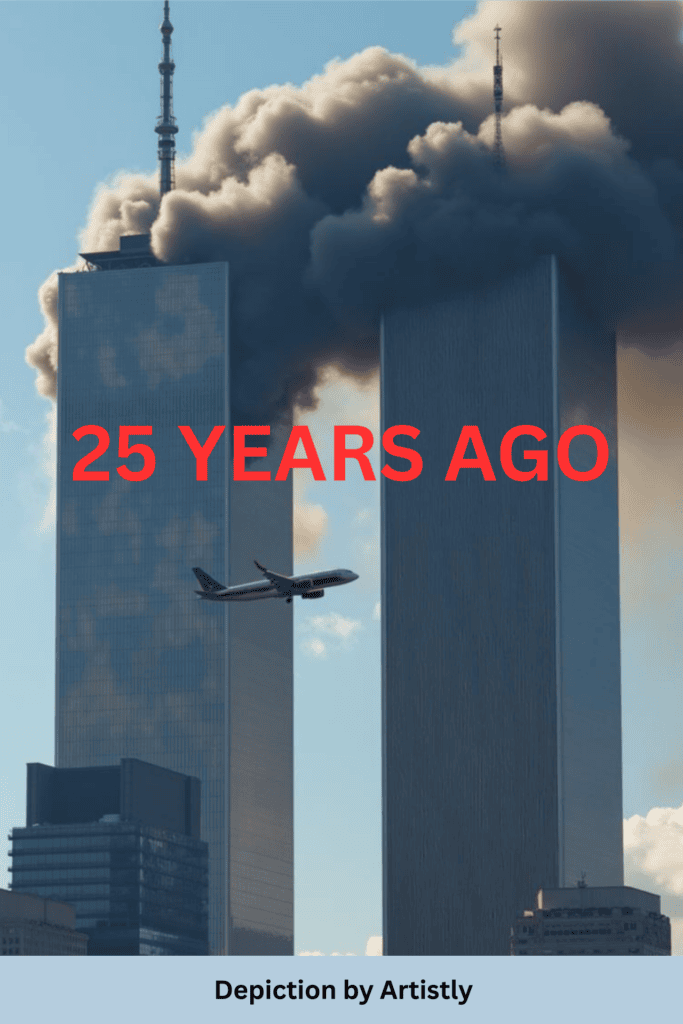
A reflection on the 25th anniversary of 9/11, faith, courage, and the seed of the church
Tertullian wrote it in the second century, defending Christians to the very empire that was killing them: “The blood of the martyrs is the seed of the church.” Singular. Seed, not seeds. One planting. One harvest, still being reaped two thousand years later.
Today is September 11, 2026, twenty-five years since the Twin Towers fell and the Pentagon burned. I didn’t set out to write about that today. But the closer I looked at the courage of the martyrs, the more I couldn’t avoid the question: did the blood shed that morning become seed too? Or did it just become ash?
I’ll come back to that. First, the martyrs, because their stories deserve to be told on their own terms, not just as a launching pad for an argument.
The First Martyrs: Jerusalem and Rome
Stephen, a deacon of the early church, was the first. Acts 7 tells us he was dragged before the Sanhedrin in Jerusalem on false charges, and instead of defending himself, he preached, walking his accusers through the whole story of Israel’s rejection of God’s messengers, ending with Jesus. They dragged him outside the city and stoned him. His last recorded words were a prayer that the sin not be held against his killers. He died forgiving them.
James, son of Zebedee, was next, the first of the twelve apostles to be martyred. Acts 12 records it in a single flat sentence: Herod Agrippa “killed James the brother of John with the sword,” in Jerusalem, somewhere around A.D. 44. No speech, no drama in the text. Just a king consolidating power by killing an apostle, and the church absorbing the blow.
Church tradition – not Scripture itself, but very old and widely attested tradition – holds that Peter was crucified in Rome under Nero, reportedly asking to be crucified upside down because he felt unworthy to die in the same manner as his Lord. Paul, a Roman citizen, was beheaded rather than crucified, also in Rome, also under Nero, likely in the mid-60s A.D. Both men had every reason to know exactly what following Christ would cost them, and neither stopped.
These weren’t reluctant deaths. Stephen preached his own eulogy. Paul wrote, from a prison cell, that he had already been poured out like a drink offering. They understood something we tend to skip past: that the call of Christ was never a promise of safety.
But it wasn’t only the apostles, and that matters, because we tend to hold the apostles at arm’s length. They walked with Jesus, they worked miracles, of course they were willing to die. The martyrs who may hit closer to home are the ordinary believers who came after them, the ones history remembers precisely because they were nobody special until the moment they refused to bend. After the Great Fire of Rome in A.D. 64, Nero needed someone to blame, and he blamed the Christians. The historian Tacitus records that they were sewn into animal skins and torn apart by dogs, nailed to crosses, or set on fire to serve as human torches for Nero’s evening garden parties. And here is the detail that makes it so different from a natural disaster: every one of them could have walked free at almost any point simply by tossing a pinch of incense on an altar and declaring Caesar to be a god. That’s all it would have taken. They knew it, and they didn’t do it. A century later, an old pastor named Polycarp, bishop of Smyrna and reportedly a disciple of the apostle John himself, was given that same offer. Curse Christ, and live. At eighty-six years old, he answered that Christ had never done him wrong in all that time, so he had no reason to betray Him now, and he was burned at the stake. Decades after that, in Carthage, a young mother named Perpetua and her slave Felicity were thrown into the arena to be gored by a wild heifer before being finished off by the sword. Both of them were offered the same way out; both of them refused it. None of these people had to die. That’s what makes their courage so hard to argue with.
Modern Martyrs: Nigeria and Libya
We like to think of martyrdom as ancient history. It isn’t.
Reverend Lawan Andimi was a pastor with the Church of the Brethren in Nigeria and the local chairman of the Christian Association of Nigeria in Adamawa State. In January 2020, Boko Haram militants raided his town, Michika, and took him captive. While held for ransom, he was forced to record a video pleading for his release. In it, instead of pure fear, he told his family, “don’t cry, don’t worry, but thank God for everything,” and said that whatever happened was in God’s hands. The ransom negotiations broke down. On January 20, 2020, he was beheaded.
Five years earlier, on a beach in Sirte, Libya, ISIS militants lined up twenty-one men in orange jumpsuits, twenty Egyptian Coptic Christians and one man from Ghana, Matthew Ayariga, who had been swept up with the others though he wasn’t Coptic himself. According to reports from those who documented the killings, the militants offered Ayariga a way out: renounce Christ, and live. He is reported to have answered, “Their God is my God,” and was killed alongside the others. Witnesses say many of the men could be heard praying, “Ya Rabb Yesua” – “O Lord Jesus” – in the moments before they died. The Coptic Church later canonized them as the 21 Martyrs of Libya.
These are not legends. These are men whose deaths were documented, dated, and in one case filmed and broadcast to the entire world. You can read more of these accounts — and support the work of documenting and aiding the persecuted church — at persecution.com (The Voice of the Martyrs), persecution.org (International Christian Concern), and barnabasaid.org.
The Contrast
Set those stories next to the version of Christianity that dominates so much American airtime: a gospel that promises God wants your best life now, your biggest house, your healthiest bank account, as though faith were a transaction and suffering were a sign you’d done something wrong. Or set them next to a different but related failure: a Christianity so eager to be liked by the culture that it quietly edits Scripture down to whatever the culture will still applaud, calling that “progress.”
There’s a third current worth naming too, because it gets the shape of the story exactly backwards. It’s often called the Seven Mountain Mandate, the teaching that the church is meant to gradually take dominion over culture, government, business, education, and the arts, so that things get better and better until Christ returns to a world the church has already won over. It’s an attractive picture. It just isn’t the one Jesus or the apostles painted. Matthew 24, 2 Timothy 3, and 2 Thessalonians 2 all describe the last days as a season marked by increasing deception, apostasy even inside the church, and darkness, not steady cultural triumph.
That’s not a small detail to get wrong. If you’re expecting victory, you have no framework left for suffering when it actually comes. And you have no defenses at all against a message that sounds triumphant precisely because it’s false. The only real safeguard against that kind of deception has always been the same one: knowing Scripture well enough ourselves to recognize counterfeit good news when we hear it, instead of borrowing our theology secondhand from whoever sounds most confident.
All three of these – a gospel that promises your best life now, a faith reshaped to keep the culture’s approval, and an end-times triumphalism that expects the church to win before Jesus even returns – share the same blind spot. None of them can produce a Lawan Andimi. None of them has a category for martyrdom. A gospel built around getting what you want from God has no answer when God’s will is your death. A gospel built around avoiding cultural offense has no martyrs, because martyrs are made precisely by refusing to bend at the one point where bending would spare their lives. And a gospel that promises earthly victory first has no room for a suffering church at all.
I’m not naming names here, and I’m not trying to. This isn’t about any one preacher, ministry, or denomination. It’s about a posture, a whole cultural mood among American Christians, myself included, of expecting comfort and control as our due, and treating any friction with the culture, or any hint that things might get harder before Christ returns, as a problem to be managed rather than a cross to be carried.
The Soldier’s Line
In the September 9 devotional in Streams in the Desert, L.B. Cowman tells of a Roman soldier warned that a journey he was about to take could kill him. His answer has stayed with me: “It is necessary for me to go – it is not necessary for me to live.”
I don’t think most of us American Christians have any real category for that sentence. We pray for God to bless the journey, protect the journey, make the journey comfortable. We rarely pray, “Your will, even if it costs me everything,” and mean it the way Andimi meant it in that ransom video, thanking God with a blade already hanging over him.
And Then There’s Today
Twenty-five years ago this morning, thousands of people went to work and never came home. In the days after, churches filled up. People who hadn’t prayed in years prayed. For a little while, the country looked, spiritually, like a nation that had just been reminded it wasn’t in control.
And then the feeling faded. Church attendance eventually settled back to where it had been, or lower. I have no doubt real, lasting conversions happened because of 9/11, and I thank God for them. But as a national moment, it doesn’t seem to have functioned as seed the way the deaths of Stephen, or Andimi, or the 21 on that beach in Libya, have functioned as seed. Those deaths were suffered for the gospel, by believers who chose faithfulness over survival, and the church has always grown out of exactly that soil. September 11 was suffered because of hatred, not for the gospel, and maybe that’s the difference. It may have been a warning, a mercy wrapped in tragedy, a moment God used to get a nation’s attention for a season. But a warning isn’t the same thing as martyrdom, and a shaken nation isn’t the same thing as a planted seed.
Maybe the real question this anniversary raises isn’t about the nation at all. It’s about us, one at a time: whether we’ve built a faith sturdy enough to say, with that Roman soldier and with Lawan Andimi, it is not necessary for me to live. Or whether we’re just negotiating with God for a better journey.
Sources for further reading
- The Voice of the Martyrs — persecution.com
- International Christian Concern — persecution.org
- Barnabas Aid — barnabasaid.org
- USCIRF, “Marks the 10th Anniversary of the Execution of 21 Christians in Libya” — uscirf.gov
***
A related blog you might like: What the Chinese Underground Church Knows That Joel Osteen Doesn’t

Here are links to my blog indexes, so please click one and keep reading!
My Books, Workbooks, and Fun Books
Knowing the Unknowable One
Opening the Treasure Chest
Walking Heart-to-Heart with God
Walking Heart-to-Heart with Each Other
Fighting the Good Fight of Faith
Christian Mysteries: Why I Love Them!
List of Some Nonfiction Books You Don’t Want to Miss
Index of Assorted Topics