

“The just shall live by faith.” — Habakkuk 2:4, Romans 1:17, Galatians 3:11, Hebrews 10:38
There’s a moment most of us know well.
You’ve prayed. You’ve waited. You’ve prayed again. And heaven feels like brass. No burning bush. No still small voice. No sign. Just silence — and a situation that isn’t getting better.
In those moments, the question rises like a tide: Where is God?
Maybe you’re asking it right now.
What you’re about to discover is that this question — as old as suffering itself — has a profound answer. Not a tidy, bumper-sticker answer. A real one. One that was hidden in plain sight for centuries, in one of the most unusual books in the entire Bible.
The Book Where God Goes Silent — On Purpose
The book of Esther is remarkable for a reason most people never notice: God’s name does not appear in it. Not once.
No prayer is recorded. No miracle is announced. No prophet speaks. No angel appears. For ten chapters covering one of the most dramatic rescue stories in history — the threatened genocide of the Jewish people — God seems to be entirely absent from the narrative.
And yet.
Theologians across centuries have understood this silence to be entirely intentional. The absence of God’s name is the point. Because when you read Esther carefully, you see the fingerprints of God everywhere — in the timing of a sleepless king, in the courage of a young woman, in the exposure of a wicked plot, in the precise reversal of fortune that saved a nation.
God was not absent. God was hidden. Working. Moving. Orchestrating.
He just wasn’t announcing Himself.
This is the ancient secret that Esther’s story teaches: God’s silence is not God’s absence. And the life He calls us to — the life of the just — is one lived by faith, not by sight.
Six Broken Compasses — And Why They Always Fail
Before we can truly understand what it means to live by faith, we need to understand what faith is not. Because there are at least six other foundations people try to build their lives on — and every single one eventually collapses.
1. Living by Feelings and Emotions
Feelings are real. Feelings are valid. Feelings are also profoundly unreliable as a guide to truth.

The person who lives by feelings prays and feels nothing, so concludes God isn’t there. They make decisions based on what feels right in the moment — and discovers, often painfully, that emotions are weather, not bedrock. They shift with circumstances, with sleep, with blood sugar, with grief.
The Bible never says “the just shall live by feelings.” In fact, feelings were never designed to lead — they were designed to follow. Joy follows obedience. Peace follows trust. But when you make feelings your compass, you’re navigating by a spinning needle that gives no reliable guidance.
Jeremiah wept through his entire prophetic ministry. Job raged at heaven. David cried out from the depths of despair. None of them felt God’s presence in those moments. All of them were walking directly in His will.
Your feelings are not the final word on what is real.
2. Living by Personal Experience
This one is subtle, because experience feels like wisdom. And sometimes it is. But experience also has a serious flaw: it only tells you what has happened, not what will happen. And it only tells you what happened from your limited, fallen, finite vantage point.
The person who lives by personal experience says: “I prayed for my father to be healed, and he died. So either God doesn’t answer prayer, or He doesn’t care.” That experience is real. That grief is real. But the conclusion drawn from it treats one chapter as the whole story.
Our experience is also shaped by our sin, our wounds, our blind spots, and our limited perspective. We experience a fraction of reality. God sees all of it — the beginning from the end, the seen and the unseen, the story still being written.
Esther’s experience, at the moment she was asked to risk her life for her people, was that such a move was likely fatal. Her experience told her to stay silent. Faith told her something else.
3. Living by Popular Opinion
Whatever the crowd thinks must be right — right?
History answers this question decisively, and not kindly. The crowd demanded Barabbas and crucified Jesus. The crowd in Noah’s day laughed at an ark being built in a land with no ocean. The crowd in Esther’s Persia had been manipulated into endorsing genocide.
Popular opinion is simply the average of what fallen human beings currently believe, filtered through the media and cultural pressures of the moment. It shifts constantly. What was unquestionable consensus thirty years ago may be considered shameful today, and what is celebrated today may be condemned tomorrow.
This is not a foundation. This is sand — and fashionable sand at that.
The just shall live by faith — not by polls, not by trend lines, not by what the influential people of the moment happen to believe.
4. Living by Science and Technology
Science is a magnificent gift. It has cured diseases, revealed the breathtaking complexity of creation, and extended human life and comfort in ways previous generations could scarcely imagine. None of this should be minimized or dismissed.
But science, rightly understood, is a method for investigating the material, measurable world. It has nothing to say about meaning, purpose, love, justice, or eternity — because these things cannot be weighed in a laboratory or measured with instruments. When science steps outside its proper boundaries and claims to answer the question of why we exist or whether we are loved, it is no longer doing science. It is doing philosophy — and usually badly.
Technology promises to solve human problems, and sometimes it does — and then generates new ones. It cannot solve the problem of death. It cannot solve the problem of guilt. It cannot fill the void in the human soul that Augustine described when he wrote that our hearts are restless until they rest in God.
To live by science and technology alone is to live as if the only reality is what can be seen, touched, measured, and manufactured. It is to live in a single dimension of a multi-dimensional universe. And it is to have no answer whatsoever for the moment when the diagnosis is terminal and the technology has reached its limit.
5. Living by Human Reason Alone
Closely related to, but distinct from science, this is the person who trusts only what they can personally reason through and fully understand. If they can’t comprehend it, they won’t believe it. If it doesn’t fit their logical framework, it must be false.
The problem is that our reason, like our experience and our feelings, is finite and fallen. We cannot reason our way to infinity. We cannot think our way to omniscience. There is a reason the wisest humans in history — Augustine, Aquinas, Pascal, Lewis — concluded not that reason is the enemy of faith, but that reason, followed faithfully, leads toward faith.

To demand that God be fully comprehensible before we will trust Him is to demand that the ocean fit in a teacup. It is to make our own mind the measure of all things, which is, in a word, pride.
6. Living by Circumstances
One more faulty foundation deserves mention: the person who reads their circumstances as a direct message from God about His feelings toward them. If things are going well, God must be pleased. If things are falling apart, God must be absent or angry.
But Esther was an orphan. Joseph was sold into slavery and imprisoned on a false accusation. Job lost everything. Lazarus died. The disciples watched their Lord be executed.
Circumstances are not God’s report card on your life. They are the terrain through which faith walks.
What It Actually Means to Live by Faith
“The just shall live by faith.”
These five words appear four times in Scripture — in Habakkuk, Romans, Galatians, and Hebrews. That kind of repetition is the Bible’s equivalent of bold and underline and exclamation points. This matters.
But what does it mean?
It does not mean ignoring reason, suppressing doubt, or pretending everything is fine. It does not mean a foggy, wishful optimism that floats above real suffering.
Faith means trusting the character of God when you cannot trace the hand of God.
It means believing that the One who holds all things together has not let go — even when your grip feels like it has slipped. It means trusting that the silence, like Esther’s story, is not absence. That God is working in ways you cannot yet see, in chapters you have not yet read.
And crucially, faith is not blind. It is grounded in the most staggering event in human history.
The Ultimate Proof That God Is Good
When every feeling fails you, when your experience argues against Him, when the crowd has turned away, when your reason reaches its limit, there remains one fixed point. One event that cannot be undone, one demonstration that cannot be explained away.
The Cross.
Jesus — who was God Himself, the second person of the Trinity — allowed human hands to drive nails through His wrists and ankles and hang Him on wood until He died. He did this not for His friends, not for the deserving, but for His enemies. For the people who were rejecting Him. For you and for me, in our worst moments.
Consider what that actually means. Imagine — truly imagine — what it would take for you to allow someone to do that to you. The agony. The humiliation. The injustice. Now imagine doing it voluntarily, for the person who despises you most.
That is what God did.
If you find yourself doubting whether God is good — whether He cares — look at the Cross. Not as a symbol. Not as a piece of jewelry. Look at what actually happened there, in history, in a body that bled.
The Cross does not answer every question about suffering. But it answers the most important one: Does God love me?
The answer, written in blood, is yes.
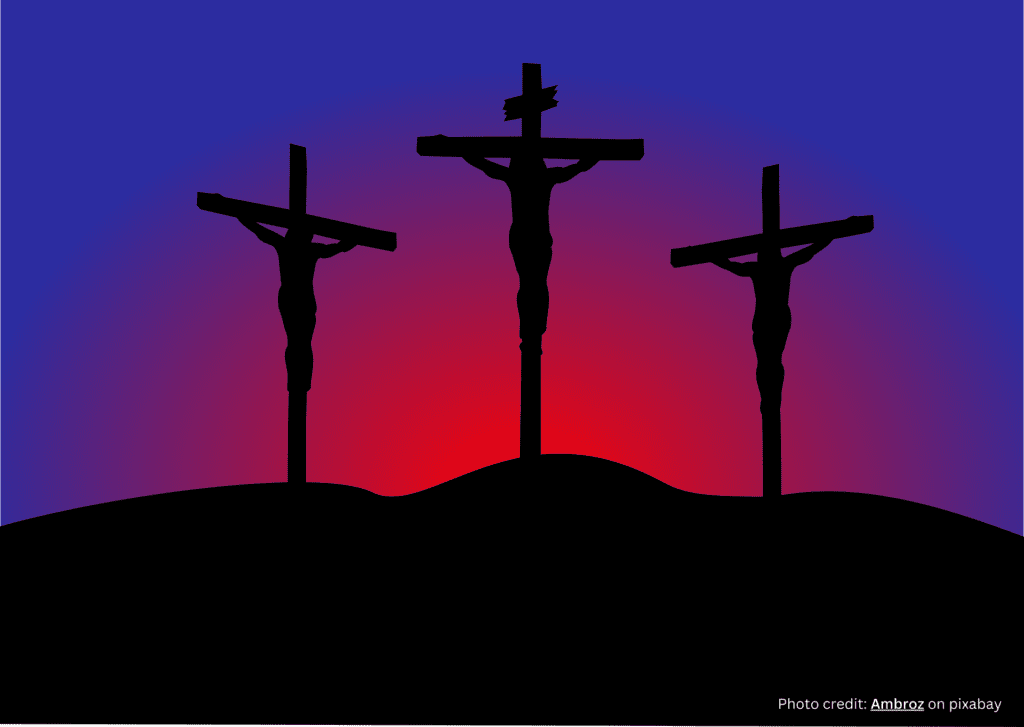
No matter what your circumstances say. No matter what you feel. No matter what the world tells you. The Cross stands as the immovable, permanent, ultimate proof that God is love — and that His love for you is without limit or condition.
This is the ground on which faith stands. Not feelings. Not experience. Not opinion or science or reason. The Cross.
Esther’s Choice — And Yours
Esther stood at a crossroads. Her circumstances said: stay silent and survive. Her feelings surely said: you are terrified. Popular opinion in the palace said: don’t approach the king uninvited. Human reason said: the odds are against you.
And then Mordecai spoke words that have echoed through millennia: “Who knows whether you have not come to the kingdom for such a time as this?”
Esther chose faith. She prayed and fasted. She walked through the door. She trusted that the God whose name was not in the headlines was nonetheless writing the story.
And He was.
He always is.
Walking by Faith in Your Own Story
You may be in a chapter right now where God seems absent. Where heaven is quiet. Where your circumstances make no sense and your feelings are in freefall.
The invitation is not to feel better. It is not to understand everything. The invitation is to trust the One who does.
To remember that in the book of Esther, God was never mentioned — and never more present.
To look at the Cross and remember what love really costs.
To take the next step, even in the dark.
The just shall live by faith.
Want to Go Deeper into Esther’s Story?
If the story of Esther — of walking by faith through impossible circumstances, of God hidden but never absent — has stirred something in you, I’d love to take you deeper.

My eBook and Audiobook, Esther: If I Perish, I Perish, explore this remarkable story in full: the courage, the cost, the providence, and the God who works invisibly in the most visible moments of history.
Whether you’re in a season of waiting, suffering, or simply longing to trust God more deeply, Esther’s story will meet you there.
[Get the eBook / Audiobook — Esther: If I Perish, I Perish]
Because your story, like hers, is not over. And God has not left the room.
***
Here are links to my blog indexes, so please click one and keep reading!
My Books, Workbooks, and Fun Books
Knowing the Unknowable One
Opening the Treasure Chest
Walking Heart-to-Heart with God
Walking Heart-to-Heart with Each Other
Fighting the Good Fight of Faith
Christian Mysteries: Why I Love Them!
List of Some Nonfiction Books You Don’t Want to Miss
Index of Assorted Topics