

C.S. Lewis, one of the most quotable Christian writers who ever lived, nailed it when he wrote: “There are two equal and opposite errors into which our race can fall about the devils. One is to disbelieve in their existence. The other is to believe, and to feel an excessive and unhealthy interest in them.”
Both errors are alive and well in American churches today. And both can cause real damage.
Error #1: Too Much Devil
Let’s start with the error that might surprise you – the one where Christians actually do believe in demons, but take it too far.
Walk into certain churches, and it’s all devil, all the time. Every headache is demonic. Every bad habit has a spirit attached to it. Can’t shake your temper? There’s probably a “spirit of anger” to be cast out. Struggling with jealousy, chronic fatigue, nightmares, or persistent sadness? According to some popular deliverance manuals, these are all candidates for exorcism (Christianity Today, 2001).
Some prominent ministers have publicly declared that OCD is demonic, promoting deliverance as the go-to answer for mental and emotional struggles that most psychiatrists would recognize as medical conditions (Servants of Grace, 2025). In one memorable anecdote from a pastor’s blog, a woman in his congregation asked him to come and cast the demons out of her car (Redeeming God, 2017).
It sounds almost funny, until you read accounts like the one from a woman in Costa Rica whose husband was repeatedly subjected to deliverance sessions for what turned out to be parathyroid tumors. The church insisted his illness was demonic. It was not. It was a medical condition that needed surgery (Patheos/No Longer Quivering, 2020). Then there’s the heartbreaking story documented at Surviving Church (2022), of a man with a traumatic brain injury and diagnosed bipolar disorder who was subjected to unregulated deliverance ministry over years. The result was not freedom. It was compounded trauma, patterns of self-harm, and a deep, abiding fear that demons were living inside him.
These are not fringe cases. Spiritual abuse tied to excessive deliverance culture is well-documented.
What’s wrong with this picture, theologically speaking? Quite a bit.
Respected Bible teacher John MacArthur points out that “the New Testament Epistles never warn believers about the possibility of demon inhabitation, even though Satan and demons are discussed rather frequently. Nor do the New Testament Epistles ever instruct believers about how to cast out demons from either a believer or an unbeliever” (Branch SD, 2025). The New Testament letters, instead, call us to focus on Christ (Colossians 1), live in Christ (Colossians 2–3), and put on the full armor of God (Ephesians 6:10–11).
There’s another problem: an obsession with demons actually gives the devil more credit than he deserves. One writer puts it well – if you find yourself mentioning the devil more than God in your prayers, something has gone sideways. Deliverance services packed with drama may draw bigger crowds than quiet sermons on repentance and holiness, but they tend to produce dependent Christians, forever chasing their next “session,” rather than mature believers who walk in sustained victory (Kilindini, 2025).
Jesus did cast out demons, but He didn’t build His ministry around it. His primary message was the Kingdom of God. That’s a clue worth following.
Error #2: Not Enough Devil
Now for the other error, and this one is arguably more common in mainstream American Christianity.
Many churchgoing believers in the United States have essentially no theology of the demonic. They may give a polite nod to the idea that Satan exists, but in practical terms, he plays no role in their thinking. He’s a cartoon character in a red suit, a Halloween costume, nothing to take seriously.
But the Bible tells a different story.
Consider two foundational accounts.
The Garden of Eden. We don’t know how long Adam and Eve lived in perfect peace before the serpent arrived. The text gives no hint that they were ever tempted by the forbidden fruit on their own. They knew the rule. They were content. Then the devil came – subtle, clever, and persuasive – and everything changed. He didn’t attack them physically. He attacked their thinking. He raised a question (“Did God really say…?”), introduced doubt, and reframed God’s good command as something suspicious. It worked. One conversation with the enemy unraveled paradise.
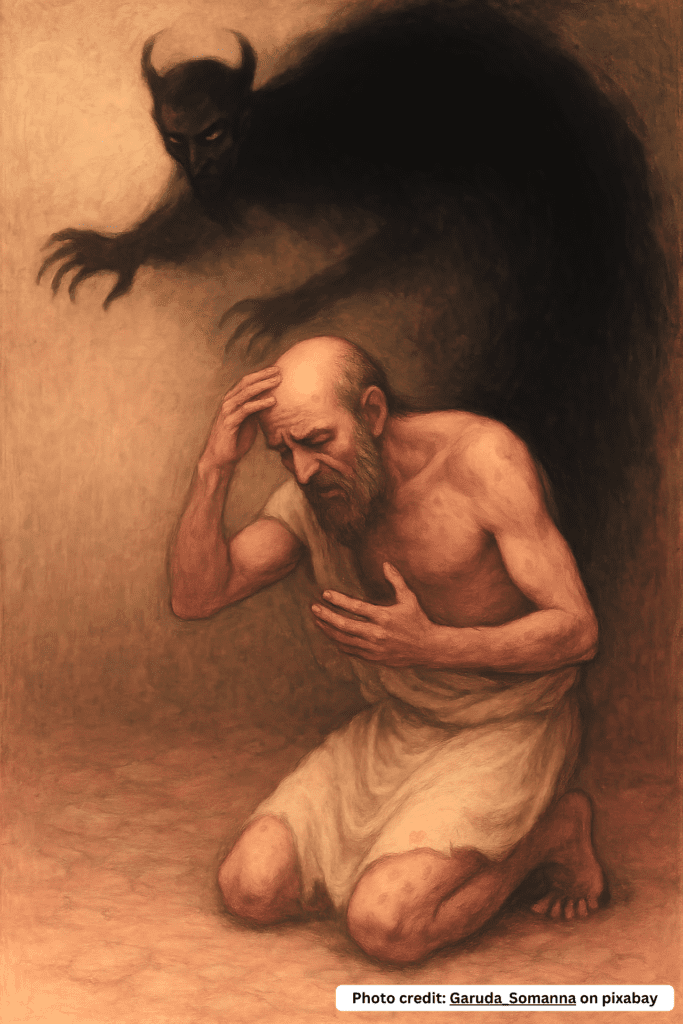
The story of Job. Job was, by every measure, a man living the good life, prosperous, righteous, surrounded by family and blessings. Then Satan, in a remarkable heavenly exchange with God, was given permission to touch Job’s world. What followed was catastrophic: his wealth was destroyed, his children were killed, and his health was shattered. Job did nothing to invite this. He wasn’t playing with Ouija boards or dabbling in the occult. He was a righteous man. And yet the powers of darkness had the ability to bring devastation into his life.
These two stories, separated by ages of biblical history, give us a vivid picture of what the enemy is capable of: the subtle corruption of the mind, and the wholesale destruction of a life.
Christians in the U.S. who have never thought seriously about this are not safer for their ignorance. They’re just less prepared.
What Should We Actually Believe?
Here’s a balanced, biblical framework:
1. Demons are real, and they have some ability to influence our thinking.
The Garden of Eden makes this plain. The enemy’s primary weapon isn’t physical; it’s ideological. He plants doubts, whispers half-truths, and corrupts reasoning. Paul warns us in Ephesians 6 that our battle is not against flesh and blood, “but against the rulers, against the authorities, against the powers of this dark world and against the spiritual forces of evil in the heavenly realms.”
2. Christians have real protection, but it’s not a reason to be careless.
There’s strong biblical evidence that a true believer cannot be possessed by demons. The Holy Spirit dwells within us, and the two cannot occupy the same space. However, that’s different from influence or oppression. A believer being oppressed by demonic forces may experience intensified temptation, feelings of despair or doubt, and in some cases physical affliction (GotQuestions.org, 2026). The armor of God (Ephesians 6:10–18) is real armor, which implies there’s a real battle.
3. Some choices are open invitations.
The Bible consistently treats certain practices as spiritually dangerous. Ouija boards. Séances. Witchcraft. Astrology. Fortune-telling. These are not innocent games. People who pursue occult practices are not just flirting with superstition. They are, according to Scripture, opening doors they may not know how to close. Deuteronomy 18:10–12 lists these practices among the things God calls detestable. This isn’t medieval superstition. It’s a warning that takes both the reality of the demonic and the human tendency to look for it seriously.
4. The answer is Jesus – not demon-hunting, and not denial.
James 4:7 gives us the formula: “Submit yourselves therefore to God. Resist the devil, and he will flee from you.” Notice the order. Submission to God comes first. The resistance follows naturally from that. Our focus should be on Christ – His power, His victory at the cross, His indwelling Spirit – not on cataloging demonic activity.
A Final Word
We are living in interesting times. Those of you who follow this site from the perspective of Hebrews 9:28, watching and waiting for the return of our Lord, know that spiritual warfare is not a relic of another era. If anything, Scripture suggests the activity of the enemy increases as history moves toward its climax (Revelation 12:12).
The wisest thing we can do is hold C.S. Lewis’s warning in both hands: don’t dismiss the enemy, and don’t obsess over him. Know what the Bible says. Stay close to the Lord. Put on the armor. And keep your eyes on Jesus.
He has already won.

a
Featured image – photo credits, all from pixabay:
Background: Thomas-Suisse
Cobra: antriksh
Ghost: DCWilliams
Devil: dilsadakcaoglu
Witch: photo-graphe
Dragon: artieblur
***
My book, The Bible in Brief, traces the cosmic war between God and Satan that began in Eden and will not be over until the end of the seven-year Tribulation described in the book of Revelation. Read more in my blog, “Track the Cosmic War Between God and Satan with The Bible in Brief.”
Or you can purchase the book itself – the eBook on Sqrindle or the paperback on Amazon:

a

a
Here are links to my blog indexes, so please click one and keep reading!
My Books, Workbooks, and Fun Books
Knowing the Unknowable One
Opening the Treasure Chest
Walking Heart-to-Heart with God
Walking Heart-to-Heart with Each Other
Fighting the Good Fight of Faith
Christian Mysteries: Why I Love Them!
List of Some Nonfiction Books You Don’t Want to Miss
Index of Assorted Topics